Showing posts with label Allan Quatermain. Show all posts

Wednesday, July 10, 2024

Crossover Cover: Strange Incursions


This chapbook contains two stories by Jason Scott Aiken.

"The Blood of Raizor" is set in 11,550 BCE. In Northeast Africa, the lion Raizor and his sons, Tyton and Rohrdeth, battle a leopard-like alien. Raizor is killed, but his sons are changed by devouring the flesh of their foe. Tyton finds himself invulnerable, possessing more powerful claws, and unaging. In Nemea, he is slain by Heracles. Rohrdeth and his descendants possess a golden hide and enhanced intelligence and senses. The alien is of the same race as Coeurl from A. E. van Vogt’s “Black Destroyer.” According to Philip José Farmer’s Time’s Last Gift, Heracles was really John Gribardsun, an immortal time traveler from the future. One of Rohrdeth’s descendants will have a connection to Gribardsun.

In "Galazi in the Enchanted City," Galazi the Wolf investigates the murders of three members of his tribe of “ghost-wolves,” not far from the village of the People of the Axe, led by his friend Umslopogaas. Galazi sees a baobab tree that bears the images of the so-called demons of Lake Tanganyika: Loubari, Mgoussa, and Mousammouria. Galazi is captured and taken to a temple whose roof bears a grey stone sphere with a winged marble woman atop it. He is brought before Queen Touloumia of Mkinyaga. Long ago, the capital of Touloumia’s nation, Akribanza, was just one of a hundred cities in the vast empire of Kôr. A cavern wall bears the image of a man with a knife and a bow. The witch Nomma receives visions from the waters of a crystal basin. Among these visions are a muscular bronze-skinned youth breaking a leopard’s back, a bronze-skinned swordsman and a bearded giant battling soldiers, another bronze-skinned young man and a one-eyed dwarf, a white man wielding a cat-headed staff, a giant looking much like the earlier one battling what appears to be an older version of Umslopogaas, and a black warrior wielding the same type of sword as the bronzed swordsman fighting alongside a grey-haired white man and a robed bronze-skinned man battling beastly creatures near a giant crystalline stalk. Galazi the Wolf is from H. Rider Haggard’s Nada the Lily. Umslopogaas appears in not only that book, but the Allan Quatermain series as well. Loubari, Mgoussa, Mousammouria, and Queen Touloumia are from Eugène Hennebert’s The Enchanted City. The statue of the winged woman is a symbol of Truth seen in Haggard’s She and Philip José Farmer and Christopher Paul Carey’s The Song of Kwasin. Kôr is the city ruled by Ayesha, She-Who-Must-Be-Obeyed. The man with the knife and bow is Sahhindar from Farmer’s Khokarsa series. Sahhindar is also the immortal time traveler John Gribardsun from Farmer’s Time’s Last Gift, but he is best known as the lord of the apes. The crystal basin is from Haggard’s She and Allan. The bronze-skinned youth is King Minruth from the Ancient Opar books in his younger years. The bronze-skinned swordsman and the bearded giant are Hadon of Opar and his cousin Kwasin from the Ancient Opar series. The other bronze-skinned young man is Hadon’s son Kohr, while the one-eyed dwarf is Paga, whom Farmer meant to be Pag from Haggard’s Allan and the Ice-Gods. The white man with the cat-headed staff is Robert E. Howard’s Puritan adventurer Solomon Kane. The battle between Umslopogaas and the bearded giant Rezu (whose description is identical to Kwasin’s, whose fate is left open-ended at the end of The Song of Kwasin) is depicted in She and Allan. The black warrior, N’desi, is from Carey and Win Scott Eckert’s “Iron and Bronze.” The grey-haired man is Hareton Ironcastle from J.-H. Rosny Aîné’s Hareton Ironcastle’s Amazing Adventure, adapted and translated by Farmer as Ironcastle. The bronze man is Doc Ardan from Guy d’Armen’s Doc Ardan: City of Gold and Lepers, who Jean-Marc and Randy Lofficier’s translation identified with a certain bronze-skinned doctor and crimefighter. The beastly creatures are the Wandarobo from John Peter Drummond’s Ki-Gor pulp stories, who Carey and Eckert implied to be exiles from Opar, originally from the Tarzan novels. The crystalline stalk is an extension of the mineral-vegetable-king from Ironcastle, and related to the Crystal Tree of Time from Farmer’s Tarzan and the Dark Heart of Time.

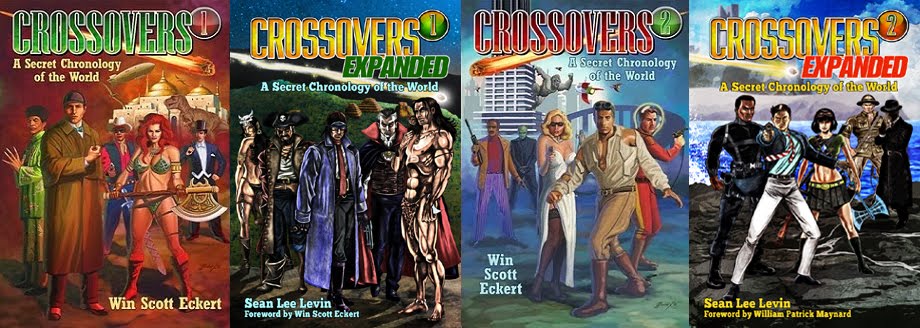
These crossovers are two of over a thousand covered in my book Crossovers Expanded: A Secret Chronology of the World Volume 3, coming this summer from Meteor House! All three volumes are AUTHORIZED companions to Win Scott Eckert's Crossovers: A Secret Chronology of the World Volumes 1 and 2! 

Sunday, July 7, 2024

Crossover of the Week

Early Autumn 1926 

A WHISPER OF SOFT WINGS 

Noticing parallels between his current case and a previous affair, Charles St. Cyprian asks Inspector Moxley if he was acquainted with Inspector Quennell. Not long after solving that case, Quennell turned over his notes to St. Cyprian’s predecessor, Carnacki. Quennell’s main suspect was Dr. Mallinger. The Voyagers Club resides on Dover Street, alongside others of its ilk, such as the Albermarle, the Drones, and the Diogenes. The late Geoffrey Botkin was one of the few who has been to Maple White Land, a few years after the Challenger expedition, with Lord John Roxton in 1913. According to a newspaperman named Malone, Botkin was almost eaten by a giant spider. The Voyagers’ bar has a bust of Quatermain over the door. St. Cyprian discusses an alchemist and member of the Order of the Cosmic Ram who engaged in experiments like Mallinger’s with another member of the Order, who also belongs to the Bollinger Club. St. Cyprian’s friend Bertie lives on Berkley Street. 

Short story by Josh Reynolds on the website Curious Fictions. Inspector Quennell and Dr. Carl Mallinger are from the movie The Blood Beast Terror. Thomas Carnacki is from William Hope Hodgson’s Carnacki, the Ghost-Finder. The Drones Club is from the works of P. G. Wodehouse. Bertie is Bertie Wooster. The Diogenes Club is from Doyle and Watson’s Sherlock Holmes stories. Maple White Land, Professor George Edward Challenger, Lord John Roxton, and Edward D. Malone are from Doyle’s The Lost World. Allan Quatermain is from H. Rider Haggard’s novels and stories. The Bollinger Club is from Evelyn Waugh’s Decline and Fall. 

This crossover writeup is one of over a thousand included in my book Crossovers Expanded: A Secret Chronology of the World Volume 3, coming this summer from Meteor House! All three volumes are AUTHORIZED companions to Win Scott Eckert's Crossovers: A Secret Chronology of the World Volumes 1 and 2!

Wednesday, June 19, 2024

Crossover Cover: The Devil's Dust


Sherlock Holmes’ latest case brings he and Dr. Watson into contact with Allan Quatermain and Umslopogaas, who are trying to discover the true circumstances of the death of Quatermain’s son Harry. Quatermain talks about his encounter with Ayesha, She Who Must Be Obeyed. Holmes and Quatermain have never met before, and Holmes denies being related to Quatermain’s friend Lady Ragnall, nee Luna Holmes. Both these details differ from Thomas Kent Miller’s various Holmes/Quatermain crossover pastiches, which have been included in the CU. Also, Lovegrove’s version of Quatermain brags about his abilities, the opposite of the humble and self-effacing character H. Rider Haggard portrayed. Consequently, I consider this novel an AU.

This novel is one of over a thousand crossovers covered in my book Crossovers Expanded: A Secret Chronology of the World Volume 3, coming this summer from Meteor House! All three volumes are AUTHORIZED companions to Win Scott Eckert's Crossovers: A Secret Chronology of the World Volumes 1 and 2!

Sunday, October 1, 2023

Crossover of the Week

November 2000

SHEBA’S NECKLACE 

Maxim Gunn battles his old foe Wanda Liszt, who seeks to conquer Africa using Sheba’s necklace, the Great Snake. Sir Richard Trelawney knew Gunn’s maternal grandfather, James Rassendyll. Receiving a note about Wanda’s whereabouts signed only “T.,” Gunn orders more coffee, and thinks, “In what might have been the words of the immortal Holmes, it looked like being a three-pot problem.” A quotation from the rite Wanda intends to perform is given: “That is not dead which can eternal lie, and with strange aeons, even death may die.” Gunn thinks of a lover of his named Frances, and later about a man he’d known in Los Angeles’ Chinatown named Kwai Chang Caine. Gunn is helped by the Zulu M’hlopekazi, who identifies himself as the great-grandson of Umslopogaas who fought with Macumazahn. 

Novel by Nicholas Boving, originally published as Maxim Gunn and Sheba’s Necklace in 2012; revised as Maxim Gunn: Sheba’s Necklace, Pro Se Productions, 2017. The Great Snake is from John Buchan’s Prester John. Boving’s The Sun Fortress established that Gunn was a descendant of Rudolf Rassendyll from Anthony Hope’s The Prisoner of Zenda and Rupert of Hentzau. The immortal Holmes needs no introduction at this point. “That is not dead which can eternal lie, and with strange aeons even death may die” is a quotation from the Necronomicon appearing in H. P. Lovecraft’s “The Nameless City” and “The Call of Cthulhu.” Frances West is the protagonist of Boving’s Castle Dark, which has a prominent appearance by Gunn. Kwai Chang Caine II is from the television series Kung Fu: The Legend Continues. Umslopogaas is Allan Quatermain’s Zulu companion in H. Rider Haggard’s novels. “Macumazahn” was Quatermain’s nickname among the natives. At one point, Gunn thinks Oksana, High Priestess of the Temple of Am-mut, who uses a green flame to maintain her immortality, may have been the inspiration for Haggard’s character Ayesha. Since we know She-Who-Must-Be-Obeyed is a real person in the CU, Gunn is mistaken, but Oksana’s green flame may be connected to Ayesha’s Fire of Life. 

This crossover writeup is one of hundreds included in my book Crossovers Expanded: A Secret Chronology of the World Volume 3, to be published by Meteor House! All three volumes are AUTHORIZED companions to Win Scott Eckert's Crossovers: A Secret Chronology of the World Volumes 1 and 2!

Sunday, June 4, 2023

Crossover of the Week

Autumn 1928

MATTHEW HENSON AND THE ICE TEMPLE OF HARLEM

Matthew Henson must stop the would-be dictators of the Medusa Council from getting their hands on a meteor fragment he brought back from the Arctic. Henson’s friend Professor Henrik Ellsmere spent some time in a sanitarium called Dunwich. At the Cotton Club, a wealthy man flirts with a woman named Myra, who spent time in Asia, where she learned to speak Chinese. As he does this, Jimmie Dale, aka the Gray Seal, burgles his home. The Challenger’s Club, a club for explorers and hunters, has portraits of Allan Quatermain, Phileas Fogg, and Gertrude Bell. Henson disguises himself as a deliveryman for B. Jonas Freight.

Novel by Gary Phillips, Agora Books, 2020. Matthew Henson was a real person. The Medusa Council also appears in the Moonstone Books anthology Day of the Destroyers, edited by Phillips, as well as his collection Astonishing Heroes: Shades of Justice. Dunwich Sanitarium is likely located in the titular Massachusetts town from H. P. Lovecraft’s “The Dunwich Horror.” Myra is a future agent of the shadowy vigilante. “B. Jonas” was the name on the door of the office where that pulp hero’s agents submitted reports to him. Perhaps he met Matthew Henson shortly before the 1929 events of The Living Shadow and heard from him about his battle against the Medusa Council, inspiring his own use of the B. Jonas cover. The Gray Seal is from Frank L. Packard’s novels. Allan Quatermain is from H. Rider Haggard’s books and stories. Phileas Fogg is from Jules Verne’s Around the World in Eighty Days. According to this novel, the Challenger’s Club was already in existence during the historical New York draft riots of 1863, so it was not named after Arthur Conan Doyle’s Professor Challenger, who was born in the same year.

This crossover writeup is one of hundreds included in my book Crossovers Expanded: A Secret Chronology of the World Volume 3! Much like the first two volumes, this one is an AUTHORIZED companion to Win Scott Eckert's Crossovers: A Secret Chronology of the World Volumes 1 and 2 and will be published by Meteor House!

Monday, June 27, 2016

Crossover Cover: King Solomon's Mines

Hey, like H. Rider Haggard's Allan Quatermain novels?

Then you've probably read his first appearance, King Solomon's Mines. But did you notice that it contains references to the Count of Monte Cristo and Robinson Crusoe that sound like they refer to real people?

For all the details, check out my forthcoming books Crossovers Expanded Vols. 1 and 2, AUTHORIZED companions to Win Scott Eckert's Crossovers: A Secret Chronology of the World Vols. 1 and 2, debuting at the Meteor House booth at PulpFest/Farmercon on July 21-24!

Sunday, June 12, 2016

Crossover of the Week

1938
LEGENDS ARE FOREVER
Jake Cutter’s fellow former Flying Tiger, Gandy Dancer, recruits him to fly medical supplies to the Watusi tribe and locate the treasure of King Solomon’s Mines. Initially, Jake tells Gandy whatever he’s searching for, whether it is the Shinto Emerald, the Maltese Falcon, Tut’s treasure, or the Fountain of Youth, he can count him out. When Bon Chance Louie refers to his past experiences at Fort Zinderneuf, Gandy wonders if Louie may know the location of the Blue Water Sapphire. Gandy says Haggard omitted from his novel the fact that after Tremain’s visit, the Watusi relocated Solomon’s treasure to a Pacific island.
Episode of the television series Tales of the Gold Monkey broadcast October 20, 1982. “Tremain” is a pseudonym for Allan Quatermain, the protagonist of King Solomon’s Mines and several other books by H. Rider Haggard. The references to the Watusi are likely another fictionalization, as the tribe Quatermain and company encountered in Haggard’s novel was called the Kukuanas. The Kukuanas were substituted with the Watusi in the 1950 film version of King Solomon’s Mines, which probably inspired their use in this story. The Maltese Falcon needs no explanation at this point. Fort Zinderneuf and the Blue Water Sapphire are from P. C. Wren’s novel Beau Geste. Bon Chance Louie referred to his service at Zinderneuf in the episode immediately preceding this one, “Black Pearl,” though there he mistakenly gave the fort’s name as “Zinderman.”

Tuesday, March 15, 2016

Crossover Cover: Some of These Cons Go Way Back

This issue includes a Nightside story by Simon R. Green. Conman Harry Fabulous is tricked by a fallen angel into murdering a woman. Taduki (from H. Rider Haggard’s Allan Quatermain novels and stories), tanna leaves (from Universal Studios’ original series of Mummy films), Martian red weed (from H. G. Wells’ The War of the Worlds), black centipede meat (from William S. Burroughs’ novel Naked Lunch), and the Jekyll and Hyde formula (from Robert Louis Stevenson’s The Strange Case of Dr. Jekyll and Mr. Hyde) are mentioned.

Thursday, November 19, 2015

Crossover Covers: The Luke Challenger series

This series features Luke Challenger, Professor Challenger's grandson. The first book, Return to the Lost World, takes place in May–July 1933. 14-year-old Luke and his cousin Nick Malone, who is the same age, travel to Maple White Land to rescue Luke’s mother, Lady Harriet Challenger, from the Sons of Destiny, a multinational group dedicated to allowing fascism to rise so they can take over the world. The second book in the series, Return to 20,000 Leagues Under the Sea, takes place in June–August 1934. Challenger Industries is contacted by Jessica Land, the 16-year-old great-granddaughter of Ned Land, who has found out her great-grandfather had been willed the Journals of Captain Nemo by Professor Aaron X. Perrier (who Jules Verne disguised as Pierre Aronnax). Luke and Nick join the expedition to locate the Nautilus in a race against the Sons of Destiny to gain the nuclear secrets of the submarine. It is possible references to the Nautilus being nuclear-powered and The Mysterious Island being fictional are influenced by Professor H. W. Starr’s essay “A Submersible Subterfuge, or, Proof Impositive.” The third book, Return to King Solomon’s Mines, takes place from December 1934–January 1935. Luke and Nick go to Ethiopia to visit Luke’s mother on an archaeological dig. Accompanying them is Elsa Fairfax, great-granddaughter of Allan Quatermain. The expedition comes across Kukuanaland, and discovers the people were ruled by the reincarnation of the High Priestess Gagool after the death of King Ignosi. Nick Malone is the son of Ned Malone and the late Enid Challenger. If he and Luke are both 14-years-old in 1933, they would’ve been born around 1919. However, Ned and Enid fell in love during the events of Doyle’s The Land of Mist, which Rick Lai has dated to 1926. Combined with the dismissal of The Mysterious Island as fictional, this argues against placement of these books in CU continuity.

Sunday, June 28, 2015

Crossover of the Week


1929

THE JUDEX CODEX

            Raymond Mystère and Henrietta de Marigny explore a Mayan temple in Guatemala. When Raymond first met Henrietta at the University of Sorbonne, he thought she was too interested in visiting professors like Henry Jones, Thomas Swift, and John Kenton. Henrietta’s brother Etienne-Laurent de Marigny was an archaeologist specializing in occult lore, who was inspired in his choice of profession by his friend Pierre d’Artois. Henrietta was once kidnapped by a madman named Don Jose to sacrifice to a dark god. Her twin sister Louise had been previously abducted and killed by the Don. Etienne was able to attend Miskatonic University through d’Artois’ influence. Etienne disappeared in 1926 while investigating some ruins in the swamps of Louisiana, the inhabitants of which he believed to be the remnants of a Tcho-Tcho group that had come to North America during the Asian Migration. When he resurfaced, he opened a shop in New Orleans dealing in occult artifacts. A group of five men, including two named Hernandez and Aguirre respectively, attempt to steal a stone tablet discovered by Raymond and Henrietta. Months later, Raymond, recognizing the pictoglyphs on the tablet as representing Vedic words, tells the pregnant Henrietta that his grandfather, Doctor Mystère, claimed that his vehicle, the Electric Hotel, was based on ancient Vedic designs. Henrietta and Raymond’s student Jean Aubry introduces them to his father, Comte Jacques de Trémeuse. The two visit the Comte’s estate, where they meet his wife Jacqueline and their two sons, their old family friend Prosper Cocantin, his wife Daisy, and their young son Jacques. Trémeuse tells Raymond and Henrietta that his mother made his brother Roger and he swear to kill the banker Favraux for driving their father to suicide. Trémeuse shows them a tablet he discovered in Africa, one of a group of such items, almost identical to the one they discovered, which has a ring set into it. Prosper and Daisy’s adopted son Michel Cocantin, formerly known as the Licorice Kid, accompanies Henrietta and Jacqueline on a trip to buy baby clothes. Henrietta is abducted by members of a group known as the Men in Black. Jacques Cocantin has been learning the martial arts from a young Annamese boy named Cato. Henrietta refers to tales of the legendary continents of Hyboria, Lemuria, Mu, and Atlantis. Raymond says that the area where he and Henrietta found the temple was near the region described by Ventidius as Atala, which had ties with Atlantis, and was sometimes mistaken for it. Raymond suspects that there was an African civilization that was the true parent of lost cities such as Zu-Vendis, Kôr, Opar, and Zimbabue. Raymond and Trémeuse charter The Pious Woman, owned and operated by Captain Owen Kettle, to take them to Easter Island. They meet the manager of the island, Señor Ortiz. Raymond and Trémeuse are confronted by the Men in Black, who are accompanied by Dr. René Belloq. Belloq claims to have trained at Rache Churan. A crystal ball emits an image of a man resembling an elderly version of Trémeuse, who tells him and Raymond that Trémeuse is a member of the house of Elessar Telcontar. Trémeuse’s forebear refers to the crystal ball as a Palantir, and charges him to take the Book of Thain, the Book of Kings, and the Book of Mazarbul to “the one who can best translate them for your people.” Henrietta identifies Khokarsa as the sunken island civilization mentioned in the African tablets discovered by Trémeuse. It is mentioned that some believe the tale of Numenor to be the Oxford scholar to whom Henrietta sent the three books’ own version of Atlantis, rather than the story of an island empire that existed ages before Atlantis. An epic about the hero named Hadon described in the African tablets was popularized by an American author whose work was recommended to the Mystères by the Ironcastle family. Wooden tablets discovered by Raymond on Easter Island form the epic tale of a warrior-King named Thongor who lived in ancient Lemuria. After Jacques’ apparent death, his son Frédéric-Jean de Trémeuse followed in his footsteps, adopting the identity of Frédéric-Jean Orth, aka L’Ombre. Jacques Cocantin grew up to become Chief of the Sûreté after his predecessor, Chief Inspector Dreyfuss, became mentally unstable. A film version of Inspector Cocantin’s famous case against Sir Charles Litton, the jewel thief known as the Phantom, portrayed him as a buffoon, causing the Inspector to demand that the filmmakers change his name.

            Short story by Dennis E. Power in The Shadow of Judex, Jean-Marc and Randy Lofficier, eds., Black Coat Press, 2013; reprinted in French in L’Ombre de Judex, Jean-Marc and Randy Lofficier, eds., Rivière Blanche, 2013. Raymond Mystère and Henrietta de Marigny are the parents of the title character of Alfredo Castelli’s comic book Martin Mystère. Henrietta is meant to be the same character as Yvonne Marigny from E. Hoffmann Price’s Pierre d’Artois story “The Devil’s Crypt.” Don Jose and Louise (de) Marigny are also from “The Devil’s Crypt.” Etienne-Laurent de Marigny is from H.P. Lovecraft and Price’s story “Through the Gates of the Silver Key.” Etienne’s shop will be inherited by his son Henri-Laurent de Marigny, as seen in Brian Lumley’s Titus Crow novels. Henry Jones, Sr. is Indiana Jones’ father. Dr. René Belloq is from the first Indiana Jones movie, Raiders of the Lost Ark. Thomas Swift is better known as Tom Swift from the novels by Victor Appleton. John Kenton is from A. Merritt’s The Ship of Ishtar. Miskatonic University and the Tcho-Tcho are staples of the Cthulhu Mythos. Hernandez is a descendant of the robber Hernandez from Joseph Conrad’s novel Nostromo. Aguirre is a descendant of the fictionalized version of the historical conquistador Don Lope de Aguirre seen in the film Aguirre: The Wrath of God. Doctor Mystère appeared in a series of novels by Paul d’Ivoi. The Martin Mystère comics have established that Martin was the grandson of Doctor Mystère’s adopted son Cigale. Jacques de Trémeuse, his brother Roger, his wife Jacqueline, Jacqueline’s son Jean Aubry, Prosper Cocantin, his wife Daisy, their adopted son the Licorice Kid, and Favraux are from Louis Feuillade’s film serial Judex. Jacques Cocantin is meant to be Inspector Jacques Clouseau from the movie The Pink Panther and its sequels. Cato will grow up to be the Inspector’s manservant and sparring partner. Chief Inspector Dreyfus and Sir Charles Litton are also from the Pink Panther films. The tablet found by Raymond and Henrietta in Guatemala and the one found by Jacques in Africa, when combined, describe the events of J.R.R. Tolkien’s fantasy saga The Lord of the Rings. In Tolkien’s books, Elessar is the name that Aragorn took after assuming the throne of the Reunited Kingdoms. Telcontor is an Elvish term for his nickname of Strider. The Palantir is one of the scrying stones used by the order of Wizards. Tolkien claimed that The Book of Thain was his source for The Hobbit, The Lord of the Rings, and The Silmarillion. The Book of Kings and The Book of Mazarbul were supposedly the other two books that served as Tolkien’s source for Middle Earth lore not found in The Book of Thain. The Men in Black are the subject of many conspiracy theories, but the version of the group seen here is the same one that will later battle Martin Mystère. Power reveals that the Men in Black are the modern day equivalent of the Black Riders, the Nazgûl, which served the Dark Lord Sauron. Power also implies that the Men in Black are connected to the Nine from Philip José Farmer’s novels A Feast Unknown, Lord of the Trees, and The Mad Goblin; although the Secrets of the Nine trilogy takes place in an alternate reality to the Crossover Universe, Win Scott Eckert’s story “The Wild Huntsman” establishes that a version of the Nine exists in the CU. Numenor is an island that rose from the sea in The Lord of the Rings and The Silmarillion. Hyboria is from Robert E. Howard’s Conan stories. Ventidius Varro and Atala are from H. Warner Munn’s novel The Ship from Atlantis. Philip José Farmer, in his novels of Ancient Opar, revealed that the lost cities of Zu-Vendis (from H. Rider Haggard’s Allan Quatermain), Kôr (from Haggard’s She and sequels), and Opar (from the Tarzan books by Edgar Rice Burroughs) were among the remnants of the destroyed Central African empire of Khokarsa, which was later mistakenly identified with Atlantis. Power’s story adds Zimbabue (from Charles R. Saunders’ Imaro novels, the precursor to Zimbabwe) to the list. Hadon is the hero of the first two Ancient Opar books, Hadon of Ancient Opar and Flight to Opar. Captain Owen Kettle is featured in a series of books by C.J. Cutcliffe Hyne. Señor Ortiz is meant to be an ancestor of the villainous Orthis from Edgar Rice Burroughs’ Moon series. Although the Moon books take place in the Edgar Rice Burroughs Alternate Universe (ERB-AU), there is no reason why Orthis’ ancestor could not exist in both that universe and the CU. The Rache Churan monastery is from Sax Rohmer’s Fu Manchu novels. The Ironcastle family is from Farmer’s adaptation and translation of J.-H. Rosny aîné’s novel Ironcastle. Thongor of Lemuria is the hero of a series of books by Lin Carter. Frédéric-Jean Orth, aka L’Ombre, is the hero of a series of novels by Alain Page; Jean-Marc Lofficier identified L’Ombre as Judex’s son in his article “The Tangled Web: Genealogies of the Members of the French Wold Newton Families – Rocambole and Fantômas” on the website The French Wold Newton Universe.
Thursday, March 19, 2015

Crossover Covers: Secret Histories


Eddie Drood, aka Shaman Bond, is a member of the Drood (née Druid) clan that protects the world from supernatural threats. He is suddenly inexplicably declared a rogue by his family, who set out to kill him. He strives to learn the reason why. The Secret Histories books are set in the same universe as the Nightside series and other works by Simon R. Green. Appearing or mentioned in this book are: a Time Agent whose latest regeneration has gone terribly wrong, turning him inside out (a reference to Doctor Who and Torchwood); the Necronomicon (from Lovecraft's Cthulhu Mythos, of course); a Kandarian possessing amulet (referencing the Evil Dead films); the Old Ones (another Mythos reference); a Hyde using a distillation of Jekyll’s old formula (from Robert Louis Stevenson's novel); Rossum’s Unionized Robots (a reference to Karel Capek's play R.U.R.); a 1930s powder blue Hirondel convertible sports car (the same fictional brand of car driven by Simon Templar, aka the Saint); Alice Little (aka Alice Liddell of Alice's Adventures in Wonderland fame); Penelope Creighton (presumably a relative of Lady Penelope Creighton-Ward from Thunderbirds, which probably takes place in an AU); Area 52 (located in the Antarctic, and therefore presumably the same Area 52 seen in the Image Comics series of the same name); taduki (from the Allan Quatermain novels); Martian red weed (from Wells' The War of the Worlds); the Arcadia Project (from the Nightside book Hell to Pay); Vril Power Inc. (based on the Vril from Edward Bulwer-Lytton's The Coming Race); the Lurkers on the Threshold (a reference to August Derleth's The Lurker at the Threshold); Arne Saknussemm (from Jules Verne's Journey to the Center of the Earth); Cave Carson (a longtime DC Comics hero); a stuffed moomintroll (from Tove Jansson's Moomin books); a statue of a black bird (the Maltese Falcon); a small black lacquered puzzle box (a Lament Configuration from the Hellraiser films); the Holy Hand Grenade of St. Antioch (from the film Monty Python and the Holy Grail, which would be a greatly exaggerated account of the quest for the Grail); scrimshaw carved from the bones of a great white whale (Moby Dick); and Baron von Frankenstein.