Showing posts with label Robert Bloch. Show all posts

Sunday, August 13, 2023

Crossover of the Week

Winter 2017

THE LIBRARIANS AND THE MOTHER GOOSE CHASE 

The Librarians must stop an individual claiming to be Mother Goose from getting her hands on all three of the original volumes of Mother Goose’s Melodies, written by Elizabeth Goose as a book of rhyming spells, and using it to reassemble the World Egg (“putting Humpty Dumpty back together again”) and undo the Big Bang. The team works with descendants of the original author to find the pieces. Cassandra Cillian is offered a drink at a music club, but declines, remembering her inebriated exploits at Dorian Gray’s club in London not too long ago. Eve Baird asks Jenkins about their current predicament caused by the Goose That Laid the Golden Eggs, “How much does this suck?” He responds, “More than Vlad Tepes’ family reunion.” Jake Stone, exploring the inside of a well, counts himself lucky he hasn’t spied any rats yet, “unlike that one time in Sumatra.” Cassandra and one of the Goose descendants, tree-trimmer and part-time rapper George “Bo-Peeps” Cole, look for one of the volumes in the library of George’s great-grandfather Ezra Wilshire, which includes several occult volumes, one of which is Mysteries of the Worm. Jenkins dons an old-fashioned jet pack resting on the floor of the Library’s Annex, at the base of a glass display case containing the Maltese Falcon. In a flashback, Flynn Carsen, returning to the Annex from the Even More Forbidden City through the Magic Door, thinks he’ll have to consult Dragomiloff’s Guide to Lethal Implements regarding a jade dagger he has just evaded. He hangs his pith helmet on a hat rack that contains, among other headwear, a deerstalker cap. Flynn wouldn’t trade his job for all the Jewels of Opar. Jenkins contemplates putting the spell book alongside The Secret Memoirs of Tom Thumb and Rip Van Winkle’s Dream Journal. 

2017 novel by Greg Cox. The Librarians encountered Dorian Gray (from Oscar Wilde’s The Picture of Dorian Gray) in the episode “The Librarians and the Image of Image.” Flynn Carsen battled Dracula (or rather one of his soul-clones) in the TV movie The Librarian: Curse of the Judas Chalice. Although The Librarians treated Professor Moriarty as a Fictional character brought to life, and indeed he is referred to as such here, the Sumatran rat and deerstalker references suggest Sherlock Holmes is every bit as real as the Librarians themselves. Mysteries of the Worm is a Cthulhu Mythos tome created by Robert Bloch. The Maltese Falcon is from Dashiell Hammett’s detective novel. Ivan Dragomiloff is from Jack London and Robert L. Fish’s The Assassination Bureau, Ltd. The Jewels of Opar are from Edgar Rice Burroughs’ Tarzan novels. Rip Van Winkle is the title character of Washington Irving’s story. 

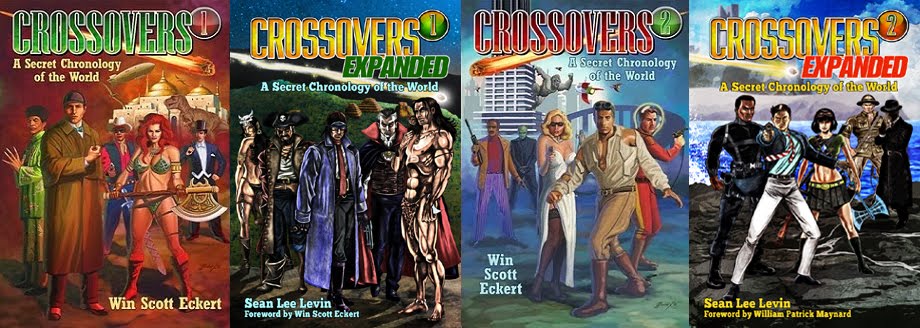
This crossover writeup is one of hundreds included in my book Crossovers Expanded: A Secret Chronology of the World Volume 3, which will be published by Meteor House! All three volumes are AUTHORIZED companions to Win Scott Eckert's Crossovers: A Secret Chronology of the World Volumes 1 and 2!

Wednesday, April 20, 2016

Crossover Cover: Casting the Stone

In John Pocsik's contribution to this 1964 Arkham House anthology, an occultist’s library includes The Book of Eibon, Cultes des Goules, Judge Pursuivant’s Vampiricon, and John Thunstone’s Myth Patterns of the Shonokins. The Book of Eibon and Cultes des Goules are tomes associated with the Cthulhu Mythos, and were created by Clark Ashton Smith and Robert Bloch respectively. Judge Keith Hilary Pursuivant is the protagonist of a series of stories by Manly Wade Wellman; The Vampiricon is mentioned in the Pursuivant stories. John Thunstone is another Wellman hero, who sometimes battled the man-like creatures known as the Shonokins; however, the book Myth Patterns of the Shonokins is Pocsik’s invention.

Friday, December 12, 2014

A Massive Crossover Endeavour

Colin Dexter has written a series of novels about Inspector Endeavour Morse, which were made into a 33-episode TV series that ran from 1987-2000. Morse's partner Inspector Lewis eventually got his own spin-off. In 2012, the television series Endeavour debuted, a prequel series featuring the young Constable Morse in the 1960s. The show, which has run two seasons so far, with a planned third next year, has had many references to other works of pop culture, including some that have already been linked to the Crossover Universe. The Morse of the novels would be older than the television version of the character in the mid-60s, and therefore it can be assumed that the TV Morse is in the CU, and his literary counterpart, who has no crossover connections, is in an alternate reality to the CU. What follows is an episode-by-episode breakdown of the crossovers found in the series.

In the TV movie that led to the series, Morse is seconded from the Carshall Newtown police force to Oxford to investigate the murder of a 15-year-old girl. In the end, Morse decides to transfer to Oxford full-time. Morse’s new landlady tells him that the other two lodgers are named Goldberg and McCann. Carshall New Town (or Newtown as it is spelled here) is the setting of Angus Wilson’s novel Late Call, while Goldberg and McCann are from Harold Pinter’s play The Birthday Party. Both the movie and Series 1 take place in 1965.

In the second episode of Series 1, "Fugue," Morse attempts to apprehend a serial killer whose methods are based on the deaths of characters in various operas. Chief Superintendent Bright calls in Dr. Daniel Cronyn, an expert on serial murders, as a consultant on the case. Cronyn refers to killings in the States in the last ten years: the Starkweather case, the bodies in the swamp at Fairvale, and DeSalvo in Boston. The bodies in the swamp at Fairvale are a reference to Alfred Hitchcock’s film Psycho, based on Robert Bloch’s novel of the same name. Since Psycho takes place in the CU via a reference in Christopher Farnsworth’s novel Red, White and Blood, we have the first piece of evidence that Endeavour is as well.

In the third episode, "Rocket," Morse looks into the death of a worker at a munitions factory owned by the Broom family, which occurred during a visit by Princess Margaret. The factory’s union shop steward is Reg Tracepurcel. The youngest Broom, Johnny, boasts to Morse that his car is the new Bellini. The Bellini is a fictional brand of car driven by Raymond Delauney in the 1960 film School for Scoundrels. Some elements of this episode’s plot reference the British film I’m All Right Jack, which featured a character named Bertram Tracepurcel. Perhaps Bertram and Reg are related. I’m All Right Jack starred Terry-Thomas, who also played Raymond Delauney in School for Scoundrels. The plot is also heavily influenced by the movie The Lion in Winter, but none of the references to that film count as crossovers.

The fourth and final episode of Series 1 is "Home," in which Morse investigates the hit-and-run killing of an Oxford don. One of the suspects in the case is retired gangster Vic Kasper, who is now persona non grata with Sid and Gerald Fletcher. Later, one of Vic’s employees tells the ex-criminal’s son Vince (who is secretly in a partnership with the Fletchers on a construction deal) that Thorpey is on the phone. Gangsters Sid and Gerald Fletcher are Jack Carter’s bosses in the 1971 film Get Carter. One of the gangsters in Get Carter is named Thorpe (also referred to as “Thorpey”), and is an old acquaintance of Jack’s. Thorpe must have worked for the Fletcher brothers for a time before switching his loyalties to rival crime boss Cyril Kinnear.


Series 2 takes place in 1966. In the first episode, "Trove," Morse investigates an apparent suicide, a missing girl, and the theft of valuable Anglo-Saxon treasures from Beaufort College, with the first two cases turning out to be intimately connected. Miss Great Britain, Diana Day, launches Burridge’s Spring into Summer Fashion Collection. Morse passes a billboard advertising Grimsby Pilchards, and interviews Diana’s manager Val Todd, whose wife tells him that Mr. White from Play-Tone called. In Soho, Morse visits the third floor office of the apparent suicide, a private investigator, which is in a building that also hosts the Pacific All-Risk Insurance Co.; the Ex-Officers’ Employment Bureau, Est. 1917; and R. Duck, Theatrical Agent, 4th Floor. Later, Morse questions Todd about his connection to the missing girl, who has turned up dead. Todd’s wife interrupts again, to tell him that Lane from SCDP is on the phone. Burridge’s Department Store is from the film Trouble in Store. Grimsby Pilchards appeared in “The Bowmans,” an episode of the British sitcom Hancock, bringing comedian Tony Hancock’s fictional persona Anthony Aloysius Hancock into the CU. Mr. White is the talent agent for Play-Tone Records played by Tom Hanks in the 1996 film That Thing You Do!, which is set in 1964. The Pacific All-Risk Insurance Co. is from Billy Wilder’s film noir Double Indemnity. Evidently Pacific All-Risk has offices in both America and Britain. The Ex-Officers’ Employment Bureau, Est., 1917, is one of the alleged businesses in the building in Fitzrovia that is actually the headquarters of the intelligence agency WOOC(P) in Len Deighton’s Harry Palmer novels. Apparently WOOC(P) also kept an individual office in Soho. In the 1987 film Withnail and I, set in 1969, Withnail’s Uncle Monty, an actor, says that his first agent was “Raymond Duck…four flights up at Charing Cross…” At some point after the end of his representation of Uncle Monty, Duck must have taken up a new office in Soho. Obviously, he preferred his offices to be on the fourth floor. Lane is Lane Pryce, co-owner of the advertising agency Sterling Cooper Draper Pryce (SCDP), as seen on the television series Mad Men, which is set in the years 1960-1969. In “The Moms,” an episode of the sitcom 30 Rock, Liz Lemon’s mother reveals that she once worked at Sterling Cooper, SCDP’s forerunner, thus bringing that show into the CU as well.

In the second episode, "Nocturne," Morse investigates a murder at a museum, and visits a girls’ school in Slepe that was having a field trip to the museum when the man was killed. A signpost giving directions to Slepe, Midwich, and Crampton Hodnet is seen. One of the students is named Bunty Glossop, and the groundskeeper’s son is Billy Karswell. Morse also questions an elderly couple that visited the museum on that day, Nahum and Tabby Gardiner of Kingsport, Massachusetts. Morse walks past the billboard for Grimsby Pilchards again, which now has graffiti on it of the name “Titch Thomas.” Morse and his superior, Detective Inspector Fred Thursday, visit the College of Arms in London, where the victim was formerly employed. They are told that Sir Hilary is on holiday. The murder soon turns out to be connected to an unsolved homicide from a century ago, which was investigated by Detective Constable Cuff. Midwich is from John Wydnham’s novel The Midwich Cuckoos. Crampton Hodnet is from Barbara Pym’s novel of the same name. Bunty Glossop is probably a relative of the Glossop family seen in P.G. Wodehouse’s Jeeves novels, while Billy Karswell and his father Wilf are likely relatives of Karswell from M.R. James’ story “Casting the Runes.” Despite the slight difference in the spelling of their surnames, Nahum Gardiner may be a relative of Nahum Gardner from H.P. Lovecraft’s “The Colour Out of Space.” Kingsport, Massachusetts is a recurring locale in Lovecraft’s Cthulhu Mythos. Titch Thomas is from Philip Larkin’s poem “Sunny Prestatyn.” In Ian Fleming’s novel On Her Majesty’s Secret Service, Sir Hilary Bray is a genealogist at the College of Arms whom James Bond briefly impersonates. Detective Constable Cuff may be related to Sergeant Cuff from Wilkie Collins’ The Moonstone.

Episode 3, "Sway," utilizes Burridges Department Store again, but has no other crossovers that I know of.

The final episode of Series 2, "Neverland," has Morse visiting the law offices of “Vholes, Jaggers, Lightwood, Solicitors” in the course of a case. The members of the law firm must all be descendants of lawyers from the works of Charles Dickens: Mr. Vholes (Bleak House); Mr. Jaggers (Great Expectations); and Mortimer Lightwood (Our Mutual Friend.)

The episode title "Trove" is vastly appropriate, as this series has been a treasure trove of crossovers. Hopefully Series 3 will continue that pattern.


Sunday, December 7, 2014

Crossover of the Week


January 1920
THE WHITECHAPEL DEMON
            The title of Royal Occultist, once held by Thomas Carnacki, has been passed to Charles St. Cyprian, who battles a demonic being that has assumed the persona of Jack the Ripper alongside his assistant, Ebe Gallowglass. St. Cyprian quotes, “That is not dead which can eternal lie and with strange eons, even death may die.” St. Cyprian accuses Robert Gladstone of using a mummy to murder Colonel Warburton and Bertie Moore. One of the members of the Whitechapel Club that summons the demon uses the name Mr. Eddowes, and tells Mr. Kelly, Mr. Nichols, and Mr. Chapman to align themselves to three cardinal points, according to Prinn’s translation of the Incantation of Raaaee. Carnacki allowed a fellow named Dodgson to write about him for The Idler. Carnacki once acted as an apprentice to Edwin Drood. St. Cyprian has inherited Carnacki’s residence at No. 427 Cheyne Walk. Prince Rupert of the Rhine, a previous Royal Occultist, gathered a library that included books by Dee, Strange, and Subtle, as well as lost Pnakotic texts, but that collection was ultimately burned by Oliver Cromwell’s men. Morris, an employee of the Ministry of Esoteric Observation, asks St. Cyprian to look into the murders of several people in Whitechapel; St. Cyprian agrees in exchange for a look at Gough-Thomas’ 1867 translation of the Livre d’Eibon. St. Cyprian asks his apprentice, Ebe Gallowglass, if a spiritualist residing in the house where the murders occurred owned a copy of The Revelations of Glaaki or Harzan’s monograph on lupine waveform entities. St. Cyprian traces the Voorish Sign in the air. St. Cyprian asks if Morris is familiar with the Sigsand Manuscript and Morris replies by asking if the deaths were the result of a Saiitii manifestation. St. Cyprian mentions an affair regarding a man named Bains that Carnacki was involved in before the War. A member of the Whitechapel Club called Stack says that St. Cyprian was associated with Carnacki before the war, along with Arkwright and Dodgson, and mentions that St. Cyprian is a member of the Drones. Morris visits St. Cyprian and Gallowglass, accompanied by men named Mr. Haddo and Mr. Booth. Gallowglass suggests taking Aife Andraste, the medium who conjured up the faux Ripper, to St. Cyprian’s Rosicrucian pal’s place, up the road, or to “that old fraud Klaw, in the East End.” St. Cyprian tells Gallowglass to go to the cabinet in his office and get some oil of Hyssop, a vial of the powder of Ibn Ghazi, and Carnacki’s electric pentacle. Edwin Drood allegedly once faced a tulpa that served as a doppelganger to its creator; this encounter was supposedly distorted into a morality play and given a gloss of science by Robert Louis Stevenson. Attempting to remove traces of the Ripper demon from Andraste’s body, Gallowglass makes the lines of the second sign of the Saaamaaa Ritual within a circle of water, and St. Cyprian traces sacred shapes from the Third and Fourth Rituals of Hloh in the air. Among the books in St. Cyprian’s library are du Nord’s Liber Ivonie in the original French, Artephous’ Key of Wisdom, a concise collected edition of the Seven Cryptical Books of Hsan, Armstrong’s English translation of The Book of Minor Grotesques, the pamphlet edition of The Zanthu Tablets, a partial Negus translation of The Book of Iod, The Garden of Forking Paths by Ts’ui Pen, and The Oldest Rite by Arkady Cottonwood. St. Cyprian refers to an acquaintance named Warren, and later mentions “those boxing lessons I got from Captain Drummond that night in Marseille.” St. Cyprian does not look forward to going up against the Sisterhood of the Rats or the Si-Fan.
            Novel by Josh Reynolds, Emby Press, 2013. Thomas Carnacki, the Incantation of Raaaee, Dodgson, No. 427 Cheyne Walk, Harzan, the Sigsand Manuscript, Saiitii manifestations, Bains, Arkwright, the electric pentacle, and the Saaamaaa Ritual are from William Hope Hodgson’s Carnacki the Ghost-Finder. The quote “That is not dead which can eternal lie and with strange eons, even death may die” is from the Necronomicon, as cited in H.P. Lovecraft’s “The Call of Cthulhu.” The Pnakotic texts are a reference to the Pnakotic Manuscripts that appear in Lovecraft’s Cthulhu Mythos. The Voorish Sign and the powder of Ibn Ghazi are from Lovecraft’s “The Dunwich Horror.” The Seven Cryptical Books of Hsan are mentioned in Lovecraft’s tales “The Other Gods” and “The Dream-Quest of Unknown Kadath.” Warren is from Lovecraft’s story “The Statement of Randolph Carter.” “Colonel Warburton’s madness” is the subject of an unchronicled Sherlock Holmes case mentioned in “The Adventure of the Engineer’s Thumb.” Prinn is Ludwig Prinn, the author of De Vermis Mysteriis, from Robert Bloch’s “The Shambler from the Stars.” Edwin Drood must be a relative of the title character of Charles Dickens’ unfinished novel The Mystery of Edwin Drood. Strange is an ancestor of the Marvel Comics magician Doctor Strange. Subtle is from Ben Jonson’s play The Alchemist. The Livre d’Eibon is Gaspard du Nord’s translation of the Liber Ivonie (Book of Eibon) into 13th century French; the tome appears in various works by Clark Ashton Smith. The Revelations of Glaaki are from Ramsey Campbell’s contributions to the Cthulhu Mythos. The Drones Club is a recurring organization in the works of P.G. Wodehouse. Mr. Haddo must be a relative of Oliver Haddo from W. Somerset Maugham’s novel The Magician. St. Cyprian’s Rosicrucian friend is the French pulp character the Sâr Dubnotal, while “that old fraud Klaw” is Moris Klaw from Sax Rohmer’s collection The Dream Detective. The Si-Fan is the criminal organization run by Rohmer’s most famous creation, Dr. Fu Manchu. The story of Drood’s encounter with the tulpa inspiring Stevenson must be false, since there are numerous stories bringing Dr. Henry Jekyll and his alter ego, Mr. Edward Hyde, into the CU. The Rituals of Hloh are from the Miles Pennoyer stories by Margery Lawrence. The Book of Minor Grotesques is mentioned in other stories by Reynolds. The Zanthu Tablets appear in Cthulhu Mythos stories by Lin Carter, while The Book of Iod and Johann Negus were added to the Mythos by Henry Kuttner. The Garden of Forking Paths is from Jorge Luis Borges’ short story of the same name. Arkady Cottonwood is from Reynolds’ story “Corn Wolf.” Cottonwood’s book The Oldest Rite appears in Reynolds’ short stories set in Jackapo County, South Carolina, as do quotes attributed to him. Captain Hugh “Bulldog” Drummond is the hero of novels written by H.C. McNeile under the pen name “Sapper.”