Showing posts with label Alan Moore. Show all posts

Saturday, January 21, 2023

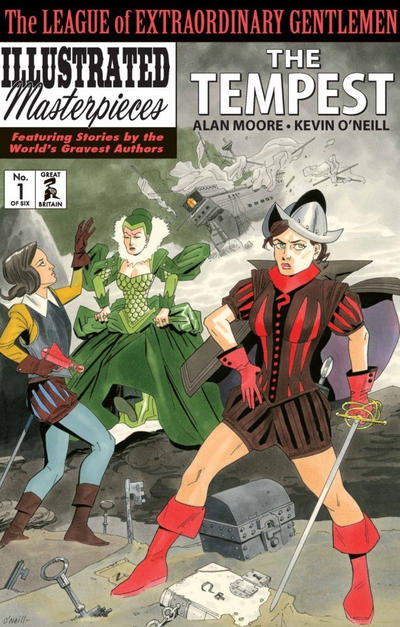
Crossover Covers: The League of Extraordinary Gentlemen: The Tempest


Are you a fan of Alan Moore and Kevin O'Neill's comic book The League of Extraordinary Gentlemen? 

Then you may enjoy this final chapter of the series, picking up directly after the events of Volume 3: Century!

For a fuller write-up of this comic, check out the appendix on alternate universes in my forthcoming book Crossovers Expanded: A Secret Chronology of the World Volume 3! As with the first two volumes, this book is an AUTHORIZED companion to Win Scott Eckert's invaluable tomes Crossovers: A Secret Chronology of the World Volumes 1 and 2 and will be published by the awesome folks at Meteor House!

Friday, March 27, 2015

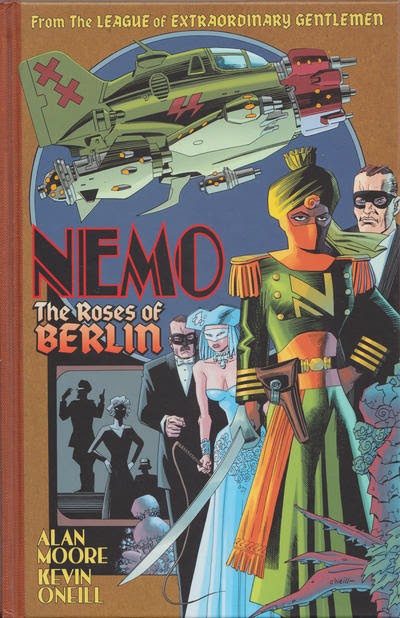
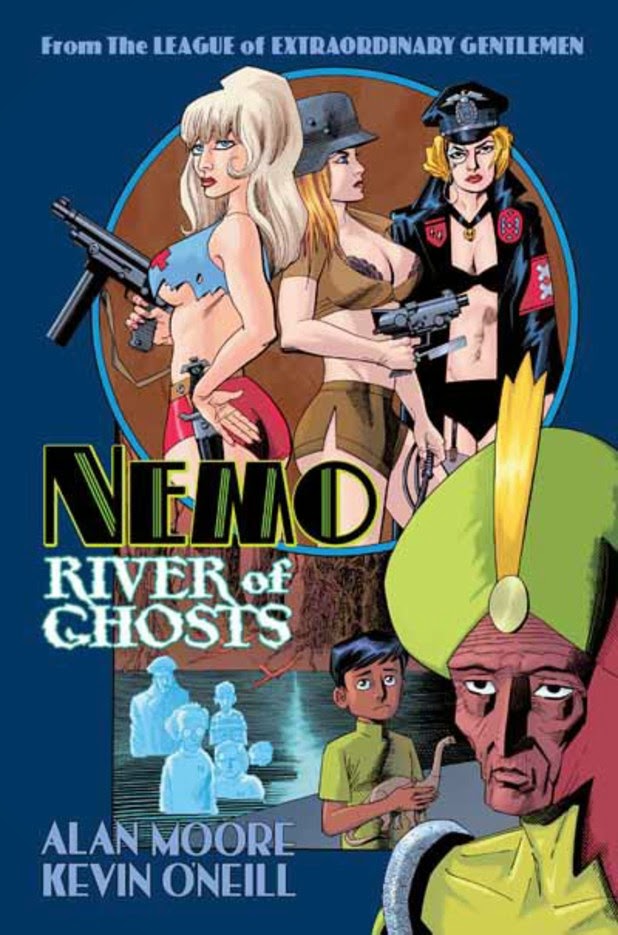
Crossover Covers: Nemo

This trilogy of graphic novels features a decades long feud between Janni Dakkar (aka Janni Nemo), Captain Nemo's daughter and heir, and the immortal queen Ayesha from H. Rider Haggard's She. Janni inherited her father's mantle in The League of Extraordinary Gentlemen Volume III: Century: 1910. I have already concluded that Century does not fit into CU continuity, and the Nemo novels do not fit either, as will be shown below. In Nemo: Heart of Ice, Janni follows the trail of her father’s Antarctic expedition from decades ago after plundering Ayesha's treasures. Ayesha’s current patron, newspaper magnate Charles Foster Kane (from Orson Welles’ film Citizen Kane) dispatches aging inventors Frank Reade Jr. and Jack Wright and their younger colleague “Tom Swyfte” to retrieve the Queen’s belongings and deal with Janni and her crew. Tom Swift is portrayed in an unflattering manner, making racist comments about Janni and shooting Reade in the leg with his Electric Rifle in order to slow down a raging shoggoth, effectively leaving the elder inventor to die. Swift is also seemingly driven irrevocably insane by the encounter with the shoggoth, which does not fit with his appearances in the Tom Swift Jr. novels in the 1950s-1970s. In Nemo: The Roses of Berlin, set in 1941, Janni and her husband Broad Arrow Jack must rescue their daughter Hira and son-in-law Armand Robur (son of Jules Verne’s Robur the Conqueror) from captivity in Nazi Germany, which is under the power of Ayesha’s current benefactor, Adenoid Hynkel (from Charlie Chaplin’s film The Great Dicator). In the process, they battle the remains of Germany’s equivalent of the League of Extraordinary Gentlemen, Die Zwielichthelden (“The Twilight Heroes”.) The Berlin of 1941 in this graphic novel is based on the titular futuristic city from Fritz Lang’s film Metropolis. Finally, in Nemo: River of Ghosts, Janni, dying and experiencing hallucinations of the ghosts of those she’s lost over the years, deals with Ayesha once and for all in South America in 1975. Janni hires the superhumanly strong Hugo Coghlan, aka Hugo Hercules (the title character of a 1902-1903 comic strip by William H.D. Koerner, who is revealed here to be the Celtic demigod Cuchulainn) to act as her bodyguard. Hugo says that he was paid by “a Mr. Savage Senior” to kill Hugo Danner (the equally superstrong protagonist of Philip Wylie’s novel Gladiator) soon after the Great War, though why Savage paid him to do this is not stated. Given the strong moral code he instilled in his son, it seems very unlikely that Doc Savage’s father, Clark Savage Sr., would put out a contract on another man’s life.

Friday, January 16, 2015

The League of Extraordinary Gentlemen, Volume III: Century

The League (particularly Mina Murray, Allan Quatermain, and Orlando) attempt, over the course of nearly 100 years, to prevent occultist Oliver Haddo (from W. Somerset Maugham's novel The Magician) from engineering the birth of a Moonchild (from the novel of the same name by Aleister Crowley, upon whom Haddo was based), thus ushering in the Apocalypse. Several factors in this trilogy place it outside CU continuity. The 1910 chapter involves characters from Bertolt Brecht and Kurt Weill's musical play The Threepenny Opera, and repeatedly references the upcoming coronation of King George V. However, The Threepenny Opera takes place in 1838, just before Queen Victoria's coronation. In the League universe, the infamous murders in Whitechapel in 1888 were committed by Jack Macheath, aka Mack the Knife, rather than Jack the Ripper. Also, there are several mentions of the 14th Earl of Gurney from the movie The Ruling Class. In the film, the mentally ill Earl believed himself to be God at first, and then later the Ripper. However, The Ruling Class is clearly set in the 1970s, when the film was made, as the Earl name-drops both Timothy Leary and Mao Zedong. In the 1969 chapter, Britain’s Prime Minister is Wilson, a long-lived athlete who appeared in the magazines The Wizard and Hornet, rather than Harold Wilson, the U.K.’s real Prime Minister in 1969. The American president is identified as pop star Max Foster, who has imprisoned non-hippies in concentration camps; this is a reference to Max Frost from the film Wild in the Street. Needless to say, nothing like this happened in our world or the CU in 1969. Additionally, a character named Tom appears; this is meant to be Tom Marvalo Riddle, alias Lord Voldemort, the archnemesis of J.K. Rowling’s boy wizard Harry Potter. However, Moore has Tom stating that he teaches occult studies at a school up north, whereas Rowling’s novels never portrayed Voldemort as a professor at Hogwarts. In 2009, America and Britain are at war with Q’Mar (aka Qumar, a fictional Middle Eastern country from the TV series The West Wing), and David Palmer (from the show 24) has succeeded The West Wing’s Jed Bartlet as President of the United States. The Prime Minister of Great Britain is Tom Davis from the TV series The Thick of It. The M played by Judi Dench in the James Bond movies is identified as Emma Peel, whereas Raymond Benson’s novel The Facts of Death gives her real name as Barbara Mawdsley. Bond himself is depicted as aging and decrepit, is suffering from cirrhosis, emphysema, and syphilis, and has been impersonated for decades by a series of increasingly younger agents, a reference to the number of actors who have portrayed him on film. This does not fit with the continuity of John Gardner and Raymond Benson’s continuation novels. Furthermore, the Moonchild is revealed here as Harry Potter, who massacred the other students and the faculty of Hogwarts, which does not fit with the continuity of J.K. Rowling’s novels.