Showing posts with label Bran Mak Morn. Show all posts

Sunday, December 10, 2023

Crossover of the Week

Summer 1967

YORKSHIRE STONES AND AMERICAN BARONS 

A Colonel and Sergeant summon Johnny Rich and May. The Colonel says the third Baron Tennington is in danger, but Johnny corrects him, saying that he has been dead for centuries, that one of his ancestors was familiar with the 11th Baron in 1795, and that the Colonel is talking about Stephen Tennington, the third Baron Darrowby. Johnny’s father mentored him in occult matters. May, who is of Manchu and English descent and has a contentious relationship with her grandfather and mother, dons a shooter’s vest with over a dozen small pockets, a smaller version of one worn by one of Johnny’s relatives, an adventurer of some note in the past. Their enemy, Jill Pole, is a Pict who worships the Moon-Woman. Johnny carries a sword cane whose silver blade, supposedly one of several forged by St. Dunstan, bears the inscription, “Sic pereant omnes inimici tui,” or “Thus perish all your enemies.” Johnny and May encounter another of the Moon-Woman's subjects, Thun Bronze Spear, son of Ka-Nu, son of Ka-Nu, who mentions King Bran and Gonar the Ancient. Johnny knows a French Japanese criminal who frequently uses grappling hooks in his thefts. 

Short story by Frank Schildiner in Johnny Rich, Pro Se Productions, 2018. The Colonel and Sergeant are Colonel Ross and Harry Palmer from Len Deighton’s spy novels. George Edward Rutherford, the 11th Baron Tennington, is from Philip José Farmer’s Tarzan Alive. The 11th Baron, who was present at the Wold Newton meteor strike in 1795, has several famous descendants, including Lord Greystoke and Professor Challenger. Darrowby, Yorkshire is from James Herriot’s It Shouldn’t Happen to a Vet. Johnny Rich’s father is Dennis Wheatley’s occult adventurer the Duke de Richleau. May’s grandfather is Fu Manchu, and her mother is the Devil Doctor’s daughter Fah Lo Suee. Johnny’s relative is a certain golden-eyed pulp superman. The Moon-Woman is from Robert E. Howard’s Bran Mak Morn story “Worms of the Earth.” Ka-Nu is from Howard’s Kull stories. Gonar is from the Bran Mak Morn stories. Two of St. Dunstan’s other silver blades are carried by Manly Wade Wellman’s occult detectives Judge Pursuivant and John Thunstone. The French Japanese criminal is Monkey Punch’s manga character Lupin III, the grandson of Maurice Leblanc’s gentleman thief Arsène Lupin. 

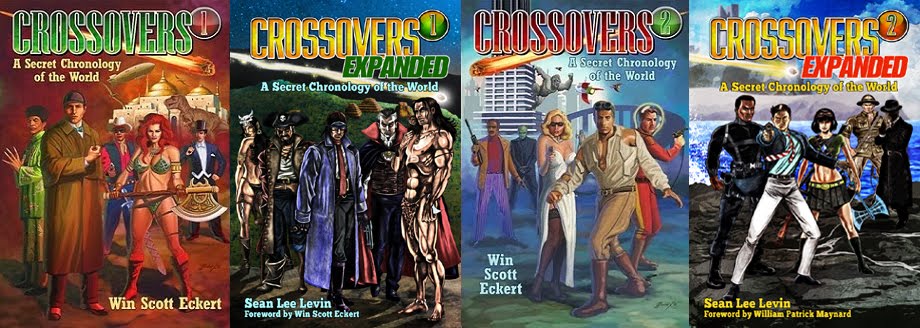
This crossover writeup is one of hundreds included in my book Crossovers Expanded: A Secret Chronology of the World Volume 3, which will be published by Meteor House! All three volumes are AUTHORIZED companions to Win Scott Eckert's Crossovers: A Secret Chronology of the World Volumes 1 and 2!

Tuesday, February 28, 2023

Crossover Cover: Maker of Shadows


Are you a fan of Robert E. Howard's fiction?

Then you'll love this novel, in which Jack Mann's occult detective Gees encounters an immortal sorcerer who is the son of Howard's Pictish king Bran Mak Morn!

For more information, see my book Crossovers Expanded: A Secret Chronology of the World Volume 3! As with the first two volumes, this new tome is an AUTHORIZED companion to Win Scott Eckert's seminal works Crossovers: A Secret Chronology of the World Volumes 1 and 2 and will be published by Meteor House!

Friday, April 1, 2016

Crossover Cover: The Difference a Day Makes

John Taylor and Dead Boy help an ordinary woman figure out why and how she came to be in the Nightside, and also try to reunite her with her husband. Appearing or mentioned are: the Maltese Falcon (from Dashiell Hammett’s private eye novel of the same name); Something from a Black Lagoon (a reference to the Universal horror film Creature from the Black Lagoon); one of Frankenstein’s female creations (from Mary Shelley's novels and its various sequels and adaptations); knockoff Hyde formula (from Robert Louis Stevenson’s novel The Strange Case of Dr. Jekyll and Mr. Hyde); a lipstick-red Plymouth Fury with a dead man grinning at the wheel (the titular car from Stephen King’s novel Christine); a great black beauty of a car, driven by an Oriental in black leathers, and a man in the back in a green face mask and a snap-brimmed hat (the Green Hornet and Kato, with this particular pair probably being Paul Reid and Kono Kato, who began working together in 1993); and worms from the earth (a reference to Robert E. Howard’s Bran Mak Morn story “Worms of the Earth.”)

Thursday, March 10, 2016

Crossover Cover: World War Cthulhu

This anthology contains two stories with crossovers, both written by authors with no little experience at same. One is "The Yoth Protocols" by Josh Reynolds. An FBI agent named Sarlowe thinks of centers of eldritch activity, such as the Warren site in the Big Cypress, the Martense molehills, and "certain secret cellars where a certain artist had painted certain pictures and almost certainly been eaten." He also thinks of Inspector Craig and his Special Detail in the subway tunnels beneath New York, as well as worms in the earth. Sarlowe’s partner Indrid Cold is described as having a wax-like face. It is stated there are worse things in Heaven and Earth than dreamt of in Alhazred’s philosophy. The local "old ones" include the Shonokins and the K’n-Yani. Sarlowe reminds Cold of the Yoth protocols. A circular stone covering the stairs leading to the mound where the K’n-Yani live was placed there after the Zamacona Cylinder was unearthed. "The batrachian hillbillies in Massachusetts" and N’Kai are mentioned. Cold is the only person who ever used the Voormithadreth Corridor and hadn’t rotted from the inside out. Cold identified Valusian spectrum radiation within the mound. The Russian necromancer Grigori Petrov refers to the Zann Concerto and the maw of Leng. Cold asks Petrov if he was planning to let Tsathoggua’s children loose to do his dirty work. Sarlowe quotes, "Evil the mind that is held by no head." Sarlowe is a relative of occult detective Baxter Sarlowe from Reynolds’ novel Wake the Dead. The Warren site in the Big Cypress is from H. P. Lovecraft’s story "The Statement of Randolph Carter." The Martense molehills are from Lovecraft’s "The Lurking Fear." The secret cellars where an artist painted pictures and was eaten are from Lovecraft’s story "Pickman’s Model." Inspector Craig and his Special Detail are from Robert Barbour Johnson’s story "Far Below." The worms in the earth are from Robert E. Howard’s Bran Mak Morn story "Worms of the Earth." Indrid Cold is an allegedly real person connected to the supposed Mothman sightings in 1966. His wax-like face implies Cold is a member of the wax-masked race of creatures seen in Lovecraft’s "The Festival," which is the source of the quote, "Evil the mind that is held by no head." Abdul Alhazred, the mad Arab, is the author of the Necronomicon in Lovecraft’s Cthulhu Mythos. The Shonokins are from Manly Wade Wellman’s John Thunstone stories. The K’n-Yani, Yoth, the Zamacona Cylinder, and N’Kai are from Lovecraft’s revision of Zealia Bishop’s story "The Mound." "The batrachian hillbillies in Massachusetts" are a reference to Lovecraft’s "The Shadow over Innsmouth." The Voormithadreth Corridor is connected to Mount Voormithadreth from Cthulhu Mythos stories by Clark Ashton Smith. Tsathoggua is also from Smith’s Mythos tales. Valusian spectrum radiation is a reference to the kingdom of Valusia in Robert E. Howard’s Kull stories. The Zann Concerto is from Lovecraft’s "The Music of Erich Zann." The plateau of Leng appears in a number of Lovecraft’s stories. The other story that I will include is "Cold War, Yellow Fever" by Pete Rawlik. Mitchell Peel is an operative of the Joint Advisory Committee on Korea (JACK), receiving orders from Colonel Doctor Wingate Peaslee, aka the Terrible Old Man. Peaslee tells Peel and other JACK agents Esteban Zamarano was sent to Banes, Cuba as part of Operation Mongoose to enlist his family’s aid. The Zamaranos bought six volumes from the sale of the Church of the Starry Wisdom Library, including what appears to be a Spanish-language edition of The King in Yellow. After contact was lost with Zamarano, another agent traveled to Banes, and disappeared himself, though not before sending the message, "Where is the Yellow Sign?" The Soviets are willing to neutralize the threat, but Peaslee says Washington does not want to see another Gizhinsk, particularly so close to the U.S. borders. Peel and company work with Major Romero of the Cuban Security Forces and Agent Tanya Romanova of Soviet Army Intelligence to deal with the situation. Romanova refers to documented cases of childrens’ minds being stimulated to see the universe in ways adults cannot, such as the Paradine children and "that village in Winshire." After the mission, a traumatized and disfigured Peaslee is retired to a minimum security facility near Arkham, Massachusetts. Mitchell Peel is related to David Conyers’ series character Major Harrison Peel, an NSA consultant who appears in stories set in the milieu of the Mythos. Wingate Peaslee is from Lovecraft’s story "The Shadow Out of Time"; his nickname of "the Terrible Old Man" is an homage to Lovecraft’s story of the same name. The Church of the Starry Wisdom is from Lovecraft’s "The Haunter of the Dark." Arkham, Massachusetts is the setting of a number of Mythos tales. The King in Yellow is from Robert W. Chambers’ short story collection of the same name, and was incorporated into the Cthulhu Mythos by Lovecraft in his story "The Whisperer in Darkness." The Yellow Sign is also from Chambers’ book. Gizhinsk and "that village in Winshire" are from John Wyndham’s novel The Midwich Cuckoos. Agent Tanya (or Tatiana) Romanova is from Ian Fleming’s James Bond novel From Russia, with Love. The Paradine children are from the short story "Mimsy Were the Borogroves" by "Lewis Padgett" (Henry Kuttner and C. L. Moore).

Sunday, November 1, 2015

Crossover of the Week

Yesterday, I had the immense pleasure of attending a midnight showing of one of my favorite movies, The Rocky Horror Picture Show. As with the previous showings I attended, the audience participation was great, as was sharing the experience with people who love RHPS as much as I do. In honor of this great experience, here's my write-up of the novel that brings the movie into the CU.

2003
THE GOOD, THE BAD, AND THE UNCANNY
John Taylor escorts an elf across the Nightside, helps deceased P.I. Larry Oblivion look for his brother Tommy, and refuses to take Walker’s place as agent of the Authorities that rule the Nightside. Appearing or mentioned are: Hydes; a cyborg from some future timeline with eyes glowing golden, mainlining a fierce and nasty future drug called Blood; taduki; Martian red weed; Queen Mab; Oberon and Titania; the Street of the Gods; Puck; the Sonic Assassin; the Time Tower; the Deep School; Salvation Kane; Old Mother Shipton; Indiana Jones; Mr. Stab; Miss Eliza Fritton, who used to run a private girl’s school; the Carnacki Insitute; the Droods; the Vril Power Gang; the Nazi Skull; Jacqueline Hyde; the worms of the Earth; a stuffed water baby; giant albino penguins; an old-fashioned grandfather clock, with a cobwebbed human skeleton propped up inside it; a lizard serum; Julien Advent; Rats’ Alley; Dr. Delirium; Wu Fang; and a Hand of Glory made from a monkey’s paw.
Novel by Simon R. Green. The Hydes are individuals who use the formula that turned Dr. Henry Jekyll into Edward Hyde as a narcotic. Jacqueline Hyde is a descendant of Jekyll’s who takes her ancestor’s serum, which turns her into a male Hyde. The cyborg from a future timeline with eyes glowing golden is one of the Hadenmen from Green’s Deathstalker series, which takes place in one of many possible futures for the CU. The Blood drug is also from the Deathstalker books. The drug Taduki is from H. Rider Haggard’s novels and stories about hunter Allan Quatermain. Martian red weed is from H. G. Wells’ novel The War of the Worlds. Queen Mab is from William Shakespeare’s play Romeo and Juliet, while Oberon, Titania, and Puck are from Shakespeare’s A Midsummer Night’s Dream. The Street of the Gods is from Green’s Hawk and Fisher novellas Winner Takes All and The God Killer. The Sonic Assassin is Michael Moorcock’s secret agent Jerry Cornelius, an incarnation of the Eternal Champion. The Time Tower is from Green’s novel Shadows Fall. Salvation Kane is probably meant to be Robert E. Howard’s heroic puritan Solomon Kane. The Deep School is an extradimensional school for sorcerers seen in Manly Wade Wellman’s John Thunstone stories. Old Mother Shipton, Mr. Stab, and the Droods are from Green’s Secret Histories series. Dr. Delirium goes on to become one of the main villains of the fourth Secret Histories novel, From Hell with Love. The Indiana Jones reference can be interpreted as a reference to either a real person or a fictional character, but since both Indy and John Taylor are firmly established as being in the CU, we can accept this as a legitimate crossover. Miss Eliza Fritton must be the same Miss Fritton who was the headmistress of St. Trinian’s, a private school for girls, in illustrated cartoons by Ronald Searle. The Carnacki Institute is featured in Green’s Ghost Finders series. The Vril Power Gang is a reference to the Vril power from Edward Bulwer-Lytton’s The Coming Race. The Nazi Skull is a reference to Captain America’s Nazi archenemy, the Red Skull. The worms of the Earth are from Robert E. Howard’s Bran Mak Morn story of the same name. The giant albino penguins are from Lovecraft’s novella At the Mountains of Madness. The stuffed water baby is a reference to Charles Kingsley’s children’s book The Water Babies. The old-fashioned grandfather clock with a cobwebbed human skeleton propped up inside it is from the movie The Rocky Horror Picture Show, bringing that film and its sequel, Shock Treatment, into the CU. The lizard serum is probably the one used by the Lizard, a foe of the Marvel Comics superhero Spider-Man. Julien Advent, a recurring character in the Nightside books, is meant to be adventurer Adam Adamant from the British television series Adam Adamant Lives! Rats’ Alley is from T. S. Eliot’s “The Waste Land.” Wu Fang is a pulp villain created by Robert J. Hogan. The Hand of Glory made from a monkey’s paw is a reference to W. W. Jacobs’ story “The Monkey’s Paw.”

Sunday, January 11, 2015

Crossover of the Week


July 1942
THE HORROR OF HYPERBOREA
            Thunder Jim Wade and his aides Dirk Marat and Red Argyle battle the Nazi mad scientist Baron Victor von Hammer and his son Franz, who have abducted Professor Isaac Levi in the hopes that the scholar can lead them to the lost civilization of Hyperborea, planning to use its secrets to take over the world. Von Hammer is actually Baron Victor von Frankenstein, the illegitimate and long-lived son of the legendary Baron von Frankenstein and a barmaid he bedded while hunting his creation, while Franz is really one of the younger Baron’s own creations. A Bedouin aiding Wade and company against Frankenstein’s living corpses uses the language of ancient Stygia. The Bedouins invoke the name of Mitra. Levi’s daughter Lise says that her father witnessed the execution of a member of the Frankenstein family who created a creature that killed dozens of people in his and nearby villages, and a member of her mother’s family lost an arm fighting against one of the Frankenstein monsters. This ruined his dreams of being a soldier, though he did become a police officer. Lise tells Wade about traps in Hyperborea, the first being the anger of Zath, the lord of spiders and the earth. Wade and company store their Thunderbug ship in a warehouse owned by a doctor colleague of Wade’s who uses his vast fortune and amazing mind to save the world. Marat refers to the time Argyle destroyed an Oparian outpost by accident. Frankenstein, who has captured Wade and friends, tells Wade that he once defeated Bulldog Drummond in London. Zath served Bel, the masked maker of chaos. A statue of Louhi, witch queen of Hyperborea, appears. The second trial of Hyperborea is the many mouths of Xotli, the Atlantean lord of blood. Wade, Frankenstein, and the others are attacked by the witch men of Hyperborea. Louhi tells Frankenstein that she was ancient when his people were food for the Elder Worms and slaves to her people and their Acheron rivals, and that only ancient Gagool and Ayesha have lived nearly as long as her. She subjects Wade and the rest to the Trial of Bori, and thinks of a barbarian who nearly killed her thousands of years ago.
            Novella by Frank Schildiner, Pro Se Press, 2014. Thunder Jim Wade appeared in five stories by “Charles Stoddard” (a pseudonym for Henry Kuttner) in the pulp Thrilling Adventures in 1941. The elder Baron Victor von Frankenstein and his creation are from Mary Shelley’s Frankenstein, of course. The younger Victor was formerly known as Victor Saville, the protagonist of Robert Myers’ novels The Cross of Frankenstein and The Slave of Frankenstein. Hyperborea is from Robert E. Howard’s stories of Conan the Barbarian, as is Stygia. Mitra is a deity from the Conan tales. Bel is from the Conan story “The Queen of the Black Coast.” Acheron appears in The Hour of the Dragon and other Conan tales. The member of the Frankenstein family that was executed is from the Hammer film The Curse of Frankenstein. Creative mythographer Chuck Loridans has identified this member of the family as Victor Frankenstein III, the son of the former Victor Saville and the grandson of Shelley’s Victor. The police officer who lost an arm to one of the Frankenstein monsters is Inspector Krogh from the Universal film Son of Frankenstein. Zath is from L. Sprague de Camp’s novel Conan and the Spider God. Louhi is from de Camp and Lin Carter’s Conan story “The Witch of the Mists.” Xotli is from de Camp and Carter’s novel Conan of the Isles. The witch men of Hyperborea are from de Camp and Carter’s “Legions of the Dead.” Wade’s doctor colleague is Doc Savage. The New York warehouse owned by Doc is used for the storage of his many vehicles, and is disguised as the headquarters of a business called the Hidalgo Trading Company. The lost city of Opar in Africa is from Edgar Rice Burroughs’ Tarzan books. Captain Hugh “Bulldog” Drummond is from a series of novels originated by H.C. “Sapper” McNeile, and continued after McNeile’s death by Gerard Fairlie. The Elder Worms are a reference to Howard’s Bran Mak Morn story “Worms of the Earth.” Gagool is from H. Rider Haggard’s first Allan Quatermain novel, King Solomon’s Mines, while Ayesha is the title character of Haggard’s novel She and its sequel and prequels. Bori (or Borri) appeared in “Twilight of the Grim Grey God” by Roy Thomas, Barry Windsor-Smith, and Sal Buscema, Conan the Barbarian #3, February 1971, Marvel Comics. The story was adapted from Howard’s “The Grim Grey God Passes,” which featured the Norse god Odin rather than Borri.