Showing posts with label Colonel Sebastian Moran. Show all posts

Sunday, July 17, 2016

Crossover of the Week


October 1885
THE HOUND OF THE D’URBERVILLES
            Professor Moriarty and Colonel Moran are hired by Jasper Stoke-d‘Urberville, nephew of Simon Stoke-d’Urberville, to kill Red Shuck, the spectral hound that has allegedly haunted the d’Urberville family for generations. Appearing or mentioned are: the village of Trantridge; the Chase; Simon’s son Alexander; Theresa “Tess” Durbeyfield-Clare; Tess’ son Sorrow and siblings Abraham and Modesty; the city of Wintoncester; Selden; Desperado Dan’l; a terrifying Fat Man in Whitehall; Doctor Jack Quartz; Dr. Nikola; the Si-Fan; the Lord of Strange Deaths; the Grand Vampire; Les Vampires; Wessex; Diggory Venn; Parson Tringham; Car Darch; Sir Pagan d’Urberville; Melchester; Lord John Roxton; Casterbridge; the Ranee of Ranchipur; Blind Herder; Arnsworth Castle; Jim Lassiter; John Durbeyfield; the parish of Kingsbere; Sherton Abbas; Singapore Charlie; Marlott Churchyard; and Elizabeth-Louise Durbeyfield.
            Short story by Colonel Sebastian Moran, edited by Kim Newman in Professor Moriarty: The Hound of the d’Urbervilles, Titan Books, 2011. The village of Trantridge, Simon Stoke-d’Urberville, the Chase, Simon’s son Alexander, Theresa “Tess” Durbeyfield-Clare, Sorrow Durbeyfield, Abraham Durbeyfield, Modesty Durbeyfield, the city of Wintoncester, Parson Tringham, Car Darch, Sir Pagan d’Urberville, John Durbeyfield, the parish of Kingsbere, Marlott Churchyard, and Elizabeth-Louise (or Eliza-Louisa) Durbeyfield are from Thomas Hardy’s novel Tess of the d’Urbervilles. Diggory Venn is from Hardy’s novel The Return of the Native. Wessex is a fictional region of England that appears in most of Hardy’s novels. Melchester is from Hardy’s Two on a Tower and Jude the Obscure. Casterbridge is from Hardy’s The Mayor of Casterbridge. Sherton Abbas is from Hardy’s The Woodlanders. Selden is from Doyle and Watson’s The Hound of the Baskervilles. The terrifying Fat Man in Whitehall is Mycroft Holmes, Sherlock’s brother. Blind Herder is the blind mechanic Von Herder from the Holmes story “The Adventure of the Empty House.” “The Arnsworth Castle business” is an untold Holmes case mentioned in “A Scandal in Bohemia.” Desperado Dan’l is inspired by (though not the same person as) the British comic book cowboy Desperate Dan. Doctor Jack Quartz is the arch nemesis of dime novel detective Nick Carter. Dr. Nikola is from the series of novels by Guy Boothby. The Si-Fan and Singapore Charlie are from the Fu Manchu novels by Sax Rohmer; the Lord of Strange Deaths is Fu Manchu himself. Les Vampires are from the titular film serial directed by Louis Feuillade, as is their leader, the Grand Vampire. Lord John Roxton is from Doyle’s Professor Challenger stories. Ranchipur is from the film The Rains of Ranchipur. Jim Lassiter is from the novel Riders of the Purple Sage by Zane Grey. The month is given, but the year is conjecture based on the facts Moran has worked for Moriarty for some time and Selden is next seen as an escaped convict in 1888.

Sunday, May 8, 2016

Crossover of the Week

Early January 1891
THE GREEK INVERTEBRATE
Professor Moriarty and Colonel Moran are asked by the Professor’s brother, Colonel James Moriarty, to ignore a summons from the third Moriarty brother, stationmaster James. The Professor and Moran defy his orders, and become involved with espionage and a new machine with which to wage war. Appearing or mentioned are: Sir Augustus Moran; the Club of the Damned; the Mausoleum Club; a chandelier falling on the audience of the Paris Opera during the jewel song from Faust; Fal Vale Junction; Greyfriars; the kuripuri; the Grand Vampire; Les Vampires; a German rival of Moriarty’s who sometimes assumes the guise of “a shock-haired, stooped alienist with mesmeric eyes”; Irma Vep; Palliser; Nevil Airey Stent; Fred Porlock; the Lord of Strange Deaths; R. G. Sanders; Eduardo Lucas; Thomas Carnacki; Cursitor Doone; Monsieur Sabin; Ilse von Hoffmansthal, aka Madame Gabrielle Valladon; Flaxman Low; Hugo Oberstein; Sophy Kratides; Malilella of the Stiletto; Irene Adler; Lady Yuki Kashima; Mad Margaret Trelawny; Dr. Syn; Partington; Paul Finglemore, alias Colonel Clay; and Ram Singh.
Short story by Colonel Sebastian Moran, edited by Kim Newman in Professor Moriarty: The Hound of the d’Urbervilles, Titan Books, 2011. Professor Moriarty, Colonel Moran, and Irene Adler are from Doyle and Watson’s Sherlock Holmes stories. Colonel Moriarty is mentioned in “The Final Problem.” Stationmaster Moriarty and Fred Porlock are from The Valley of Fear. Sir Augustus Moran, the Colonel’s father, is mentioned in “The Adventure of the Empty House.” Eduardo Lucas is from the Holmes story “The Adventure of the Second Stain”; since Lucas died in that story, which Baring-Gould has dated to October 1886, the Lucas in Newman’s story must be a cousin of Doyle’s character who is also involved in espionage. Hugo Oberstein is mentioned in both “The Adventure of the Second Stain” and “The Adventure of the Bruce-Partington Plans,” which is also the source of Partington. Sophy Kratides is from the Holmes tale “The Adventure of the Greek Interpreter.” The Club of the Damned is from the 1970s British television series Supernatural. The Mausoleum Club is from the 1980s BBC radio comedy series Tales from the Mausoleum Club. The chandelier falling on the audience of the Paris Opera during the jewel song from Faust is a reference to The Phantom of the Opera by Gaston Leroux. Fal Vale Junction is from Arnold Ridley’s play The Ghost Train. Greyfriars is the school attended by Billy Bunter in stories written by Charles Hamilton under the pen name Frank Richards. The kuripuri (originally spelled curupuri) is from Doyle’s novel The Lost World. Les Vampires are from Louis Feuillade’s film serial of the same name, as are their leader, the Grand Vampire, and Irma Vep. This Grand Vampire’s predecessor, who appeared in “The Adventure of the Six Maledictions,” must be the one murdered by Erik, the Phantom of the Opera, in 1889, as mentioned in Josh Reynolds’ Phileas Fogg and the War of Shadows. Rick Lai’s “All Predators Great and Small” has Irma as a child in 1895; perhaps the alias “Irma Vep” is used by whoever serves as Les Vampires’ primary female operative at any given time. This is likely the same Irma seen in Phileas Fogg and the War of Shadows. Moriarty’s German rival is Dr. Mabuse, the master criminal who appeared in fiction by Norbert Jacques and three films directed by Fritz Lang. Palliser is Plantagenet Palliser, the protagonist of a series of novels by Anthony Trollope. The Palliser novels are connected to the Chronicles of Barsetshire series, as well as several non-series novels by Trollope. Stent is from H. G. Wells’ The War of the Worlds. The Lord of Strange Deaths is Fu Manchu. R. G. Sanders is Edgar Wallace’s Sanders of the River. Sanders and another of Wallace’s characters, Lieutenant Bones, appear in each other’s series. Thomas Carnacki, “the Ghost-Finder,” was created by William Hope Hodgson. Cursitor Doone’s name is meant to evoke the British comic book character Cursitor Doom. Monsieur Sabin is from E. Phillips Oppenheim’s novels Mysterious Mister Sabin and The Yellow Crayon. Ilse Von Hoffmansthal (originally spelled without the second “h”), aka Gabrielle Valladon, is from Billy Wilder’s film The Private Life of Sherlock Holmes. Flaxman Low is from the collection Ghosts; Being the Experiences of Flaxman Low, by “E. and H. Heron” (Hesketh V. Prichard and Kate O’Brien Ryall Prichard). Malilella (usually spelled without the second “l”) is from Ermanno Wolf-Ferrari’s opera The Jewels of the Madonna. Lady Yuki Kashima is better known as the title character of Kazuo Koike and Kazuo Kamimura’s manga Lady Snowblood. Margaret Trelawny is from Bram Stoker’s The Jewel of Seven Stars. Dr. Syn is from novels by Russell Thorndike. Paul Finglemore, aka Colonel Clay, is from Grant Allen’s An African Millionaire. Ram Singh is from the film Sherlock Holmes and the Secret Weapon. Several details given about the Moriarty family in this story contradict their established CU history: the Colonel is younger than the Professor, the father of all three brothers was named James, and the Professor implicitly killed his own parents. Moriarty must have had an ulterior motive for lying to Moran.

Sunday, March 20, 2016

Crossover of the Week

Early January 1891
THE GREEK INVERTEBRATE
Professor Moriarty and Colonel Moran are asked by the Professor’s brother, Colonel James Moriarty, to ignore a summons from the third Moriarty brother, stationmaster James. The Professor and Moran defy his orders, and become involved with espionage and a new machine with which to wage war. Appearing or mentioned are: Sir Augustus Moran; the Club of the Damned; the Mausoleum Club; a chandelier falling on the audience of the Paris Opera during the jewel song from Faust; Fal Vale Junction; Greyfriars; the kuripuri; the Grand Vampire; Les Vampires; a German rival of Moriarty’s who sometimes assumes the guise of “a shock-haired, stooped alienist with mesmeric eyes”; Irma Vep; Palliser; Nevil Airey Stent; Fred Porlock; the Lord of Strange Deaths; R. G. Sanders; Eduardo Lucas; Thomas Carnacki; Cursitor Doone; Monsieur Sabin; Ilse von Hoffmansthal, aka Madame Gabrielle Valladon; Flaxman Low; Hugo Oberstein; Sophy Kratides; Malilella of the Stiletto; Irene Adler; Lady Yuki Kashima; Mad Margaret Trelawny; Dr. Syn; Partington; Paul Finglemore, alias Colonel Clay; and Ram Singh.
Short story by Colonel Sebastian Moran, edited by Kim Newman in Professor Moriarty: The Hound of the d’Urbervilles, Titan Books, 2011. Professor Moriarty, Colonel Moran, and Irene Adler are from Doyle and Watson’s Sherlock Holmes stories. Colonel Moriarty is mentioned in “The Final Problem.” Stationmaster Moriarty and Fred Porlock are from The Valley of Fear. Sir Augustus Moran, the Colonel’s father, is mentioned in “The Adventure of the Empty House.” Eduardo Lucas is from the Holmes story “The Adventure of the Second Stain”; since Lucas died in that story, which Baring-Gould has dated to October 1886, the Lucas in Newman’s story must be a cousin of Doyle’s character who is also involved in espionage. Hugo Oberstein is mentioned in both “The Adventure of the Second Stain” and “The Adventure of the Bruce-Partington Plans,” which is also the source of Partington. Sophy Kratides is from the Holmes tale “The Adventure of the Greek Interpreter.” The Club of the Damned is from the 1970s British television series Supernatural. The Mausoleum Club is from the 1980s BBC radio comedy series Tales from the Mausoleum Club. The chandelier falling on the audience of the Paris Opera during the jewel song from Faust is a reference to The Phantom of the Opera by Gaston Leroux. Fal Vale Junction is from Arnold Ridley’s play The Ghost Train. Greyfriars is the school attended by Billy Bunter in stories written by Charles Hamilton under the pen name Frank Richards. The kuripuri (originally spelled curupuri) is from Doyle’s novel The Lost World. Les Vampires are from Louis Feuillade’s film serial of the same name, as are their leader, the Grand Vampire, and Irma Vep. This Grand Vampire’s predecessor, who appeared in “The Adventure of the Six Maledictions,” must be the one murdered by Erik, the Phantom of the Opera, in 1889, as mentioned in Josh Reynolds’ Phileas Fogg and the War of Shadows. Rick Lai’s “All Predators Great and Small” has Irma as a child in 1895; perhaps the alias “Irma Vep” is used by whoever serves as Les Vampires’ primary female operative at any given time. This is likely the same Irma seen in Phileas Fogg and the War of Shadows. Moriarty’s German rival is Dr. Mabuse, the master criminal who appeared in fiction by Norbert Jacques and three films directed by Fritz Lang. Palliser is Plantagenet Palliser, the protagonist of a series of novels by Anthony Trollope. The Palliser novels are connected to the Chronicles of Barsetshire series, as well as several non-series novels by Trollope. Stent is from H. G. Wells’ The War of the Worlds. The Lord of Strange Deaths is Fu Manchu. R. G. Sanders is Edgar Wallace’s Sanders of the River. Sanders and another of Wallace’s characters, Lieutenant Bones, appear in each other’s series. Thomas Carnacki, “the Ghost-Finder,” was created by William Hope Hodgson. Cursitor Doone’s name is meant to evoke the British comic book character Cursitor Doom. Monsieur Sabin is from E. Phillips Oppenheim’s novels Mysterious Mister Sabin and The Yellow Crayon. Ilse Von Hoffmansthal (originally spelled without the second “h”), aka Gabrielle Valladon, is from Billy Wilder’s film The Private Life of Sherlock Holmes. Flaxman Low is from the collection Ghosts; Being the Experiences of Flaxman Low, by “E. and H. Heron” (Hesketh V. Prichard and Kate O’Brien Ryall Prichard). Malilella (usually spelled without the second “l”) is from Ermanno Wolf-Ferrari’s opera The Jewels of the Madonna. Lady Yuki Kashima is better known as the title character of Kazuo Koike and Kazuo Kamimura’s manga Lady Snowblood. Margaret Trelawny is from Bram Stoker’s The Jewel of Seven Stars. Dr. Syn is from novels by Russell Thorndike. Paul Finglemore, aka Colonel Clay, is from Grant Allen’s An African Millionaire. Ram Singh is from the film Sherlock Holmes and the Secret Weapon. Several details given about the Moriarty family in this story contradict their established CU history: the Colonel is younger than the Professor, the father of all three brothers was named James, and the Professor implicitly killed his own parents. Moriarty must have had an ulterior motive for lying to Moran.

Friday, December 11, 2015

Crossover Cover: The Fifth Heart

A Sherlock Holmes pastiche. Colonel Moran is identified as Colonel John Sebastian “Tiger Jack” Moran, the same full name and nickname given for him in George MacDonald Fraser’s Flashman and the Tiger. Inspector Hanaud (a detective seen in novels by A. E. W. Mason) and Hercule Poirot are mentioned, and the Lakota Indian Paha Sapa from Simmons’ novel Black Hills appears. The revelations in this novel about Holmes and Moriarty place it in an alternate universe.

Sunday, December 6, 2015

Crossover of the Week

Autumn 1888
THE ADVENTURE OF THE SIX MALEDICTIONS
Professor Moriarty and Colonel Moran are hired by Major Humphrey “Mad” Carew to protect him from the mi-go, which seek to retrieve the gem known as the Green Eye of the Little Yellow God from him. Moriarty’s plan involves hiring a group of master thieves to steal similar cursed items. Appearing or mentioned are: Ted Baldwin; the Vermissa Valley Scowrers; Birdy Edwards, aka John McMurdo and John Douglas; Birlstone Manor; the Assassination Bureau, Ltd.; “that Limehouse Chinese with the marmoset”; the Moonstone; the Eye of Klesh; the All-Seeing Eye of the Goddess of Light; the Crimson Gem of Cyttorak; the Pink Diamond of Lugash; Lukundoo; a Zuni fetish; “a naked Porroh man”; the Barlow rubies; the Rosenthall diamonds; the Mirror of Portugal; the Agra treasure; Azathoth; Tabanga; St. Custard’s; Amaryllis Framington; Giles Conover; the Ingestre Necklace; Mrs. Lovett’s Fleet Street pie shop; the Herncastle Heirloom; the Black Pearl of the Borgias; the Hoxton Creeper; “the cricketing ponce”; the Falcon of the Knights of St. John; the Jewels of the Madonna of Naples; the Jewel of Seven Stars; the Eye of Balor; Simon Carne; Fat Kaspar; the Grand Vampire; Les Vampires; Abel Trelawny; Margaret Trelawny; Gennaro; King Brian of the Leprechauns; Bianca Castafiore; Alf Bassick; Don Rafaele Corbucci; Irene Adler; “Dynamite” Desmond Mountmain and his son Tyrone; Malvoisin’s Mirror; the Monkey’s Paw; Cap’n Flint’s treasure; Sir Michael Sinclair’s Door; Marshall Alaric Molina de Marnac; Vokins; Malilella; Henry Wilcox; Queen Tera; Mrs. Sarah “The Black Widow of Lauder” Stewart; and Hagar “Thieving Pikey” Stanley.
Short story by Colonel Sebastian Moran, edited by Kim Newman in Gaslight Arcanum: Uncanny Tales of Sherlock Holmes, J. R. Campbell and Charles Prepolec, eds., EDGE Science Fiction and Fantasy Publishing, 2011; reprinted and revised in Professor Moriarty: The Hound of the d’Urbervilles, Titan Books, 2011. Professor Moriarty, Colonel Moran, and Irene Adler are from the Sherlock Holmes stories. Ted Baldwin, the Vermissa Valley Scowrers, Birdy Edwards, and Birlstone Manor are from the Holmes novel The Valley of Fear. The Agra treasure is from the Holmes novel The Sign of Four. The Black Pearl of the Borgias is from the Holmes story “The Adventure of the Six Napoleons.” In “The Adventure of the Empty House,” Holmes states “the death of Mrs. Stewart, of Lauder, in 1887” was likely perpetrated by Moran. Mad Carew, the Green Eye of the Little Yellow God and Amaryllis Framington are from J. Milton Hayes’ poem “The Green Eye of the Little Yellow God,” although in the poem Amaryllis is only identified as “the Colonel’s daughter.” Azathoth is one of the Great Old Ones from H. P. Lovecraft’s Cthulhu Mythos. The mi-go are also from the Mythos. The Assassination Bureau, Ltd. is a novel by Jack London, completed posthumously by Robert L. Fish. “That Limehouse Chinese with the marmoset” is Dr. Fu Manchu. The Moonstone (aka the Herncastle Heirloom) is the subject of a novel by Wilkie Collins. The Eye of Klesh is from Lord Dunsany’s one-act melodrama A Night at an Inn. The All-Seeing Eye of the Goddess of Light is from the 1940 film The Thief of Bagdad. The Crimson Gem of Cyttorak is from the exploits of Marvel Comics’ Doctor Strange. Although the gem is best known as the power source of the X-Men villain Juggernaut, it is unlikely it empowered Cain Marko in the CU. The Pink Diamond of Lugash is better known as the Pink Panther, from the film series of the same name. Lukundoo is from the short story of the same name by Edward Lucas White. The Zuni fetish is from Richard Matheson’s story “Prey,” later adapted as “Amelia,” the third segment of the made-for-television film Trilogy of Terror. The “naked Porroh man” is from H. G. Wells’ story “Pollock and the Porroh Man.” The Barlow rubies are from Patrick Hamilton’s play Gas Light. “The cricketing ponce” is E. W. Hornung’s Raffles. The Rosenthall diamonds are from the Raffles story “A Costume Piece.” Don Rafaele Corbucci is Raffles’ nemesis Count Corbucci from “The Fate of Faustina” and “The Last Laugh.” Rick Lai gives the Count the first name Salvatore in his own fiction. Perhaps his full name is Salvatore Rafaele Corbucci. The Mirror of Portugal is from Arthur Morrison’s story “The Case of ‘The Mirror of Portugal,’” found in the collection The Dorrington Deed Box. Tabanga is from the film From Hell It Came. St. Custard’s is the school attended by Nigel Molesworth in books written by Geoffrey Willans and illustrated by Ronald Searle. Giles Conover and the Hoxton Creeper are from the Sherlock Holmes film The Pearl of Death. The Creeper was played by Rondo Hatton, who also portrayed a character called the Creeper in the films House of Horrors and The Brute Man; perhaps the latter-day Creeper is a descendant of his Victorian namesake and look-alike. The Ingestre Necklace and Mrs. Lovett’s Fleet Street pie shop are from the penny dreadful story “The String of Pearls: A Romance,” which formed the basis for the stage musical Sweeney Todd: The Demon Barber of Fleet Street. The Falcon of the Knights of St. John is the titular statue from Dashiell Hammett’s novel The Maltese Falcon; Fat Kaspar is Casper Gutman. The Jewels of the Madonna of Naples, Genarro, and Malilella (usually spelled without the second “l”) are from Ermanno Wolf-Ferrari’s opera The Jewels of the Madonna. The Jewel of Seven Stars, Abel Trelawny, Margaret Trelawny, and Queen Tera are from the novel The Jewel of Seven Stars by Bram Stoker. The Eye of Balor is from Celtic mythology. Simon Carne is from the collection A Prince of Swindlers by Guy Boothby. The Grand Vampire and Les Vampires are from Louis Feuillade’s serial named for the latter. King Brian of the Leprechauns is Brian Connors from the film Darby O’Gill and the Little People. Bianca Castafiore is from the Tintin comics by Hergé. Alf Bassick is from William Gillette’s play Sherlock Holmes. Desmond and Tyrone Mountmain are undoubtedly relatives of the Mountmain family which appears in Newman’s serial novel Seven Stars. Malvoisin’s Mirror is from a titular story by Chris Lowder and Brian Lewis in the British comic magazine Halls of Horror #12. The Monkey’s Paw is the subject of the short story of the same name by W. W. Jacobs. Cap’n Flint’s treasure is from Treasure Island by Robert Louis Stevenson. Sir Michael Sinclair’s Door is from “The Door,” a segment of the British horror anthology film From Beyond the Grave. Marshall Alaric Molina de Marnac is likely a descendant of Alaric de Marnac, the 15th century warlock played by Paul Naschy (née Jacinto Molina Álvarez) in the films Horror from the Tomb and Cries of Terror. Vokins is Charles Vokins from “The Horizontal Witness,” an episode of the television series Cribb, based on Peter Lovesey’s series of novels about a Victorian era Police Sergeant. Henry Wilcox is from E. M. Forster’s novel Howards End. Hagar Stanley is from the collection Hagar of the Pawn-Shop: The Gypsy Detective by Fergus Hume. The original version of this tale had references to the Emeralds of Suliman (from Edgar Wallace’s J. G. Reeder tale “The Green Mamba”) and Sylvia Marsh (from Ken Russell’s 1988 film version of Bram Stoker’s The Lair of the White Worm).

Sunday, November 8, 2015

Crossover of the Week

Early January–May 4, 1891
THE PROBLEM OF THE FINAL ADVENTURE
Colonel Sebastian Moran recounts the events leading to Professor Moriarty’s battle with Sherlock Holmes at the Reichenbach Falls. Appearing or mentioned are: Watson; Colonel Moriarty; the third James Moriarty; “an Irish spinster scribbler”; the Fat Man of Whitehall; the Diogenes Club; Billy the Page; Charlie Vokins; Lestrade; Mackenzie; MacDonald; Simon Carne; the Ranee of Ranchipur; the Lord of Strange Deaths; Fal Vale; Sophy Kratides; Harold Latimer and Wilson Kemp; Charles Milverton; Dan Levy; Les Vampires; the Grand Vampire; Irma Vep; Kingstead Cemetery; La Castafiore; Thomas Carnacki; Van Helsing; Bulstrode & Sons; Baron Maupertuis; quap; Mr. Beebe; the Daughter of the Dragon; Doctor Nikola; Madame Sara; Margaret Trelawny; the Hoxton Creeper; Doctor Mabuse; Alraune ten Brincken; Arthur Raffles and Bunny Manders; Théophraste Lupin and Joséphine Balsamo, Countess Cagliostro; Doctor Jack Quartz and Princess Zanoni; Rupert of Hentzau; Irene Adler; the Si-Fan; Queen Tera; the Jewel of Seven Stars; the Black Pearl of the Borgias; the Duke of Shires; Dr. Syn; Barchester Cathedral; the Forsyte tomb; Colonel Clay; Jim Lassiter; Diggory Venn; Sir Augustus Moran; Von Herder; a skull-faced “ghost” in the khanum’s palace at Mazenderan; Parker; the Reverend John Jago; the Mountmains; Colonel Sapt; Princess Flavia; Birdy Edwards; Grimesby Roylott; John Clay; Bert Stevens; Fred Porlock; Birlstone Manor; Paul Kratides; Ruritania; Rudi; Michael; Rassendyll; The Englischer Hof; and Peter Steiler. The endnotes to the story reveal Kate Reed ghosted for her friend and later lover, Charles Beauregard, and the Diogenes Club traded as Universal Exports in the 1950s. Paul Forrestier is mentioned in the same endnote.
Short story by Colonel Sebastian Moran, edited by Kim Newman in Professor Moriarty: The Hound of the d’Urbervilles, Titan Books, 2011. Moriarty, Moran, Holmes, Watson, the Fat Man of Whitehall (Sherlock’s brother Mycroft), the Diogenes Club, Billy the Page, and Lestrade are from the Sherlock Holmes stories. Further references from the Holmes stories: Colonel Moriarty, Inspector Patterson, the Englischer Hof, and Peter Steiler from “The Final Problem”; the third James Moriarty (the stationmaster, later known as the second Professor Moriarty), MacDonald, Birdy Edwards, Fred Porlock, and Birlstone Manor from The Valley of Fear; Sophy Kratides, Harold Latimer, Wilson Kemp, and Paul Kratides from “The Adventure of the Greek Interpreter”; Charles Milverton from “The Adventure of Charles Augustus Milverton”; Baron Maupertuis, mentioned in “The Adventure of the Reigate Squire”; the Black Pearl of the Borgias from “The Adventure of the Six Napoleons”; Sir Augustus Moran, Von Herder, and Parker from “The Adventure of the Empty House”; Grimesby Roylott from “The Adventure of the Speckled Band”; John Clay from “The Adventure of the Red-Headed League”; and Bert Stevens from “The Adventure of the Norwood Builder.” Moran’s claim he shot Moriarty as the latter grappled with Holmes at Reichenbach must be considered spurious; Holmes would surely have noticed, and The League of Extraordinary Gentlemen depicts Moran and Campion Bond tending to Moriarty after his plunge down the falls. Moran must have lied to conceal the fact the Professor survived his painful fall. The “Irish spinster scribbler” is Kate Reed, a “deleted” character from Dracula who appears in several stories by Newman, and also has a counterpart in the Anno Dracula Universe. Charlie Vokins is from “The Horizontal Witness,” an episode of the television series Cribb. Arthur Raffles, Bunny Manders, and Mackenzie are from the Raffles stories by E. W. Hornung. Dan Levy is from the novel Mr. Justice Raffles. Given that Philip José Farmer identified Raffles as the father of Arthur Upfield’s Inspector Napoleon Bonaparte, Moran and Sophy must be mistaken about Raffles and Bunny’s sexual orientation. Simon Carne is from Guy Boothby’s collection of stories A Prince of Swindlers. Ranchipur is from the film The Rains of Ranchipur. The Lord of Strange Deaths is Fu Manchu; the Si-Fan is the criminal organization Fu Manchu runs. The Daughter of the Dragon is presumably meant to be Fu Manchu’s daughter, Fah Lo Suee; however, this conflicts with Fah’s established birthdate of 1896. Fu must have had another daughter before Fah Lo Suee. Fal Vale is from Arnold Ridley’s play The Ghost Train. Les Vampires, the Grand Vampire, and Irma Vep are from Louis Feuillade’s serial Les Vampires. Kingstead Cemetery and Van Helsing are from Stoker’s Dracula. La Castafiore is Bianca Castafiore from Hergé’s Tintin comics. Thomas Carnacki, “the Ghost-Finder,” was created by William Hope Hodgson. Bulstrode & Sons is a reference to the British sitcom That’s Your Funeral. Quap is a radioactive compound from H. G. Wells’ novel Tono-Bungay. Mr. Beebe is from E. M. Forster’s novel A Room with a View. Doctor Nikola is the master criminal created by Guy Boothby. Madame Sara is from L. T. Meade and Robert Eustace’s The Sorceress of the Strand. Rick Lai has identified Madame Sara as the mother of Miss Warrender from Doyle’s short story “Uncle Jeremy’s Household” in his own fiction, and therefore Moran is wrong about Sara’s sexuality as well as Raffles and Bunny’s. Margaret Trelawny, Queen Tera, and the Jewel of Seven Stars are from Bram Stoker’s The Jewel of Seven Stars. The Hoxton Creeper is from the Sherlock Holmes film The Pearl of Death. Doctor Mabuse is the subject of fiction by Norbert Jacques, as well as a film trilogy by Fritz Lang. Alraune ten Brincken is from the novel Alraune by Hanns Heinz Ewers. Théophraste Lupin is the father of Maurice Leblanc’s gentleman thief Arsène Lupin, while Joséphine Balsamo is Arsène’s future nemesis. Doctor Jack Quartz and Princess Zanoni are foes of dime novel detective Nick Carter. Rupert of Hentzau, Colonel Sapt, Princess Flavia, Ruritania, Rudi (Rudolf V), Michael (Black Michael), and Rassendyll (Rudolf Rassendyll) are from The Prisoner of Zenda and Rupert of Hentzau by Anthony Hope. The Duke of Shires is from the Sherlock Holmes film A Study in Terror. Dr. Syn, aka the Scarecrow of Romney Marsh and Captain Clegg, is from the series of novels by Russell Thorndike. Barchester Cathedral is from Anthony Trollope’s Chronicles of Barsetshire novels. The Forsyte Saga is a series of novels by John Galsworthy. Colonel Clay is from the novel An African Millionaire by Grant Allen. Jim Lassiter is from Zane Grey’s novel Riders of the Purple Sage. Diggory Venn is from Thomas Hardy’s The Return of the Native. The skull-faced “ghost” in the khanum’s palace at Mazenderan is the Phantom of the Opera, from the novel by Gaston Leroux. The Reverend John Jago is an ancestor of Anthony Jago from Newman’s novel Jago, and also has a counterpart in the Anno Dracula Universe. Paul Forrestier is also from Jago. The Mountmains are likely kin to the Mountmains who appear in Newman’s Seven Stars. Charles Beauregard is from Newman’s Diogenes Club stories, and has a counterpart in the Anno Dracula Universe. In Billy Wilder’s film The Private Life of Sherlock Holmes, the Diogenes Club was portrayed as a front for the British Secret Service, a theory Newman has adopted for his own fiction; here, it is revealed the Club eventually became Universal Exports, the front for the BSS in Ian Fleming’s James Bond novels. However, the BSS must have still privately used the Club’s name at times, as demonstrated by Richard Jeperson’s exploits.
Friday, March 6, 2015

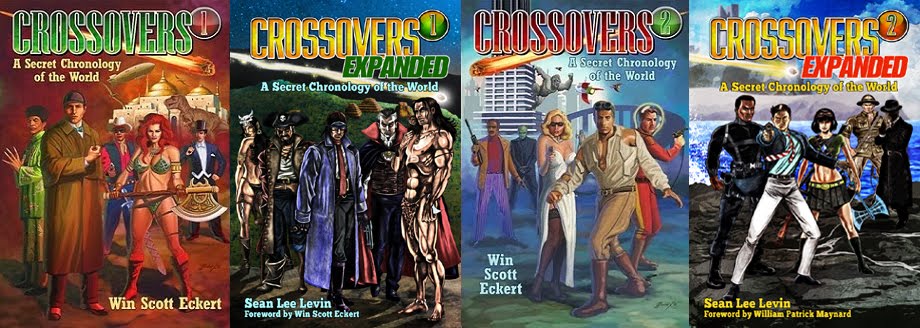
Crossover Cover: Lifeblood

Jack Fleming, a vampire P.I. in Chicago, meets fanatical vampire hunter James Braxton, who possesses a copy of the Necronomicon. The appearance of Lovecraft’s Necronomicon places Jack Fleming in the CU. All of Elrod’s vampire series are set in the same universe. Fleming was bitten by Maureen Dumont, who was herself turned by the title character of Elrod’s Jonathan Barrett, Gentleman Vampire series, who met Lucie Manette and a young Percy Blakeney in Elrod’s story “Death in Dover.” Barrett was himself turned by Nora Jones, who also turned Quincey Morris, as seen in Elrod’s novel Quincey Morris, Vampire, a sequel to Stoker’s Dracula that has already been included in the CU via a reference to Colonel Sebastian Moran. Quincey Morris, Vampire also has an appearance by Lord Richard d’Orleans from Elrod and Nigel Bennett’s Ethical Vampires series.