Showing posts with label Erwin K. Roberts. Show all posts

Sunday, June 16, 2024

Crossover of the Week

Early June 2015

TOMMY HANCOCK’S BRANSON NON-ADVENTURE 

While New Pulp publisher and author Tommy Hancock is being treated at the Nettles Clinic for congestive heart failure, assassin and master of disguise Mirror Image is targeting another patient, Morton Vickers, an analyst for a multiagency task force operating against various loosely allied organized crime organizations. Vickers is the grandson of legendary 1930s G-Man Lynn Vickers. After hearing about the assassination plot, the Voice, long semi-retired, called Curt Van Loan’s covert network for help. A woman equally adept at disguise pits herself against Mirror Image. Lemuel Barnes of the Treasury Department is monitoring Vickers’ operation. The woman, Emily, later introduces herself to Hancock. 

Short story by Erwin K. Roberts in Legends of New Pulp Fiction, Ron Fortier, ed., Airship 27 Productions, 2015. Tommy Hancock is a real person, and this story is inspired by a medical crisis he suffered in real life on June 8, 2015. Lynn Vickers, Agent G-77, appeared in nine stories by Bryan James Kelly in the pulps Public Enemy and Federal Agent from 1935-1938. The Voice is the protagonist of a series of novels and stories by Roberts. The hero is implicitly the son of Secret Agent X. Curt Van Loan, another of Roberts’ creations, is the son of Richard Curtis Van Loan, aka the Phantom Detective, and Muriel Havens. Emily is the Pulptress, a second-generation heroine who has appeared in novels and anthologies from Hancock’s company, Pro Se Productions. Lemuel Barnes is likely a descendant of Bromley Barnes, a Treasury Department agent who appeared in stories, novels, and collections by George Barton from 1909-1920. 

This crossover writeup is one of over a thousand included in my book Crossovers Expanded: A Secret Chronology of the World Volume 3, coming this summer from Meteor House! All three volumes are AUTHORIZED companions to Win Scott Eckert's Crossovers: A Secret Chronology of the World Volumes 1 and 2!

Friday, May 20, 2016

Crossover Cover: The False Globe

In this story by Erwin K. Roberts, the Moon Man (Steve Thatcher) remembers a reporter from the St. Louis Clarion telling him about the Saint, an Englishman dubbed the “Modern Robin Hood of Crime,” who steals from what he calls “the ungodly.” The reporter also said for some reason the Clarion’s home office takes a serious interest in mysterious folks like the Saint. The Moon Man appeared in tales by Frederick C. Davis in the pulp magazine Ten Detective Aces in 1933–1937. The Saint, also known as Simon Templar, is from Leslie Charteris’ books. The Clarion’s home office is the New York Clarion, owned by Frank Havens, an ally of another pulp hero, the Phantom Detective.

Sunday, April 10, 2016

Crossover of the Week

December 1999
VOICE OF PAIN
FBI Agent-in-Charge Jeffrey Reynolds tells Police Lt. Ralph Adams he has been reading classified official reports about vigilantes such as the Voice. The most recent report was dated in the late sixties, and concerned a disguise artist referred to as Mr. Jones who worked for the Bureau. The Voice refers to George Sanchez as “my Burbank.” Reynolds considers asking his Great-Uncle Lynn about the vigilantes of the old days. Former police chief Cobbins refers to vigilantes (or “Independent Operators”) who were involved in World War II, including an Australian who served with his country’s military while wearing a mask and using the code name “the Phantom Commando.”
Story by Erwin K. Roberts in Double Danger Tales #52, Tom and Ginger Johnson, eds., Fading Shadows Publications, May 2002; reprinted in Casebook of the Voice, Modern Knights Press, 2014. Mr. Jones appeared in Dennis Lynds’ story “The Man of a Million Faces,” published in the June 1968 issue of Mike Shayne Mystery Magazine under the house name of Robert Hart Davis. Burbank is an agent of a shadow-cloaked pulp hero, specializing in communications. Reynolds’ great-uncle Lynn is FBI agent Lynn Vickers, who appeared in stories by Bryan James Kelley in Public Enemy (later retitled Federal Agent). The Phantom Commando is an Australian comic character created by John Dixon who appeared in his own series from 19591970.

Sunday, February 14, 2016

Crossover of the Week

July 1996
EXPLOSIVE JUSTICE
Former police officer Bowen Chadwick (secretly the superpowered vigilante known as the Blaster) watches a news story on National News Net, a part of Havens International Media, delivered by Curtis Van Loan. In a flashback to the circumstances under which Chadwick gained his powers, Sergeant Sampson Jones tells Special Agent Simmons, “I do not care if the ghost of J. Edgar Hoover comes up to me with a request signed by the ghosts of Eliot Ness, Wyatt Earp, and Sherlock Holmes; I will not relinquish control of this environmental travesty.” Van Loan later introduces Chadwick to another vigilante, the Voice, who needs his help against a right wing militia. The Voice says, “If it weren’t for the women and children in the compound, I’d be sorely tempted to use my honorary Uncle Dick’s scorched earth methods. Go Mack Bolan on ’em.” After the militia is defeated, a helicopter picks up the Voice and Chadwick; the crew of the aircraft refers to the pilot as String.
Short story by Erwin K. Roberts in Casebook of the Voice, Modern Knights Press, 2014. Havens International Media is an outgrowth of the Daily Clarion newspaper owned by Frank Havens, an ally of the Phantom Detective (aka Richard Curtis Van Loan). The Detective’s girlfriend in the pulp stories was Muriel Havens, Frank’s daughter; Curtis “Curt” Van Loan is their son. Sergeant Jones is almost certainly mistaken about Sherlock Holmes being deceased, and was probably fooled by Holmes faking his death in 1957. The Voice’s honorary Uncle Dick is Richard “Dick” Wentworth, better known as the Spider. Mack Bolan, the Executioner, is the protagonist of a series of novels by Don Pendleton and others. It has been suggested Bolan is Wentworth’s son. The helicopter pilot is Stringfellow “String” Hawke from the television series Airwolf.

Sunday, September 6, 2015

Crossover of the Week

1945
THE SECRET OF THE AERO PLANE

Major Henderson and Captain Cody meet Captain Hercules Hurricane at a bar in Walkabout Creek, Australia. Henderson tells Cody during World War I, a splinter enemy group claimed to be empowered by Thor and the Norse gods. He also says Hitler allegedly lost major expeditions trying to find the Holy Grail and the Ark of the Covenant, and dispatches Cody to meet the enigmatic pilot Captain Aero.
Short story by Erwin K. Roberts at the Planetary Stories website. Captain Cody and Major Henderson will later be known as Commando Cody and Mr. Henderson from the film serial Radar Men from the Moon and the television series Commando Cody: Sky Marshal of the Universe. The superhumanly strong Captain Hercules Hurricane appeared in the British comic Valiant during the 1960s and 1970s, though his stories were set during World War II. Walkabout Creek, Australia is from the film Crocodile Dundee. The German splinter group is the titular organization from Roberts’ two-part novella “The Sons of Thor.” The Nazi expeditions to find the Holy Grail and the Ark of the Covenant were seen in the movies Indiana Jones and the Last Crusade and Raiders of the Lost Ark, respectively. Captain Aero’s exploits were published by the American comic book company Holyoke during the 1940s.

Sunday, March 1, 2015

Crossover of the Week


September 16-23, 1989
CRIME OF THE ARTS
            The Voice teams up with a woman named Dana to take down the militia to which the man who disfigured her belonged. The hero uses his father’s gas gun, and quotes the First Master Detective, “Watson, you see, but you do not observe.” The Voice uses a meditative technique one of his honorary uncles taught him rather than go to sleep. The Voice compares a female scientist working with Dana’s victimizer to the original Victor Frankenstein. The woman’s father worked at a secret facility that reprogrammed people located near a town in upstate New York. The Voice calls his friend Curt Van Loan of Havens International Media. The Voice uses his Uncle Kent’s mental trick to fall asleep nearly instantly, and teaches Dana his Uncle Jethro’s technique for reducing pain without drugs. The Voice remembers seeing a picture of the militia’s leader in the New York Clarion. The Voice thinks that Matt Helm would have taken a practice shot at a tree, but he can’t alert whoever is approaching. Dana compares the militia’s headquarters to Fu Manchu’s lair, but the Voice replies “If old Fu owned this place, we’d probably be dead by now.”
            Story by Erwin K. Roberts in Casebook of the Voice, Modern Knights Press, 2014. The Voice’s father is the pulp hero Secret Agent X, who was created by Paul Chadwick under the pen name “Brant House.” The First Master Detective is Sherlock Holmes. The Voice’s honorary uncle who taught him the meditative technique is Michael Traile, “the Man who Could Not Sleep,” the archenemy of Donald E. Keyhoe’s pulp villain Dr. Yen Sin. The reference to “the original Victor Frankenstein” is consistent with numerous books, comics, and movies in which relatives and descendants of Mary Shelley’s Victor Frankenstein engage in experiments of their own. The secret facility near upstate New York is Doc Savage’s Crime College. Curt Van Loan is the son of Richard Curtis Van Loan, aka the Phantom Detective, who appeared in a titular pulp magazine by several authors using the pseudonym “Robert Wallace.” Van Loan’s girlfriend in the original pulp stories, Muriel Havens, is Curt’s mother; her father, Frank Havens, was the publisher of the New York Clarion newspaper. Uncle Kent is Kent Allard, alias the Shadow, while Uncle Jethro is Kendell Crossen’s pulp hero The Green Lama, whose real name was Jethro Dumont. The references to Matt Helm and Fu Manchu could be interpreted as allusions to fictional characters, but given the Voice’s familiarity with a number of other heroes and villains, I am treating them as valid crossovers.

Saturday, October 25, 2014

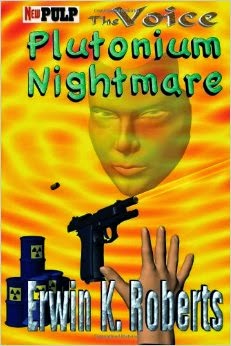
Crossover Cover: Plutonium Nightmare

This novel features the New Pulp hero the Voice, who is heavily implied to be Secret Agent X's son. I covered the Voice's origin story, "Voice to a New Generation," in a Crossover of the Week post a while ago. At one point, the Voice says, “In the long run the police, as Nero Wolfe once told my Dad, have their legions of experts.” The hero also gives many thanks to Uncle Simon and Willie, his British knife throwing mentors, referring to Simon Templar (alias the Saint) and Willie Garvin (Modesty Blaise's sidekick), respectively. There's also a bonus story included called "The Last Son of Thor," a sequel to Roberts' novella "The Sons of Thor," which was previously the subject of a Crossover Cover post here, in which the Voice encounters the last remnants of the Sons, a German nationalist group that had a run-in with several vigilantes in the late '30s. The hero remembers his Uncle Dick, the father of his best friend Curt Van Loan, telling them about the Sons, and recommending the young boy ask his big Uncle Jim and Uncle Tony about them. Uncle Dick is Richard Curtis Van Loan, aka the Phantom Detective. Big Uncle Jim is Jim Anthony. Uncle Tony is Tony Quinn, aka the Black Bat. Information about the Sons that came from the Ashton-Kirk estate was recently stolen from the locked archives of a local university. Ashton-Kirk was a detective created by John McIntyre for The Popular Magazine; the stories were collected in four books. He, the Phantom Detective, Jim Anthony, and the Black Bat all appeared in "The Sons of Thor."

Sunday, August 31, 2014

Crossover of the Week

1934
NEIGHBORHOOD IN PERIL
            Jim Anthony works to protect the non-Anglo Saxon residents of a New York neighborhood from a racist group. Officer Burland secretly meets with Jim to discuss the situation. Gibbons, the Managing Editor of Jim’s paper, the New York Star, tells Jim that Gunigun at the Sentinel says one of his delivery boys in the neighborhood got hit by a truck. FBI agent Dan Fowler asks Jim not to get involved with the investigation. Jim threatens to go to Frank Havens of the Clarion with the story, and suggests that someone in the U.S. government may be working with a “pure America” group like the Knights of the Open Palm. Jim is later visited by G-2 agent Jeff Shannon, aka the Eagle, who refers to a man named Ashton-Kirk. After the villains are defeated, Jim shakes hands with Dan, the Sentinel’s elderly owner.
            Story by Erwin K. Roberts in Jim Anthony: Super Detective Volume Four, Ron Fortier, ed., Airship 27 Productions, 2013. Officer Kip Burland is the alter ego of the comic book hero the Black Hood, whose adventures were published by MLJ, the company later known as Archie Comics. The character also appeared in a short-lived pulp magazine, Black Hood Detective. It is unconfirmed whether Burland ever operated as the Black Hood in the CU. “Gunigun” is a reference to Bill Gunnigan, the City Editor of the Daily Sentinel, the newspaper owned by Britt Reid, aka the Green Hornet. Dan is Britt’s father, Dan Reid Jr. Since the Green Hornet was based out of Detroit in the CU, Gunnigan and the elder Reid must have been visiting New York to work with the paper’s branch in that city. The year of this story is conjecture based on the fact that it takes place before Britt took over ownership of the Sentinel from his father. FBI agent Dan Fowler was created by Major George Fielding-Eliot and appeared in the pulp G-Men Detective. Frank Havens and the Clarion newspaper are from the pulp magazine The Phantom Detective, written by a number of authors using the pen names “G. Wayman Jones” and “Robert Wallace.” The Knights of the Open Palm are from Carroll John Daly’s short story of the same name, the first of a series of tales about P.I. Race Williams that appeared in the pulp Black Mask. Jeff Shannon, aka the Eagle, appeared in four stories in the pulp Thrilling Spy Stories and one in Popular Detective, all written by Norman A. Daniels as “Kerry McRoberts.” Ashton-Kirk was a Sherlock Holmes-like detective (albeit based in New York) who appeared in stories by John T. McIntyre for The Popular Magazine, which were collected in four books.