Showing posts with label Herbert West. Show all posts

Saturday, May 27, 2023

Crossover Covers: Vampirella vs. Reanimator


Are you a Vampirella fan?

Then you'll love this comic, in which she crosses paths with Herbert West of Reanimator fame!

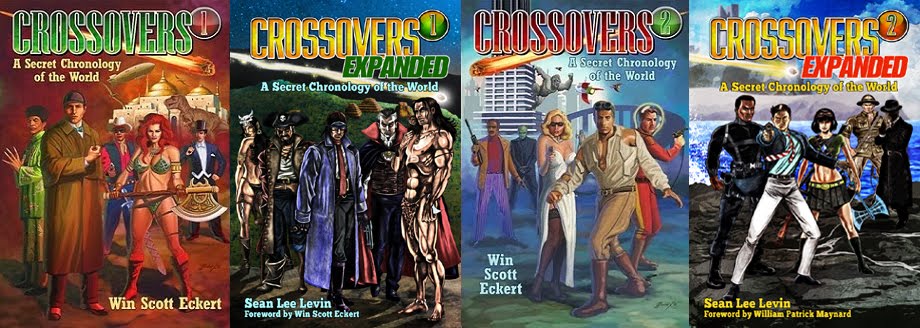
For more information, be sure to pick up my book Crossovers Expanded: A Secret Chronology of the World Volume 3 when it is published by Meteor House! Much like its predecessors, this latest volume is an AUTHORIZED companion to Win Scott Eckert's Crossovers: A Secret Chronology of the World Volumes 1 and 2!

Wednesday, January 6, 2016

Crossover Cover: Sherlock Holmes: The Crossovers Casebook

This anthology consists of stories featuring Holmes meeting other historical and fictional characters. One story, "Sherlock Holmes in the Lost World" by Martin Powell, originally appeared in the anthology Gaslight Grimoire, and was included in Volume 1 by Win. It's worth noting that this story references Farmer's theory that Lord John Roxton was the Spider's father. I covered Win's contribution, "The Adventure of the Fallen Stone," in a previous post. Here are the other stories that have Holmes meeting other characters from fiction. In Matthew Baugh's "The Adventure of the Ethical Assassin," Holmes is hired by the King of Bohemia once again, this time to protect him from an assassin. After preventing one such attempt, Holmes discovers the would-be assassin is a member of the Assassination Bureau, Ltd., led by Ivan Dragomilov. The assassin’s weapon is a device invented by the Russian hunter Zaroff. The Bureau and Dragomilov (originally Dragomiloff) are from Jack London’s novel The Assassination Bureau, Ltd., completed posthumously by Robert L. Fish. Zaroff is from Richard Connell’s short story "The Most Dangerous Game." In Christopher Sequeira's "The Scion of Fear," Holmes and Dr. Watson work with Inspector Athelney Jones and Jonathan Small to investigate a pair of attacks apparently committed by an Andaman Islands native like Small’s late confederate Tonga. Watson reveals to Mycroft Holmes the box which once held the Agra treasure has a hidden panel which opens to reveal three yellow diamonds. Mycroft says they are part of a series of four “moonstones” that adorned temple idols in India. He adds the fourth diamond was recovered years ago after much drama. Inspector Jones, Jonathan Small, and Tonga are from the Sherlock Holmes novel The Sign of Four. The diamonds are from Wilkie Collins’ novel The Moonstone. In Barbara Hambly's "The Adventure of the Sinister Chinaman," Watson, recovering from an illness, accompanies Holmes to San Francisco, where they become embroiled in an investigation of a Chinese-American magician who has been accused of kidnapping a young girl who was helping him perform a trick. They are aided by another stage magician, Professor Oscar Zoroaster Diggs, who is also a balloonist. Diggs claims to have spent the last forty years in a magical realm, and built a City of Emeralds and done battle with the Wicked Witch of the East and her minions. After the resolution of the case, Watson learns Professor Diggs looked exactly the same when he returned as when he disappeared forty years ago, and concludes the Professor that he and Holmes met was an impostor. He notes the alleged Professor disappeared a year later on another ballooning expedition. Professor O. Z. Diggs is better known as the Wizard of Oz. Of course, the Diggs who disappeared in the 1860s and the one who encountered Holmes and Watson are one and the same. In Matthew Mayo's "The Folly of Flight," Arsène Lupin recruits Sherlock Holmes and Dr. Watson to help him apprehend the murderer of a French aeronaut who has invented a remarkable airship. In Don Roff's "The House on Moreau Street," Holmes is abducted by Augustus Moreau, nephew of the notorious Dr. Moreau, whose beast-men have committed a series of murders in the course of robberies to finance Augustus’ experiments. Edward Prendick brought the elder Moreau’s predations to the public’s attention. Dr. John Thorndyke and Christopher Jervis, investigating the crimes independently from Holmes, wind up working with Dr. Watson to save Holmes. Thorndyke has Nathaniel Polton examine hair samples found at one of the crime scenes. Dr. Moreau and Edward Prendick are from H. G. Wells’ The Island of Doctor Moreau. Thorndyke, Jervis, and Polton appear in a series of books by R. Austin Freeman. In Joe Gentile's "The Secret of Grant's Tomb," Holmes and Watson, visiting Inspector Lestrade, are drawn into Professor Van Dusen and his sidekick Hutchinson Hatch’s investigation of the murder of a friend and fellow reporter of Hatch’s. The quartet, along with Lestrade and Inspector Conway, apprehend the culprit, master thief Bradlee Cunnyngham Leighton. Professor Augustus S. F. X. Van Dusen and Hutchinson Hatch are featured in the Thinking Machine stories by Jacques Futrelle. Cunnyngham and Conway appear in the Thinking Machine story "Problem of the Missing Necklace." In Martin Gately's "The Petrifying Well," Holmes accepts T. E. “Ned” Lawrence’s request to investigate the bizarre death of a friend’s brother. The planned Maracot expedition to the deep Atlantic is mentioned several times. The Maracot expedition is a reference to Arthur Conan Doyle’s The Maracot Deep, which takes place in 1926. Gately’s story "Rouletabille and the New World Order" explains why the expedition seen in this story (set two years after "The Adventure of the Lion's Mane," which Baring-Gould place in 1909) failed. Christopher Sequeira's other story, "The Adventure of the Lost Specialist," must be an AU. Holmes and Watson do battle with Professor Moriarty, who identifies himself as the stationmaster, and reveals both the Moriarty who Holmes dueled with at Reichenbach and Colonel Moriarty were actually his alternate reality counterparts. Moriarty than unleashes alternate versions of Holmes and Watson on the duo; one pair are meant to be Batman’s foes the Joker and the Penguin, while another pair are Dracula and Frankenstein’s Monster. Watson mentions Holmes’ actions in the affair of the depraved Herbert West and the grave-robberies in Essex County, Massachusetts, and also refers to Victor Savage’s uncle, the famous American doctor and adventurer. Given the story takes place in 1903, this most likely refers to the father of a certain bronze-skinned adventurer.

Saturday, August 22, 2015

Crossover Cover: Army of Darkness/Reanimator

Ash Williams time-travels to March 1922 from 2012 and meets Herbert West, who is later revealed to be the same West whom Ash has met before, having used the Necronomicon Ex Mortis to travel back in time. Ash previously met West in the stories Army of Darkness vs. Re-Animator and Prophecy. Jay Lindsey notes “This one takes some wrangling, since the implication is that the 2000s West is the one from Lovecraft’s original story. Since the Cthulhu Mythos timeline I generally refer to claims that West disappeared in 1921, I propose that the 2000s West attempted to use the Necronomicon to visit his ancestor, but due to some temporal quirk, missed his demise and ended up with amnesia, assuming the identity of the previous West.” Although the latter-day Herbert dies in this story, he is later resurrected via sorcery and returned to the 21st century via unrevealed means, as referenced in the Reanimator miniseries.

Friday, July 31, 2015

Crossover Cover: The Quest of Frankenstein

My good friend Frank Schildiner has had his first novel published by Black Coat Press, featuring Gouroull, the version of Frankenstein's Monster that appeared in novels by Jean-Claude Carriere. As one can see from reading the plot synopsis and the excerpt, Herbert West appears, as does Rondo Hatton's villain the Creeper. Frank assures me that there are a number of other crossovers in the book. I'm keeping my fingers crossed that Frank will have copies available for sale at Pulpfest/FarmerCon. Congrats to Frank, who has been kind enough to always put likes on my posts here when I've shared them on Facebook. :)

Sunday, March 29, 2015

Crossover of the Week


1935
THE GRAY REAPERS
            The Spider (aka Richard Wentworth) battles dead men brought back as zombies by an Egyptian cult. When Nita Van Sloan expresses astonishment at the idea of resurrecting the deceased, Wentworth cites a monograph on the subject by a Dr. West who works at a university in New England, and also notes that Savage claims to have revived an Egyptian mummy using a process involving tana leaf extract; however, the tana plant is extinct, and Savage used the last known specimens of the extract for his experiment.
            Short story by Matthew Baugh in The Spider: Extreme Prejudice, Joe Gentile and Tommy Hancock, eds., Moonstone Books, 2013. This story explains how the Spider’s chauffeur and aide Ronald Jackson appeared alive and well in the pulp novel Reign of the Death Fiddler and later novels after his death in The Pain Emperor. Both of the aforementioned novels were published in 1935. Dr. West is the title character of H.P. Lovecraft’s “Herbert West—Reanimator.” The university West teaches at is Miskatonic University, which is featured prominently in Lovecraft’s Cthulhu Mythos. Savage is Doc Savage, of course. Doc resurrected a mummy in the pulp novel Resurrection Day; however, both Philip José Farmer and Rick Lai’s Doc Savage chronologies place the events of that novel in 1936. Perhaps Doc resurrected a mummy in 1935 or earlier using the tana leaves, and turned to other methods when his supply ran out, leading to another mummy resurrection in 1936. Doc’s first revived mummy probably did not live very long. Tana leaves are from Universal Studios’ original cycle of Mummy films.

Sunday, March 15, 2015

Crossover of the Week


May 5, 1919
REVENGE OF THE REANIMATOR
            Robert Peaslee writes a letter to his wife Hannah describing his visit to Locus Solus in Montmartre, the estate of Dr. Martial Canterel. Peaslee, a native of Arkham, is met by a colleague of his, a young veteran named Gatsby. Peaslee mentions his father, Professor Nathaniel Peaslee. Canterel says that he believes a goggle-eyed light fixture he owns to be a piece of Nemo’s Nautilus. Canterel confuses Peaslee for Dr. Herbert West, a member of the faculty at Miskatonic, with whom he worked on a reagent long ago. His own reagent, Resurrectine, is based on their past work, and can bring the dead back to life. Canterel says that he infuses Vril energy into the reagent during formulation.
            Short story by Pete Rawlik in Tales of the Shadowmen Volume 10: Esprit de Corps, Jean-Marc and Randy Lofficier, eds., Black Coat Press, 2013; reprinted in French in Les Compagnons de l’Ombre (Tome 14), Jean-Marc and Randy Lofficier, eds., Rivière Blanche, 2014. Robert Peaslee, his wife Hannah, and his father, Professor Nathaniel Wingate Peaslee, are from H.P. Lovecraft’s “The Shadow Out of Time.” Arkham, Massachusetts and Miskatonic University play prominent roles in Lovecraft’s Cthulhu Mythos. Dr. Herbert West is from Lovecraft’s “Herbert West—Reanimator.” Locus Solus, Dr. Martial Canterel, and Resurrectine are from Raymond Roussel’s novel Locus Solus. Jay Gatsby is from F. Scott Fitzgerald’s The Great Gatsby. Captain Nemo and his Nautilus are from Jules Verne’s 20,000 Leagues Under the Sea and The Mysterious Island. The Vril energy is from Edward Bulwer-Lytton’s novel The Coming Race.

Saturday, September 20, 2014

Crossover Covers: Prophecy

This miniseries from Dynamite Entertainment involves Red Sonja being transported through time to the year 2012, where she fights her old foe Kulan Gath alongside Dracula, Vampirella, Pantha, Dr. Herbert West, Eva (daughter of Dracula), Athena (the Greek goddess), and Ash Williams. A series of flashbacks to 1890 features Sherlock Holmes and Dr. Watson, Allan Quatermain, and Dorian Gray, who possesses the same dagger wielded by Gath. As Sonja is thrown forward and backward through time, images of a number of other characters are seen, including Indiana Jones, the Three Musketeers, Quasimodo, and the Phantom. There are a number of other characters seen in these sequences that don't fit into CU continuity: Dynamite's version of the Green Hornet, which doesn't fit with the NOW Comics stories of the '80s and '90s; the company's take on Flash Gordon, which has a very different version of Flash's origin story; the Lone Ranger appearing alongside Zorro, a reference to the Dynamite miniseries The Lone Ranger: The Death of Zorro, which contradicts the circumstances of the latter hero's death in the movie The Mask of Zorro; the characters of Project Superpowers, a series featuring a number of Golden Age superheroes brought into the present day; and Evil Ernie, whose stories take place in a world devastated by nuclear war. I have chosen to interpret these as cross-promotional cameos and disregard them for the purposes of the CU.

Friday, January 31, 2014

Crossover Covers: Hack/Slash (Part 1)

Tim Seeley's comic Hack/Slash, starring slayer of slashers Cassie Hack and her hulking companion Vlad, has had a number of crossovers, including several with properties that have already been linked to the Crossover Universe. Among the famous (or infamous) individuals Cassie and Vlad have encountered are:

Chaos Comics' Evil Ernie, who exists in an alternate reality to Cassie's native Earth, but traveled to the CU for this story...

The killer Good Guy Doll Chucky, from the Child's Play film franchise...

The ghostly murderer Edgar Dill and his monstrous Treehugger creations, from Mark Kidwell's comic Bump (By the way, Evan Dorkin's Milk and Cheese only appear in a dream sequence in this story, and the massive destruction wrought by the "dairy products gone bad" in their own stories is incompatible with CU continuity, so this doesn't count as a workable crossover)...

The notorious Dr. Herbert West of Re-Animator fame...


The Living Corpse, a heroic zombie who battles supernatural evil. Interestingly, Cassie and the Corpse clearly knew each other prior to the events of this story, but the details of their first meeting have yet to be revealed...

And the would-be successors to a number of heroes from the Golden Age of Comic Books who have fallen into the public domain. Win and I have chosen to incorporate only a limited number of superheroes into the CU, based on the fact that a large number of superhuman beings running around violates the core premise that the CU, on the surface anyways, closely resembles the world outside our window. Any superheroes included are considered to be less powerful, active for a shorter period of time and much more covertly, and have had much less earth-shaking exploits than the comics depicted. The same can be assumed to be true of the heroes mentioned in this storyline, though most of the characters in question had no superpowers or very low-level ones.

To be continued tomorrow...