Showing posts with label Mycroft Holmes. Show all posts

Sunday, July 17, 2016

Crossover of the Week


October 1885
THE HOUND OF THE D’URBERVILLES
            Professor Moriarty and Colonel Moran are hired by Jasper Stoke-d‘Urberville, nephew of Simon Stoke-d’Urberville, to kill Red Shuck, the spectral hound that has allegedly haunted the d’Urberville family for generations. Appearing or mentioned are: the village of Trantridge; the Chase; Simon’s son Alexander; Theresa “Tess” Durbeyfield-Clare; Tess’ son Sorrow and siblings Abraham and Modesty; the city of Wintoncester; Selden; Desperado Dan’l; a terrifying Fat Man in Whitehall; Doctor Jack Quartz; Dr. Nikola; the Si-Fan; the Lord of Strange Deaths; the Grand Vampire; Les Vampires; Wessex; Diggory Venn; Parson Tringham; Car Darch; Sir Pagan d’Urberville; Melchester; Lord John Roxton; Casterbridge; the Ranee of Ranchipur; Blind Herder; Arnsworth Castle; Jim Lassiter; John Durbeyfield; the parish of Kingsbere; Sherton Abbas; Singapore Charlie; Marlott Churchyard; and Elizabeth-Louise Durbeyfield.
            Short story by Colonel Sebastian Moran, edited by Kim Newman in Professor Moriarty: The Hound of the d’Urbervilles, Titan Books, 2011. The village of Trantridge, Simon Stoke-d’Urberville, the Chase, Simon’s son Alexander, Theresa “Tess” Durbeyfield-Clare, Sorrow Durbeyfield, Abraham Durbeyfield, Modesty Durbeyfield, the city of Wintoncester, Parson Tringham, Car Darch, Sir Pagan d’Urberville, John Durbeyfield, the parish of Kingsbere, Marlott Churchyard, and Elizabeth-Louise (or Eliza-Louisa) Durbeyfield are from Thomas Hardy’s novel Tess of the d’Urbervilles. Diggory Venn is from Hardy’s novel The Return of the Native. Wessex is a fictional region of England that appears in most of Hardy’s novels. Melchester is from Hardy’s Two on a Tower and Jude the Obscure. Casterbridge is from Hardy’s The Mayor of Casterbridge. Sherton Abbas is from Hardy’s The Woodlanders. Selden is from Doyle and Watson’s The Hound of the Baskervilles. The terrifying Fat Man in Whitehall is Mycroft Holmes, Sherlock’s brother. Blind Herder is the blind mechanic Von Herder from the Holmes story “The Adventure of the Empty House.” “The Arnsworth Castle business” is an untold Holmes case mentioned in “A Scandal in Bohemia.” Desperado Dan’l is inspired by (though not the same person as) the British comic book cowboy Desperate Dan. Doctor Jack Quartz is the arch nemesis of dime novel detective Nick Carter. Dr. Nikola is from the series of novels by Guy Boothby. The Si-Fan and Singapore Charlie are from the Fu Manchu novels by Sax Rohmer; the Lord of Strange Deaths is Fu Manchu himself. Les Vampires are from the titular film serial directed by Louis Feuillade, as is their leader, the Grand Vampire. Lord John Roxton is from Doyle’s Professor Challenger stories. Ranchipur is from the film The Rains of Ranchipur. Jim Lassiter is from the novel Riders of the Purple Sage by Zane Grey. The month is given, but the year is conjecture based on the facts Moran has worked for Moriarty for some time and Selden is next seen as an escaped convict in 1888.

Monday, February 22, 2016

Crossover Cover: The Secret Casebook of Simon Feximal

This collection features occult detective Simon Feximal and his biographer and lover, Robert Caldwell. In "The Caldwell Ghost," Feximal says the Third Line of the Saaamaaa Ritual, on which he and his fellow ghost-hunter Carnacki had done such perilous research. The Saaamaa Ritual and Carnacki are from William Hope Hodgson’s Carnacki the Ghost-Finder. In "Remember, Remember," Mr. Lownie, editor of the Chronicle, tells Caldwell that Feximal is at Hartley House "with Miss Kay and Dr. Berry. Carnacki’s in Ireland chasing some haunting, else he’d be there too, I hear." According to Robert, "that list encompassed the best-known ghost-hunters in England, with the exception of the reclusive Dr. Silence." Dr. Silence is the title character of Algernon Blackwood's collection John Silence. In "Devils on Horseback," Feximal is a member of the Diogenes Club, to which he had been nominated by one of his more peculiar acquaintances, a Government man whose intellectual capacity is matched only by his corpulence. Both Simon and Caldwell are members of a club called the Remnant, whose members include Dr. Silence, Thomas Carnacki, and Dr. Nikola. The Diogenes Club and the corpulent Government man (Mycroft Holmes) are from the Sherlock Holmes stories. Nikola is a supervillain created by Guy Boothby. In "The Writing on the Wall," Feximal and Caldwell encounter the occultist Karswell. Dr. Silence appears, and the Saaamaaa Ritual and John Watson are mentioned. Karswell is from M. R. James’ story “Casting the Runes.” Dr. John Watson is Sherlock Holmes’ best friend and biographer.

Saturday, December 12, 2015

Crossover of the Week

HAPPY WOLD NEWTON DAY!!!

April 1917
THE ADVENTURE OF THE FALLEN STONE
Dr. Watson’s pregnant wife, Nylepthah, is staying with her cousin, Sir George Curtis. In 1919, Holmes would visit his old friend with a large financial payment from the English Lord of the Apes, the result of their adventure in Africa in 1916. Holmes’ gardener, Black Mike Croteau, has been murdered. After examining the body, Holmes and Watson are met at the former’s cottage by Harry Dickson, who has apprenticed with both Barker (Holmes’ Surrey rival) and Blake. He takes them to the Diogenes Club, where Holmes accuses his brother Mycroft of knowing there was a possibility he and Watson would be blown off course during the previous year’s African expedition he sent them upon. Holmes suggests Mycroft knew all along the ape lord was actually impersonating his deceased cousin, “William Clayton, the 7th Duke of Grey—.” Holmes points out Mycroft identified their flier, Leftenant John Drummond, as the great-nephew of Holmes’ old acquaintance, the 6th Duke. However, if Mycroft had been unaware of the imposture, he would have identified the Leftenant as the 6th Duke’s grandson. Mycroft reveals William Clayton was a government agent reporting directly to him, and William’s alleged shipwreck in Africa was actually part of his investigation. When he died, the Duke’s cousin, the ape lord, who had survived a prior shipwreck as an infant, assumed his identity, wishing to avoid the publicity attendant to the discovery of an English lord who had been reared and suckled by apes. The mission involved tracking down the German spy Von Bork and his bacillus. Holmes deduces Mycroft hoped he and Watson would encounter the ape lord and asks why. Holmes speculates it has to do with the many unlikely coincidences the ape man comes up against. Mycroft says their scientists call it “the human magnetic moment.” Holmes’ adversary, Dr. Shan Ming Fu, informed Holmes of the lotus vitae almost ten years ago. Holmes’ encounter with the ape man brought him into contact with the jungle man’s “human magnetic” influence, causing him to discover the lotus in the hidden valley of Zu-Vendis, though he asked Watson to omit that discovery from his written account. The lotus has been stolen from Holmes’ garden. Mycroft says if Holmes’ bees can be induced to sample the lotus’ nectar, a particular honey may result, which would be the key ingredient in a unique concoction. Holmes mentions the “Hellbirds” incident, in which Von Bork escaped, though Mycroft asked Watson to distort his account of these events so Von Bork fell to his death from the Eiffel Tower. Von Bork is being trailed by Sexton Blake. The mastermind of the theft is a man who has been known by many names, including Wolf Larsen, Karl Woldheim, and Carl Woldhaus; currently, he goes by the name of Baron Ulf Von Waldman. He is the Commandant of a seemingly inescapable German prison camp for those who have escaped from other camps and been recaptured. The Baron also conducts experiments on humans. There are rumors Von Waldman is the son of Professor Moriarty. Holmes, Watson, Dickson and Isis Vanderhoek travel to Blakeney House. Isis’ father was Mr. Klaw, “the dreaming detective.” Mycroft tells Sherlock that the Diogenes Club has recently become more focused on investigating outré and unexplainable matters that affect the Empire. The butler at Blakeney House gives Dickson a coded message from Blake, in which he says he has wired Peter Blakeney in Richmond (with whom he has common relatives dating back to the mid 17th century), and Blakeney House is at their disposal, with Blakeney Jr. off at war. Blake soon arrives with a captive Von Bork in tow. Holmes recalls the tale of Openshaw. Blake tells his comrades about several places of interest in the East Riding of Yorkshire, including the village of Wold Newton, where a meteor fell near Major Edward Topham’s property, the Wold Cottage, in 1795. Holmes decides they must visit the Wold Cottage and the monument Topham had placed at the site of the meteor’s fall. Holmes unmasks “Blake” as Von Waldman. Holmes and his allies free the true Blake, and discover some fragments of stone. Holmes concludes the Germans believe exposing the lotus vitae to the meteor fragments will result in the prolongation of human life. Isis mentions Holmes’ own cultivation of the plant. Von Waldman escapes from his bonds, taking the plant with him; however, Holmes still has seeds to grow more. When Watson asks Holmes if he thinks Von Waldman is really the son of Professor Moriarty, Holmes replies that Mycroft’s files on the Baron indicate that he was born in 1888, that he was investigating Moriarty quite thoroughly at that time, and that there was no indication of a child born to the Professor in that period. Dickson suggests Von Waldman may have been someone else, much older, who once had access to a similar elixir, but whose supply may have run out, leading him to attempt to find a means of duplicating it.
Short story by Dr. Watson, edited by Win Scott Eckert in Sherlock Holmes: The Crossovers Casebook, Howard Hopkins, ed., Moonstone Books, 2012. This story serves as a sequel to Watson’s account The Adventure of the Peerless Peer, as edited by Philip José Farmer. Watson’s wife Nylepthah and child are from that novel; Nylepthah is the daughter of Sir Henry Curtis from the Allan Quatermain stories (although Farmer says she is Curtis’ granddaughter, Eckert’s essay “Who’s Going to Take Over the World When I'm Gone?: A Look at the Genealogies of Wold Newton Family Super-Villains and Their Nemeses” [Myths for the Modern Age: Philip José Farmer’s Wold Newton Universe, Win Scott Eckert, ed., MonkeyBrain Books, 2005] argues she is in fact his daughter). Nylepthah’s cousin, Sir George Curtis, is from Farmer’s translation and adaptation of J.-H. Rosny aîné’s Ironcastle; Farmer specifically identifies Sir George as Sir Henry’s nephew. The ape lord is Lord Greystoke, of course. Harry Dickson is “the American Sherlock Holmes” who appeared in French pulp stories by Jean Ray and others. Holmes’ rival Cecil Barker first appeared in the story “The Adventure of the Retired Colourman”; Dickson acted as his apprentice in Eckert’s story “No Ghosts Need Apply” (The Phantom Chronicles, Vol. 2, Joe Gentile and Mike Bullock, eds., Moonstone Books, 2010). Sexton Blake is one of the longest-running British penny dreadful detectives; Dickson acted as his apprentice in Greg Gick’s story “The Werewolf of Rutherford Grange” (originally published in two parts in Tales of the Shadowmen Volume 1: The Modern Babylon, Jean-Marc and Randy Lofficier, eds., Black Coat Press, 2005, and Tales of the Shadowmen Volume 2: Gentlemen of the Night, Jean-Marc and Randy Lofficier, eds., Black Coat Press, 2006; reprinted in Harry Dickson and the Werewolf of Rutherford Grange, Black Coat Press, 2011). William Clayton, the 7th Duke of Greystoke, appears in Edgar Rice Burroughs’ novels Tarzan of the Apes and The Return of Tarzan; in his essay “A Case of Identity,” H. W. Starr identified the 6th Duke of Holdernesse and his son Lord Saltire from the Holmes story “The Adventure of the Priory School” as the 6th and 7th Duke of Greystoke, respectively, a theory adapted by Farmer for his biography Tarzan Alive. Leftenant Drummond is the jungle lord’s adopted son John Drummond-Clayton. Farmer identified the human magnetic moment in Tarzan Alive. Dr. Shan Ming Fu is Sax Rohmer’s Fu Manchu; Dennis E. Power revealed the Devil Doctor’s birth name in his essay “The Devil Doctor: The Early History of Fu Manchu,” found on the Wold Newton Universe: A Secret History website. The lotus vitae is the plant from which Fu Manchu’s life-prolonging Elixir vitae is derived; Fu Manchu told Holmes about the elixir in George Alec Effinger’s story “The Adventure of the Celestial Snows.” The honey is the Royal Jelly that, according to William S. Baring-Gould in his biography Sherlock Holmes of Baker Street, has extended Holmes’ natural lifespan. The Hellbirds incident refers to Austin Mitchelson and Nicholas Utechin’s Holmes pastiche Hellbirds. Wolf Larsen is from Jack London’s novel The Sea Wolf; in his essay “The Green Eyes Have It—Or Are They Blue? or Another Case of Identity Recased” (Myths for the Modern Age), Christopher Paul Carey argued Larsen and Baron von Hessel (from Farmer’s authorized Doc Wildman novel Escape from Loki) were really aliases of XauXaz from Farmer’s trilogy of novels about the evil secret society known as the Nine. In his essay “Asian Detectives in the Wold Newton Universe” (Myths for the Modern Age), Dennis E. Power instead offered the alternative theory Larsen was the son of Professor Moriarty. Isis and her father Moris Klaw are from Sax Rohmer’s book The Dream Detective. The Diogenes Club’s latter-day focus on outré matters is the subject of many stories by Kim Newman. Blakeney House is one of the holdings of the Blakeney family, whose most famous member is Sir Percy Blakeney, the Scarlet Pimpernel. Blakeney House previously appeared in Eckert’s stories “Is He in Hell?” (Tales of the Shadowmen Volume 6: Grand Guignol, Jean-Marc and Randy Lofficier, eds., Black Coat Press, 2010; reprinted and revised in The Worlds of Philip José Farmer 1: Protean Dimensions, Michael Croteau, ed., Meteor House, 2010) and “Nadine’s Invitation” (Tales of the Shadowmen Volume 7: Femmes Fatales, Jean-Marc and Randy Lofficier, eds., Black Coat Press, 2010). Peter Blakeney Jr. is Sir Percy’s descendant from The Pimpernel and Rosemary. In his series of articles “The Wold Wold West” (found at the Wold Newton Universe: A Secret History website), Dennis E. Power argued Sexton Blake was distantly related to the Blakeney family, a theory Eckert adopted for his essay “The Blakeney Family Tree” (The Worlds of Philip José Farmer 1). Openshaw is from the Holmes story “The Five Orange Pips.”
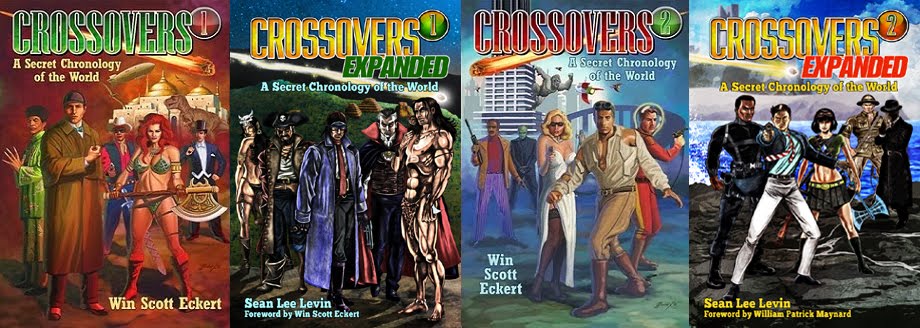
Saturday, December 5, 2015

Crossover Covers: Stoker and Holmes


This series is set in a Steampunk London (and therefore takes place in an AU), and features Alvermina “Mina” Holmes, Mycroft’s daughter and Sherlock’s niece, and Evaline Stoker, sister of Bram and descendant of Victoria Gardella Grantworth from Gleason’s series The Gardella Vampire Chronicles.

Sunday, November 8, 2015

Crossover of the Week

Early JanuaryMay 4, 1891
THE PROBLEM OF THE FINAL ADVENTURE
Colonel Sebastian Moran recounts the events leading to Professor Moriarty’s battle with Sherlock Holmes at the Reichenbach Falls. Appearing or mentioned are: Watson; Colonel Moriarty; the third James Moriarty; “an Irish spinster scribbler”; the Fat Man of Whitehall; the Diogenes Club; Billy the Page; Charlie Vokins; Lestrade; Mackenzie; MacDonald; Simon Carne; the Ranee of Ranchipur; the Lord of Strange Deaths; Fal Vale; Sophy Kratides; Harold Latimer and Wilson Kemp; Charles Milverton; Dan Levy; Les Vampires; the Grand Vampire; Irma Vep; Kingstead Cemetery; La Castafiore; Thomas Carnacki; Van Helsing; Bulstrode & Sons; Baron Maupertuis; quap; Mr. Beebe; the Daughter of the Dragon; Doctor Nikola; Madame Sara; Margaret Trelawny; the Hoxton Creeper; Doctor Mabuse; Alraune ten Brincken; Arthur Raffles and Bunny Manders; Théophraste Lupin and Joséphine Balsamo, Countess Cagliostro; Doctor Jack Quartz and Princess Zanoni; Rupert of Hentzau; Irene Adler; the Si-Fan; Queen Tera; the Jewel of Seven Stars; the Black Pearl of the Borgias; the Duke of Shires; Dr. Syn; Barchester Cathedral; the Forsyte tomb; Colonel Clay; Jim Lassiter; Diggory Venn; Sir Augustus Moran; Von Herder; a skull-faced “ghost” in the khanum’s palace at Mazenderan; Parker; the Reverend John Jago; the Mountmains; Colonel Sapt; Princess Flavia; Birdy Edwards; Grimesby Roylott; John Clay; Bert Stevens; Fred Porlock; Birlstone Manor; Paul Kratides; Ruritania; Rudi; Michael; Rassendyll; The Englischer Hof; and Peter Steiler. The endnotes to the story reveal Kate Reed ghosted for her friend and later lover, Charles Beauregard, and the Diogenes Club traded as Universal Exports in the 1950s. Paul Forrestier is mentioned in the same endnote.
Short story by Colonel Sebastian Moran, edited by Kim Newman in Professor Moriarty: The Hound of the d’Urbervilles, Titan Books, 2011. Moriarty, Moran, Holmes, Watson, the Fat Man of Whitehall (Sherlock’s brother Mycroft), the Diogenes Club, Billy the Page, and Lestrade are from the Sherlock Holmes stories. Further references from the Holmes stories: Colonel Moriarty, Inspector Patterson, the Englischer Hof, and Peter Steiler from “The Final Problem”; the third James Moriarty (the stationmaster, later known as the second Professor Moriarty), MacDonald, Birdy Edwards, Fred Porlock, and Birlstone Manor from The Valley of Fear; Sophy Kratides, Harold Latimer, Wilson Kemp, and Paul Kratides from “The Adventure of the Greek Interpreter”; Charles Milverton from “The Adventure of Charles Augustus Milverton”; Baron Maupertuis, mentioned in “The Adventure of the Reigate Squire”; the Black Pearl of the Borgias from “The Adventure of the Six Napoleons”; Sir Augustus Moran, Von Herder, and Parker from “The Adventure of the Empty House”; Grimesby Roylott from “The Adventure of the Speckled Band”; John Clay from “The Adventure of the Red-Headed League”; and Bert Stevens from “The Adventure of the Norwood Builder.” Moran’s claim he shot Moriarty as the latter grappled with Holmes at Reichenbach must be considered spurious; Holmes would surely have noticed, and The League of Extraordinary Gentlemen depicts Moran and Campion Bond tending to Moriarty after his plunge down the falls. Moran must have lied to conceal the fact the Professor survived his painful fall. The “Irish spinster scribbler” is Kate Reed, a “deleted” character from Dracula who appears in several stories by Newman, and also has a counterpart in the Anno Dracula Universe. Charlie Vokins is from “The Horizontal Witness,” an episode of the television series Cribb. Arthur Raffles, Bunny Manders, and Mackenzie are from the Raffles stories by E. W. Hornung. Dan Levy is from the novel Mr. Justice Raffles. Given that Philip José Farmer identified Raffles as the father of Arthur Upfield’s Inspector Napoleon Bonaparte, Moran and Sophy must be mistaken about Raffles and Bunny’s sexual orientation. Simon Carne is from Guy Boothby’s collection of stories A Prince of Swindlers. Ranchipur is from the film The Rains of Ranchipur. The Lord of Strange Deaths is Fu Manchu; the Si-Fan is the criminal organization Fu Manchu runs. The Daughter of the Dragon is presumably meant to be Fu Manchu’s daughter, Fah Lo Suee; however, this conflicts with Fah’s established birthdate of 1896. Fu must have had another daughter before Fah Lo Suee. Fal Vale is from Arnold Ridley’s play The Ghost Train. Les Vampires, the Grand Vampire, and Irma Vep are from Louis Feuillade’s serial Les Vampires. Kingstead Cemetery and Van Helsing are from Stoker’s Dracula. La Castafiore is Bianca Castafiore from Hergé’s Tintin comics. Thomas Carnacki, “the Ghost-Finder,” was created by William Hope Hodgson. Bulstrode & Sons is a reference to the British sitcom That’s Your Funeral. Quap is a radioactive compound from H. G. Wells’ novel Tono-Bungay. Mr. Beebe is from E. M. Forster’s novel A Room with a View. Doctor Nikola is the master criminal created by Guy Boothby. Madame Sara is from L. T. Meade and Robert Eustace’s The Sorceress of the Strand. Rick Lai has identified Madame Sara as the mother of Miss Warrender from Doyle’s short story “Uncle Jeremy’s Household” in his own fiction, and therefore Moran is wrong about Sara’s sexuality as well as Raffles and Bunny’s. Margaret Trelawny, Queen Tera, and the Jewel of Seven Stars are from Bram Stoker’s The Jewel of Seven Stars. The Hoxton Creeper is from the Sherlock Holmes film The Pearl of Death. Doctor Mabuse is the subject of fiction by Norbert Jacques, as well as a film trilogy by Fritz Lang. Alraune ten Brincken is from the novel Alraune by Hanns Heinz Ewers. Théophraste Lupin is the father of Maurice Leblanc’s gentleman thief Arsène Lupin, while Joséphine Balsamo is Arsène’s future nemesis. Doctor Jack Quartz and Princess Zanoni are foes of dime novel detective Nick Carter. Rupert of Hentzau, Colonel Sapt, Princess Flavia, Ruritania, Rudi (Rudolf V), Michael (Black Michael), and Rassendyll (Rudolf Rassendyll) are from The Prisoner of Zenda and Rupert of Hentzau by Anthony Hope. The Duke of Shires is from the Sherlock Holmes film A Study in Terror. Dr. Syn, aka the Scarecrow of Romney Marsh and Captain Clegg, is from the series of novels by Russell Thorndike. Barchester Cathedral is from Anthony Trollope’s Chronicles of Barsetshire novels. The Forsyte Saga is a series of novels by John Galsworthy. Colonel Clay is from the novel An African Millionaire by Grant Allen. Jim Lassiter is from Zane Grey’s novel Riders of the Purple Sage. Diggory Venn is from Thomas Hardy’s The Return of the Native. The skull-faced “ghost” in the khanum’s palace at Mazenderan is the Phantom of the Opera, from the novel by Gaston Leroux. The Reverend John Jago is an ancestor of Anthony Jago from Newman’s novel Jago, and also has a counterpart in the Anno Dracula Universe. Paul Forrestier is also from Jago. The Mountmains are likely kin to the Mountmains who appear in Newman’s Seven Stars. Charles Beauregard is from Newman’s Diogenes Club stories, and has a counterpart in the Anno Dracula Universe. In Billy Wilder’s film The Private Life of Sherlock Holmes, the Diogenes Club was portrayed as a front for the British Secret Service, a theory Newman has adopted for his own fiction; here, it is revealed the Club eventually became Universal Exports, the front for the BSS in Ian Fleming’s James Bond novels. However, the BSS must have still privately used the Club’s name at times, as demonstrated by Richard Jeperson’s exploits.

Sunday, September 27, 2015

Crossover of the Week

1898
A PROFESSIONAL MATTER
In 1902, Adam Adamant tells Sherlock Holmes and Dr. Watson the tale of how Inspector Ganimard recruited him to apprehend Arsène Lupin four years ago. A Collector received a note warning Lupin would rob him of his green paste idol of Princess Hermonthis. Adamant meets Inspector Ledoux at the scene of a murder. The victims are members of the Diogenes Club, in Paris on orders from Mycroft Holmes. The Collector gives a grimoire to Griffin, an invisible English scientist who is currently in league with a cult of Nyarlathotep worshippers. The grimoire was written by Charles le Sorcier, an alchemist and magician, the son of Michel Mauvais. Adamant heard about Nyarlathotep and his follower Pharaoh Nephren-Ka from the Curator at Miskatonic University. Adamant receives a letter from Lupin, revealing the thief had impersonated the real Ledoux, who died in 1879 while hunting the Phantom of the Opera.
Short story by Sam Shook in Tales of the Shadowmen Volume 11: Force Majeure, Jean-Marc and Randy Lofficier, eds., Black Coat Press, 2014. Adam Adamant is from the 1960s BBC television series Adam Adamant Lives! Sherlock Holmes, his brother Mycroft, Dr. Watson, and the Diogenes Club are from Arthur Conan Doyle’s stories. The Collector and the idol of Princess Hermonthis are from Théophile Gautier’s short story “The Mummy’s Foot.” Inspector Ledoux is from the 1925 film version of Gaston Leroux’s novel The Phantom of the Opera. Griffin is from H. G. Wells’ classic science fiction novel The Invisible Man. After escaping Adamant and Lupin’s clutches in this story, Griffin returns to England, where he takes up residence in a private girl’s school, as seen in The League of Extraordinary Gentlemen, Volume I. Nyarlathotep, Charles le Sorcier, Michel Mauvais, and Nephren-Ka are from the works of H. P. Lovecraft.

Sunday, August 9, 2015

Crossover of the Week


Summer 1945
ACCORDING TO PLAN OF A ONE-EYED TRICKSTER
            Richard Henry Benson, alias the Avenger, is visited by American government agent Tony McKay and a British agent named Jim. Jim tells Benson that almost thirty years ago, Sherlock Holmes, whose brother was then head of the British Secret Service, fought a man called Baron Ulf Von Waldman, who appears to be the same person as Dr. Walden, whom Benson encountered last month. Walden’s ally in his battle with Benson was the Countess Lilya Zarov. Walden has demanded that Benson and his own ally in their previous conflict, the Domino Lady, come to him. Walden is renting Stonecraft Castle. One of Walden’s past aliases is Larsen. Walden states that Benson is a great scientist, perhaps second only to another who lives in New York. Zarov once had her back broken by an enemy who was escaping from a prison camp Walden ran during the Great War. Prior to that, this enemy had slept with her, resulting in a pregnancy. Lilya used her shape-changing abilities, inherited from an extraterrestrial mother, to heal her injuries. Another member of her mother’s race was defeated by “a doltish ‘gentleman thief’” in the 1890s. Lilya’s son went on to battle his hated father, who did not realize the truth about his parentage, as the son had changed his features so that he would appear older. At the conclusion of the battle, Walden alludes to a future encounter with Benson’s daughter.
            Short story by Win Scott Eckert in The Avenger: Roaring Heart of the Crucible, Nancy Holder and Joe Gentile, eds., Moonstone Books, 2013. This story completes the trilogy begun by Eckert with his stories “Death and the Countess” (The Avenger Chronicles, Joe Gentile and Howard Hopkins, eds., Moonstone Books, 2008) and “Happy Death Men” (The Avenger: The Justice, Inc. Files, Joe Gentile and Howard Hopkins, eds., Moonstone Books, 2011.) Tony McKay is from Sax Rohmer’s novel Emperor Fu Manchu. “Jim” is James Bond. Sherlock Holmes’ encounter with “Baron Ulf von Waldman” was chronicled by Dr. Watson in his tale “The Adventure of the Fallen Stone” (Sherlock Holmes: The Crossovers Casebook, Howard Hopkins, ed., Moonstone Books, 2012), edited by Eckert. Holmes’ brother, Mycroft, was portrayed as the head of the British Secret Service and one of the first to hold the title of “M” (a reference to the James Bond novels) in John T. Lescroart’s novels Son of Holmes and Rasputin’s Revenge, as well as Alan Moore and Kevin O’Neill’s comic book series The League of Extraordinary Gentlemen. Dr. Karl Walden, alias Baron Ulf Von Waldman, is meant to be Baron von Hessel from Philip José Farmer’s authorized Doc Savage novel Escape from Loki. In his essay “The Green Eyes Have It – Or Are They Blue?” (Myths for the Modern Age: Philip José Farmer’s Wold Newton Universe, Win Scott Eckert, ed., MonkeyBrain Books, 2005), Christopher Paul Carey argued that the Baron and Wolf Larsen (from Jack London’s The Sea-Wolf) were aliases of the immortal XauXaz from Farmer’s trilogy of novels about the ancient society known as the Nine, a theory elaborated upon and modified by Eckert in his story “The Wild Huntsman” (The Worlds of Philip José Farmer 3: Portraits of a Trickster, Michael Croteau, ed., Meteor House, 2012), among others. Countess Lilya Zarov is meant to be Lili Bugov, Countess Idivzhopu, from Escape from Loki; the use of the surname Zarov is meant to imply that she is related to General Zaroff from Richard Connell’s story “The Most Dangerous Game.” In his essay “Who’s Going to Take Over the World When I’m Gone?” (Myths for the Modern Age), Eckert argued that Doc Savage’s nemesis John Sunlight was the result of Lili and Doc’s sexual encounter in Escape from Loki; the shape-changing abilities shared by mother and child explain how Lili was able to recover from her crippling and disfiguring injuries suffered at the climax of that novel, as well as why Lester Dent claimed in The Fortress of Solitude that Sunlight “was not a young man,” despite the fact that he would have been only eighteen years old at that time. Doc Savage is the New York resident who is possibly a greater scientist than Benson. The Domino Lady, created by Lars Anderson, is one of the most well-known pulp heroines. Stonecraft Castle was formerly owned by James D. Stonecraft, an oil magnate obsessed with immortality, who appears in Farmer’s authorized Tarzan novel The Dark Heart of Time. The “doltish ‘gentleman thief’” is A.J. Raffles; his encounter with a member of Lili’s mother’s race was recounted by his amanuensis Harry “Bunny” Manders in “The Problem of the Sore Bridge – Among Others,” edited by Farmer. The Avenger and the Domino Lady’s future daughter, Helen Benson, was first mentioned in Farmer and Eckert’s novel The Evil in Pemberley House. The title of this story is a play on that of the Doc Savage pulp novel According to Plan of a One-Eyed Mystic.

Wednesday, February 12, 2014

Crossover Covers: Enter the Lion

According to William S. Baring-Gould's Sherlock Holmes of Baker Street, Sherlock's older, much heavier, and even more brilliant brother Mycroft was born on February 12, 1847. Therefore, in honor of Mycroft's 167th birthday, here is the cover to an account of one of his exploits alongside Sherlock (who had yet to meet Dr. Watson), edited by Michael P. Hodel and Sean M. Wright. At one point, fighting ships such as the more recent four-deckers of Nelson and Hornblower are mentioned, providing further evidence that C.S. Forester's naval hero Horatio Hornblower is in the Crossover Universe. (It is worth noting that Philip José Farmer stated in Tarzan Alive that Tarzan's son married Hornblower's great-great-granddaughter.) There is an apparent continuity conflict between this novel and Farmer's work: Farmer identified Professor James Moriarty as the illegitimate son of housemaid Morcar Moriarty in Doc Savage: His Apocalyptic Life, whereas this account identifies his father as Jerrold Moriarty, who plays a prominent role in the tale. Win Eckert reconciled the two versions by stating that Jerrold was actually Urania's brother, and a beloved uncle and father-figure to James.