Showing posts with label The Phantom of the Opera. Show all posts

Sunday, May 12, 2024

Crossover of the Week

May 26, 1846

THE LAMENT OF THE DUKE AND THE KING 

The so-called Duke of Bridgewater and King of France hop a train, and in the process meet Doctor Omega and his companion Miki. The Doctor gives the conductor a Hynerian sixteen harzmo gold piece. They are joined by the Doctor's other companion, the Steel General. The King says he is the long-lost Dauphin of France, and that he used to be visited by a woman named Madame LaFarge. The Chevalier de Maison-Rouge allegedly tried to rescue the King’s mother. An artist named La Salle was sent by the Baron de Batz to rescue the Dauphin and replace him with a lookalike. When he nearly drowned, a man named Moreau rescued him. The General claims he incited Moreau’s animal people to revolt, but the Doctor clarifies that the King means Andre-Louis Moreau, who he and Miki saw costar with Marguerite St. Just in a play called Don Juan Triumphant in 1791. De Batz was working with the Scarlet Pimpernel, who the Duke claims was the Prince-Regent’s butler, Mr. Edmund Blackadder. The Pimpernel turned the Dauphin over to a smuggler dressed as a scarecrow, who handed him off in turn to an American named Bumppo. The Doctor refers to Miki’s colossal, radioactive, reptilian friend, and says General Santa Anna has the services of an evil scientist named Dr. Campos, who has uncovered a mind control device left on Earth centuries ago by an alien named Kukulcan. 

Short story by Matthew Baugh in Tales of the Shadowmen Volume 12: Carte Blanche, Jean-Marc and Randy Lofficier, eds., Black Coat Press, 2015; reprinted in French in Les Compagnons de l’Ombre (Tome 20), Jean-Marc Lofficier, ed., Rivière Blanche, 2017. The Duke of Bridgewater and the King of France are from Mark Twain’s Adventures of Huckleberry Finn. Doctor Omega is the title character of Arnould Galopin’s novel. Miki Saegusa is from the Godzilla movies. Although the massive level of destruction seen in the films does not fit into the CU, other crossovers indicate a version of Godzilla exists in the CU whose exploits are much less Earth-shattering. The Hynerian Empire is from the television series Farscape. The Steel General is from Roger Zelazny’s Creatures of Light and Darkness. Madame LaFarge (or rather DeFarge) is from Charles Dickens’ A Tale of Two Cities. The Chevalier de Maison-Rouge is from Alexandre Dumas’ eponymous novel. Florence de La Salle is from Rafael Sabatini’s The Lost King. The Baron de Batz is a historical figure who appears in both that book and Sabatini’s Scaramouche, whose title character is really Andre-Louis Moreau. The other Moreau and his animal people are from H. G. Wells’ The Island of Doctor Moreau. Marguerite St. Just is the wife of Sir Percy Blakeney, aka Baroness Orczy’s hero the Scarlet Pimpernel. The play Don Juan Triumphant is the basis for the opera of the same name penned by the title character of Gaston Leroux’s The Phantom of the Opera. Edmund Blackadder is from the television series Blackadder the Third. The smuggler dressed as a scarecrow is Russell Thorndike’s Dr. Syn, aka Captain Clegg and the Scarecrow of Romney Marsh. Natty Bumppo is from James Fenimore Cooper’s The Leatherstocking Tales. Dr. Campos is from the movie Santo Contra Hombres Infernales. Kukulcan is from the Star Trek: The Animated Series episode “How Sharper Than a Serpent’s Tooth” and the Tarzan, Lord of the Jungle episode “Tarzan and the Space God.” 

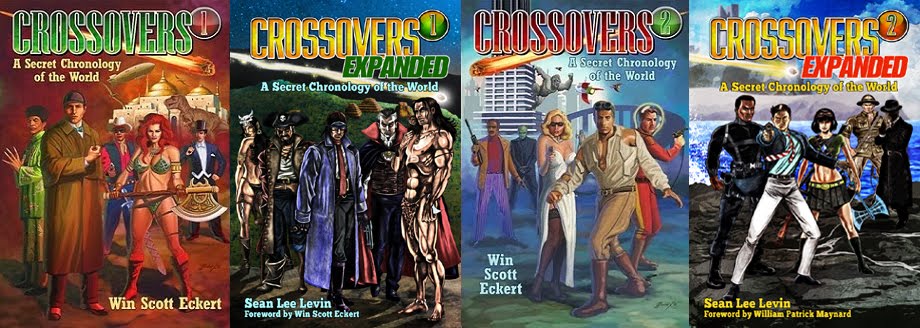
This crossover writeup is one of over a thousand appearing in my book Crossovers Expanded: A Secret Chronology of the World Volume 3, coming this summer from Meteor House! All three volumes are AUTHORIZED companions to Win Scott Eckert's Crossovers: A Secret Chronology of the World Volumes 1 and 2!

Wednesday, May 1, 2024

Bonus Crossover of the Week (RIP Rick Lai)

Autumn 1866

THE TOMB OF THE VEILED PROPHET 

Anis-ed-Dowleh, the Shah of Persia’s favorite wife, shows Haji Abdu, the Daroga of the Secret Police, the corpse of a handmaiden allegedly murdered by Erik, the court illusionist. Erik mentioned to the Shah’s spouse he had been trained to kill with the Punjabi lasso by the deposed Maharani of Pankot. Haji Abdu and Erik discuss the rebel leader Mokanna, whose cult was led by Abd Dhulma after his death. Erik shows the Daroga a map he acquired in the mountain citadel Yolgan, which has the words, “The Lord of the Empty Abode,” “The Lord of Illusion,” and “The Lord of the Fourth Axis” written on it. Mokanna appears to the duo, saying they have resurrected him by summoning the Three Avatars of Yog-Sothoth. Mokanna names the sorcerers of Lemuria and Attluma, including Thulsa Doom, Kathulos, Rotath, Mardanax, and Descales, each of whom performed the Black Litany to infuse their souls with the Torch Fire of Nug. Erik’s nom de guerre is derived from Erlik of the Dark Star, whom Mokanna describes as a minor entity eclipsed by the cosmic splendor of the Lord of the Fourth Axis and his twin spawn, Nug and Yeb. Mokanna evokes the Moon of Yian, saying Nug demands a Red Offering in exchange for bestowing his Torch Fire upon Erik. 

Short story by Rick Lai in Tales of the Shadowmen Volume 12: Carte Blanche, Jean-Marc and Randy Lofficier, eds., Black Coat Press, 2015; reprinted in French in Les Compagnons de l’Ombre (Tome 20), Jean-Marc Lofficier, ed., Rivière Blanche, 2017. Haji Abdu is from Sir Richard Francis Burton’s poem “The Kasîdah of Hâjî Abdû El-Yezdî.” He is also mentioned in Philip José Farmer’s authorized Doc Savage novel Escape from Loki. Lai conflates Haji Abdu with the Persian from Gaston Leroux’s The Phantom of the Opera. Erik is the title character of that book. Pankot is from the movie Indiana Jones and the Temple of Doom. Mokanna is from “The Veiled Prophet of Khorassan,” the first of four poems in Thomas Moore’s collection Lalla-Rookh, as well as Sax Rohmer’s The Mask of Fu Manchu. Abd Dhulma is from G. G. Pendarves’ “Abd Dhulma, Lord of Fire.” Yolgan is from Robert E. Howard’s El Borak stories. The Lord of the Empty Abode is the title of Yog in Robert E. Howard’s Conan story “Shadows in Zamboula.” “The Lord of Illusion” and “The Lord of the Fourth Axis” are stories by E. Hoffmann Price. Here, the three Lords are all avatars of Yog-Sothoth, one of the Great Old Ones of H. P. Lovecraft's Cthulhu Mythos. Attluma and Descales are from the works of David C. Smith. Thulsa Doom is from Howard’s Kull tale “The Cat and the Skull.” Kathulos is from Howard’s “Skull-Face” and “Taverel Manor,” the latter completed posthumously by Richard A. Lupoff. Rotath is from the Kull story “The Curse of the Golden Skull.” Mardanax is from Lin Carter’s Thongor novels. Nug and Yeb are from various Lovecraft collaborations: “Out of the Aeons” (co-written by Hazel Heald), “The Mound” (coauthored by Zealia Bishop), and “The Last Test” (co-penned by Adolph de Castro). The Black Litany of Nug and Yeb is from Joseph S. Pulver’s poem of the same name. Erlik of the Dark Star is from Robert W. Chambers’ The Dark Star. The Moon of Yian is from Chambers’ “The Maker of Moons.” The Red Offering is from Lin Carter’s Cthulhu Mythos story of the same name. 

As I wrote on Facebook yesterday, RIP my friend Rick Lai, an amazing human and writer. In the 1980s, he wrote articles expanding on the Wold Newton concepts of Philip Jose Farmer and continued it after the Wold Newton websites began appearing with Win Scott Eckert’s in 1997. He broke into fiction writing beginning with the story “The Last Vendetta” in the first TALES OF THE SHADOWMEN anthology, and consistently turned out quality work. I am honored to have had my first published story in close proximity to his contribution in the last TALES. I was constantly in awe of the depth of his knowledge and retention of pop cultural details, and I genuinely believe he was a genius. We also shared a love of Spaghetti Westerns, which he drew from often in his fiction. I’m in shock right now, and I am deeply saddened that I will never see him again. FarmerCon this year will be bittersweet without him.

Sunday, November 26, 2023

Crossover of the Week

Summer 1888

THE CASE OF MRS. NORTON 

The former Irene Adler hires Erik’s Opera Ghost Agency (whose current operatives are Ayda Heidari, Ysabel de Ferre, and Hagar Stanley) to determine whether her husband Godfrey Norton is the good man he appears. Appearing or mentioned are the Persian; the Countess de Cagliostro; Liddle, Neal, & Liddle; the King of Bohemia; A. J. Raffles; Professor Moriarty; Sherlock Holmes; Trilby; Coppélius; Spallanzani; Olympia; Irma Vep; Les Vampires; La Marmoset; and Mr. Calhoun. 

Story by Kim Newman in Angels of Music, Titan Books, 2016. Erik and the Persian are from Gaston Leroux’s The Phantom of the Opera. Irene Adler, her husband Godfrey Norton, and the King of Bohemia are from Doyle and Watson’s Sherlock Holmes tale “A Scandal in Bohemia.” Ayda Heidari is the future wife of Bob Ferguson from “The Adventure of the Sussex Vampire.” Professor Moriarty is Holmes’ greatest foe. Ysabel de Ferre is a foe of detective Sexton Blake. Hagar Stanley is from Fergus Hume’s Hagar of the Pawn-Shop. Josephine Balsamo, the Countess of Cagliostro, is the archenemy of Maurice Leblanc’s gentleman burglar Arsène Lupin. Liddle, Neal, & Liddle is from Arthur Morrison’s Martin Hewitt story “The Case of Laker, Absconded.” A. J. Raffles is E. W. Hornung’s amateur cracksman. Trilby O’Ferrall is from George du Maurier’s Trilby. Coppélius, Spallanzani, and Olympia are from Jacques Offenbach’s opera Tales of Hoffmann. Irma Vep and Les Vampires are from Louis Feuillade’s silent film serial named for the latter. La Marmoset and Mr. Calhoun are from Albert W. Aiken’s “La Marmoset, the Detective Queen; or, The Lost Heir of Morel.” 

This crossover writeup is one of hundreds included in my book Crossovers Expanded: A Secret Chronology of the World Volume 3, which will be published by Meteor House! All three volumes are AUTHORIZED companions to Win Scott Eckert's Crossovers: A Secret Chronology of the World Volumes 1 and 2!

Saturday, November 18, 2023

Crossover Cover: A Touch of Fever


Are you a fan of the TV series Warehouse 13?

Then you'll love this tie-in novel, which has nods to Robert Louis Stevenson's Treasure Island, W. W. Jacobs' "The Monkey's Paw," Lewis Carroll's Through the Looking-Glass, Meredith Willson's musical The Music Man, and Gaston Leroux's The Phantom of the Opera!

For more details, be sure to pick up a copy of my book Crossovers Expanded: A Secret Chronology of the World Volume 3 when Meteor House publishes it! All three volumes are AUTHORIZED companions to Win Scott Eckert's Crossovers: A Secret Chronology of the World Volumes 1 and 2!

Sunday, September 10, 2023

Crossover of the Week

April 1923

THE HAUNTING OF DREARCLIFF GRANGE SCHOOL 

Drearcliff Grange School student Amy Thomsett, aka the Kentish Glory, and her fellow members of the Moth Club take part in the Great Game, an annual contest of skill between their school and others and must deal with the mysterious ghostly figure known as the Broken Doll. Appearing or mentioned are: Lucinda Tregellis-d’Aulney, aka the Aviatrix; Dr. Shade; Ariadne; Richard Cleaver, aka Clever Dick; the Diogenes Club; Janice Marsh; the Black Sow of Under-London; the Undertaking; Miss Violet “Fossil” Borrodale; Dennis Rattray, aka Blackfist; Maurice Wyvil; Moll Flanders; the Old Jago; Bert Stevens; Enoch Drebber; Lauriston Gardens; Jefferson Hope; Dr. Watson; the Splendid Six; Lord Piltdown; Jennifer God; Lord Leaves; Hans von Hellhund; Number 347, Piccadilly; Geoffrey Jeperson; Count DeVille; “Necro-nommi-con des Mortis”; Valmouth; the Hurstpierpoint Hotel; Sir Wilfrid Teazle; Mark Robarts’ A Counterblast to Agnosticism; Brichester; Colonel Clay; Sophy Kratides; Graustark; “a cove with either too many or too few names”; the Moriarty Mob; Sebastian Moran; Johnny Barlowe; the Opera Ghost Agency; Erik de Boscherville, aka the Phantom; Silver Blaze; Uncle Satt; Thomas Carnacki; the Mausoleum; the Royal North Surrey Regiment; Sir Boris de Bruin; the Department of Supplies; Sally Nikola’s dad; a Rolls-Royce ShadowShark; Colonel Zenf; Mr. John Bronze; the Angel Down Changeling; Queen Tera; the Mystic Maharajah; Lydia Marlowe; Anne Sercombe; Anne D’Arbanvilliers-Cleaver; Cassandra, Heather, and Priscilla Wilding; Thelma Guildmar; Giulietta Nefaria; Vera Claythorne; and Cunegonde Quive-Smith. 

Novel by Kim Newman, Titan Books, 2018. The Splendid Six, consisting of the Aviatrix, Clever Dick, Blackfist, Lord Piltdown, the Blue Streak, and the Mystic Maharajah, are from Newman’s Diogenes Club story “Clubland Heroes.” Hans von Hellhund is also from that story; an AU counterpart is mentioned in “Coastal City.” Dr. Shade is from Newman’s “The Original Dr. Shade.” Ariadne is from Newman’s Bad Dreams. The Diogenes Club and Sophy Kratides are from Doyle and Watson’s Sherlock Holmes story “The Adventure of the Greek Interpreter.” Bert Stevens is from the Holmes story “The Adventure of the Norwood Builder.” Enoch Drebber, Lauriston Gardens, and Jefferson Hope are from Holmes’ first appearance, A Study in Scarlet. Colonel Sebastian Moran is Professor Moriarty’s lieutenant from “The Adventure of the Empty House.” Silver Blaze is from the Holmes tale “The Adventure of Silver Blaze.” The Undertaking is from the Diogenes Club stories “Angel Down, Sussex” and “Sorcerer Conjurer Wizard Witch.” The Angel Down Changeling is from the former story. The Mausoleum is from the latter story. Violet Borrodale is from Newman’s “Richard Riddle, Boy Detective in ‘The Case of the French Spy.’” Janice Marsh, a member of the Marsh family seen in H. P. Lovecraft’s “The Shadow over Innsmouth,” is from Newman’s “The Big Fish” and “Another Fish Story.” The Black Sow of Under-London is the Beast of London from Neil Gaiman’s Neverwhere. Maurice Wyvil is from William Harrison Ainsworth’s Old St. Paul's. Moll Flanders is the title character of Daniel Defoe’s novel. The Old Jago is from Arthur Morrison’s A Child of the Jago. “Jennifer God” is a reference to vampire Geneviève Dieudonné from the Diogenes Club stories, who also has a counterpart in the Anno Dracula Universe. Lord Leaves is from the Diogenes Club stories “Soho Golem" and “Cold Snap.” Number 347, Piccadilly was Dracula’s home in London in Bram Stoker’s novel. “Count DeVille” was the alias Dracula used to buy the house. Geoffrey Jeperson is the adoptive father of Richard Jeperson, a 1960s and 1970s agent of the Diogenes Club seen in Newman’s The Man from the Diogenes Club. Richard Jeperson drives a Rolls-Royce ShadowShark. “Necro-nommi-con des Mortis” is a reference to the Necronomicon Ex Mortis from the Evil Dead movies; the book appears under the variant name Necronomicon des Mortes in the Angel episode "Hell Bound." Valmouth is from Ronald Firbank’s novel of the same name. One of the characters in the book is Mrs. Eulalia Hurstpierpoint. Sir Wilfrid Teazle is an ancestor of Louise Magellan Teazle from Newman’s An English Ghost Story. Mark Robarts is from Anthony Trollope’s Framley Parsonage. A Counterblast to Agnosticism is from Thomas Hardy’s Tess of the d’Urbervilles. Brichester University is from Ramsey Campbell’s Cthulhu Mythos stories. Colonel Clay is from Grant Allen’s An African Millionaire. Graustark is a European kingdom in novels by George Barr McCutcheon. The “cove with either too many or too few names” is the Man with No Name from Sergio Leone’s films dubbed “the Dollars Trilogy”: A Fistful of Dollars, For a Few Dollars More, and The Good, the Bad, and the Ugly. Johnny Barlowe is from Ilya Surguchev and Frederick Albert Swan’s The Man Who Broke the Bank at Monte Carlo. The Opera Ghost Agency is from Newman’s Angels of Music. Erik is from Gaston Leroux’s The Phantom of the Opera. Uncle Satt and Sir Boris de Bruin are from the Diogenes Club story “The Gypsies in the Wood.” Thomas Carnacki is from William Hope Hodgson’s Carnacki, the Ghost-Finder. The Royal North Surrey Regiment is from A. E. W. Mason’s The Four Feathers. The Department of Supplies is from Newman’s Professor Moriarty: The Hound of the d’Urbervilles. Sally Nikola’s father is Guy Boothby’s villain Dr. Nikola. Colonel Zenf is from “Sorcerer Conjurer Wizard Witch” and “Cold Snap.” John Bronze is from Newman’s contributions to The Lovecraft Squad mosaic novel series, created by Stephen Jones. Queen Tera is from Stoker’s The Jewel of Seven Stars. Lydia Marlowe is from the Sherlock Holmes movie The Woman in Green. Anne (or Ann) Sercombe is the future wife of John le Carré’s spy George Smiley. Anne D’Arbanvilliers-Cleaver may be the sister of Clever Dick, whose aunt, Rebecca D’Arbanvilliers-Cleaver, appears in “The Gypsies in the Wood.” Cassandra, Heather, and Priscilla Wilding are likely related to Newman’s recurring character Heather Wilding. Thelma Guildmar is from the 1922 movie Thelma. Giulietta Nefaria, aka Whitney Frost, is better known as Madame Masque, a foe and onetime love interest of the Marvel Comics hero Iron Man. Vera Claythorne is from Agatha Christie’s And Then There Were None. Cunegonde Quive-Smith must be related to Major Quive-Smith from the movie Man Hunt

This crossover writeup is one of hundreds included in my book Crossovers Expanded: A Secret Chronology of the World Volume 3, which will be published by Meteor House! All three volumes are AUTHORIZED companions to Win Scott Eckert's Crossovers: A Secret Chronology of the World Volumes 1 and 2!

Sunday, July 9, 2023

Crossover of the Week

Autumn 1898

GUIGNOL 

Erik's current Angels of Music (Kate Reed, Lady Yuki, and Clara Watson) are hired to bring an end to the Théâtre des Horreurs, whose gruesome plays may not be staged. Appearing or mentioned are: Henry Wilcox; the Diogenes Club; Jacques Hulot; La Vie Francaise; the Persian; Morpho; Berma; Phroso; Bertrand Caillet; Eugene Mortain; Charles Pradier; General Assolant; Père de Kern; Georges du Roy; Dr. Orloff; Gustav von Aschenbach; Madame Mandelip; Place Frollo; Max Valentin, aka Maximilian the Great; Janus Stark; Malita; the Marquis d’Amblezy-Sérac; Aristide Forestier; Les Vampires; the Suicide Club; Frédéric Larsan; Inspecteur Juve; Dr. Johannes; the Grand Vampire; Sultan the Gorilla; Rollo the Knife-Thrower; and “a strange figure...wearing the headdress and golden death-mask of a pharaoh.” 

Story by Kim Newman in Angels of Music, Titan Books, 2016. Erik and the Persian are from Gaston Leroux’s The Phantom of the Opera. Kate Reed, a “deleted” character from Bram Stoker’s Dracula, also appears in Newman’s Diogenes Club series, and has a counterpart in the Anno Dracula Universe. The Club is from Doyle and Watson’s “The Adventure of the Greek Interpreter.” Lady Yuki is Yuki Kashima, the title character of Kazuo Koike and Kazuo Kamimura’s manga Lady Snowblood. Clara and Eugene Mortain are from Octave Mirbeau’s novel Torture Garden. The surname Watson is derived from Pierre Chaine and André de Lorde's Grand Guignol play based on the book. Père de Kern is from Mirbeau’s Sébastien Roch. The Marquis d’Amblezy-Sérac is from Mirbeau’s Un Gentilhomme. Henry Wilcox is from E. M. Forster’s novel Howards End. Jacques Hulot is an ancestor of Monsieur Hulot, a character created and played by French comedian Jacques Tati. La Vie Francaise and Georges du Roy are from Guy de Maupassant’s novel Bel-Ami. Morpho and Dr. Orloff are from the movie The Awful Dr. Orloff. Berma is from Marcel Proust’s In Search of Lost Time. Phroso is an ancestor of Phroso the clown from Tod Browning’s film Freaks. Madame Mandelip and Malita are from Browning’s movie The Devil-Doll. Bertrand Caillet is from Guy Endore’s The Werewolf of Paris. Charles Pradier is from Marcel Allain and Pierre Souvestre’s Fantômas novel Le Magistrat Cambrioleur. Inspecteur Juve is Fantômas’ archenemy. General Assolant is from Humphrey Cobb’s novel Paths of Glory. Gustav von Aschenbach is from Thomas Mann’s Death in Venice. Place Frollo is named after Monseigneur Claude Frollo from Victor Hugo’s The Hunchback of Notre Dame. Valentin is from the movie Le Jour Sè Leve; his first name and stage name are derived from his equivalent in the American remake, The Long Night. Janus Stark is a Victorian escape artist and crimefighter who appeared in the British comics Smash and Valiant. Aristide Forestier is from Cole Porter’s musical Can-Can. Les Vampires are from Louis Feuillade’s titular serial. The Grand Vampire is the title of the gang’s leader. The Suicide Club is from Robert Louis Stevenson’s short story of the same name. Frédéric Larsan is the alias used by Rouletabille’s father, the criminal Ballmeyer, in Gaston Leroux’s The Mystery of the Yellow Room. Dr. Johannes is from J.-K. Huysmans’ Là-Bas. Sultan the Gorilla is from the movie Phantom of the Rue Morgue. Rollo the Knife-Thrower is from the movie Mad Love. The “strange figure...wearing the headdress and golden death-mask of a pharaoh” is a reference to the title character of the serial Belphégor. However, Simone Desroches, the villain's alter ego, was born in 1902, so there must have been an earlier wearer of the mask. 

This crossover writeup is one of hundreds included in my book Crossovers Expanded: A Secret Chronology of the World Volume 3, which will be published by Meteor House! All three volumes are AUTHORIZED companions to Win Scott Eckert's Crossovers: A Secret Chronology of the World Volumes 1 and 2!

Monday, June 12, 2023

Crossover Cover: Contact High (Verse-Chorus-Verse)


In this story by Joseph Lamere, the Lemon Herberts, a pop band who keep getting into adventures, disrupt a black magic rite by a rival band’s manager, Lester Wicked. Decades later, Wicked attempts to finish what he started. In 1967, the Lemon Herberts perform at the Catacombs underneath the Paris Opera House, which rumor has it a Phantom once haunted. In the twenty-first century, FBI agent Dell tells Dilly Button, the Herberts’ former rhythm guitar player, “This case just keeps getting weirder and weirder all the time. There used to be this guy at the Bureau, this guy named Fox, and...” Dilly says he met Fox once in the 1980s. The Phantom is Erik from Gaston Leroux’s The Phantom of the Opera. Fox is Fox Mulder of The X-Files fame. Both these references bring the Lemon Herberts, created by Jim Beard, into the CU.

This crossover is one of hundreds covered in my book Crossovers Expanded: A Secret Chronology of the World Volume 3, to be published by Meteor House! All three volumes are AUTHORIZED companions to Win Scott Eckert's Crossovers: A Secret Chronology of the World Volumes 1 and 2!

Sunday, April 16, 2023

Crossover of the Week

Winter 2018
THE LIBRARIANS AND THE POT OF GOLD 
The Librarians must find a leprechaun’s long-lost pot of gold before their old foes the Serpent Brotherhood can get their hands on it. Before that, the team deals with a seeming haunting at the Paris Opera House by a party that is seeking the only copy of the Phantom’s concerto, Don Juan Triumphant. The new Opera Ghost reveals to Jake Stone and Ezekiel Jones that he is the descendant of Erik and Christine Daaé, the consummation of whose relationship Gaston Leroux left out of his novel. Cassandra Cillian, before directly encountering the new Opera Ghost, wonders if the book was based on a real person who is still around, like with Dorian Gray. The Librarians’ Guardian, Colonel Eve Baird, having trouble reaching Jake and Ezekiel on her phone, remembers running into the same problem while buried alive beneath the Mountains of Madness. The Librarians play Trivial Pursuit; all three of them have mastered the Geography category, though Baird doubts there are too many Geography questions concerning Shangri-La, El Dorado, or the Bermuda Triangle. The Library holds everything from Penelope’s unfinished tapestry to Prufrock’s intimidating peach. Included in the Hibernian Wing is a copy of Bram Stoker’s book The Lair of the White Worm, which Jenkins describes as, “One of his lesser works, to be frank, but not nearly as fictional as generally believed.” Serpent Brotherhood member Max Lambton knows that magic wishes, be they granted by fairies, devils, djinns, or a mummified monkey’s paw, almost invariably backfire on the wisher, no matter how carefully the wish is phrased. Jenkins says a chasm he and Cassandra encounter reminds him of a bottomless pit he once encountered while in pursuit of a certain grail. Stone, battling Max, adopts a fighting stance taught to him by none other than the Monkey King himself. Ezekiel cracks a Glenn-Rieder X-3000 vault. 
2018 novel by Greg Cox. Erik the Opera Ghost, Christine Daaé, and Don Juan Triumphant are from Gaston Leroux’s The Phantom of the Opera. Dorian Gray is from Oscar Wilde’s The Picture of Dorian Gray. The Mountains of Madness are from H. P. Lovecraft’s novella “At the Mountains of Madness.” Shangri-La is from James Hilton’s Lost Horizon. Penelope’s unfinished tapestry is from Homer’s The Odyssey. Prufrock’s intimidating peach is from T. S. Eliot’s poem “The Love Song of J. Alfred Prufrock.” The events of Bram Stoker’s novel The Lair of the White Worm have been established as part of the CU. The mummified monkey’s paw is from W. W. Jacobs’ “The Monkey’s Paw.” The mention of a bottomless pit in conjunction with the Holy Grail is a reference to the movie Indiana Jones and the Last Crusade. Sun Wukong, the Monkey King, is from Wu Cheng’en’s Journey to the West. Glenn-Rieder security systems are from the TV series Leverage

This crossover writeup is one of hundreds found in my book Crossovers Expanded: A Secret Chronology of the World Volume 3! As with the first two volumes, this one is an AUTHORIZED companion to Win Scott Eckert's Crossovers: A Secret Chronology of the World Volumes 1 and 2 and will be published by Meteor House!

Sunday, March 5, 2023

Crossover of the Week

Spring 1868-1876 
THY NAME IS SABBATH 
A failed murder sets in motion an eight-year-long series of events that leads to a bounty hunter adopting the alias of Major D. M. Sabbath. Appearing or mentioned are: Jimmy Ballantrae (aka Valentin L’Ollonaise); Bougival Junction; Otto Stejar; Colonel Heinrich Von Skimmel; the Black Indian (aka Christian Adam Sabbath); Red Galloway; the Crazy Indian; Isaiah; Brockston-Morton Railways; Arthur Gordon; Leroy Bailey; the Hellbender Regiment; Randall; Sheriff Priam Ramsey; Hatfield; Paolo di Marco and his nephew Gino; Philip “Hot Lead” Holden; Marty Heywood; Lieutenant Tervis; Colonel Jonas Leland; Giddy Burnett; Samson McDade; Jake Sartana (aka the Ace of Hearts); “that crazy Englishman who made a bet this year about traveling around the world in 80 days”; the Gentlemen of the Night; Fergus O’Breane; Jason McIntock; O’Breane’s successor in London; Redstone; Rocambole; William LeFrank Gordon, aka Bill Gordon and Frank Gordon; Baron Gustav Von Schulenberg; Enrique Claudin; the Chupin Detective Agency; Grandville Fuller; Lost Knob, Texas; Christian Adam Sabbath, Jr.; Arthur Gordon’s wife Xaviera; Skurlock; Mitchell Stangerson; Ignacz Djanko; the J. V. Harden Tobacco Company; Bryant’s Gap; Delilah L’Ollonaise; Madame Delphine; Hot Lead’s son; John Gordon; Snow Hill County; Judge Cutthroat; Bennet’s Raiders; Specs; Horst Drebber; the Council of Four; John Ferrier; Count Stanislaus Kowalski; Anton Niklas Petersen; San Miguel; the Drifter with Many Names; Chadwell; the Black Coats; Regina; Louie Gordon; Sgt. Boomerang Smith; Captain Younger; and Delta Valley, California. 
Story by Rick Lai in Rick Lai’s Major Sabbath, Ron Fortier, ed., Airship 27 Productions, 2016. Major D. M. Sabbath is a conflation of Colonel Douglas Mortimer from the movie For a Few Dollars More with the title character of the movies Sabata and Return of Sabata, both played by Lee Van Cleef. Jimmy Ballantrae is meant to be Ballantine from the movie Adiós, Sabata. Stejar and Colonel Skimmel are also from that film. The Black Indian is meant to be the title character of Adiós, Sabata, also known as Indio Black, and played by Yul Brynner. Bougival Junction is from the movie Frenchie King. Red Galloway is a combination of Lee Galloway, the actual protagonist of the inaccurately titled film Sartana in the Valley of Death, with Banjo from Sabata; William Berger played both roles. The Crazy Indian and Isaiah are El Indio and Prophet from For a Few Dollars More. Brockston-Morton Railways is a conflation of the Brockston railroad company from the movie The Big Gundown with the Morton railroad company from the film Once Upon a Time in the West. William LeFrank Gordon is a combination of William L. “Bill” Gordon from Robert E. Howard’s “The Dead Remember” with Frank from Once Upon a Time in the West. Baron Von Schulenberg is from The Big Gundown. Here, he is Colonel Skimmel’s cousin; both characters were played by Gérard Herter. Arthur Gordon is from Emile Gaboriau’s La Vie Infernale. The Chupin Detective Agency is also from Gaboriau’s works. Bailey is from the movie Hannie Caulder. Specs is another character from that film, Thomas Luther Price. The Hellbender Regiment and Colonel Jonas are from the movie The Hellbenders. Jonas’ surname of Leland implies a genealogical relationship to Jed Leland from Citizen Kane; Joseph Cotten played both characters. Randall is bounty hunter Josh Randall from the TV series Wanted: Dead or Alive. Sheriff Priam Ramsey is the father of the title character of the TV show Hec Ramsey. Samson McDade is Sam McDade from the Hec Ramsey episode “Scar Tissue.” Hatfield is from the movie Stagecoach. Paolo and Gino di Marco are from the Have Gun – Will Travel episode “The High Graders.” Delta Valley, California is where Paladin adopted his alias in the Have Gun – Will Travel episode “Genesis.” Philip “Hot Lead” Holden is meant to be “Hot Dead” Holden from the movie I Am Sartana, Your Angel of Death. Sartana is a spaghetti western hero played by Gianni Garko, who also portrayed a virtually identical character called the Ace of Hearts in A Bullet for a Stranger. Grandville Fuller is from Light the Fuse...Sartana Is Coming. Marty Heywood is from the movie Wanted. Lieutenant Tervis is meant to be Clyde from Return of Sabata. Jason McIntock is related to Joe McIntock from the same film. In Return of Sabata, it is revealed Sabata left a woman at the altar in Redstone who later gave birth to his son; Delilah L’Ollonaise is meant to be that woman. Giddy Burnett (later Sheriff Gideon Burnett), Hot Lead’s son (Loco, played, like Hot Dead himself, by Klaus Kinski), John Gordon, Snow Hill County, Judge Cutthroat (Henry Pollicut), Regina, and Louie Gordon (Silence) are from the movie The Great Silence. “That crazy Englishman” is Phileas Fogg from Jules Verne’s Around the World in Eighty Days. The Gentlemen of the Night are from Paul Féval’s novel of the same name, as is Fergus O’Breane. The Black Coats are featured in a series of novels by Féval. O’Breane’s successor in London is Professor Moriarty, Sherlock Holmes’ archenemy. Stangerson, Drebber, the Council of Four, and John Ferrier are from Doyle and Watson’s first Holmes novel, A Study in Scarlet. The J. V. Harden Tobacco Company is based on a reference to a tobacco millionaire named John Vincent Harden in the Holmes tale “The Adventure of the Solitary Cyclist.” Rocambole is the protagonist of a series of novels by Ponson du Terrail. Enrique Claudin is really Erik, the title character of Gaston Leroux’s The Phantom of the Opera, using an alias. Erique Claudin was the Phantom’s real name in the 1943 film adaptation of the novel. Lost Knob, Texas is from Robert E. Howard’s “Graveyard Rats,” “Old Garfield’s Heart,” and “Wild Water.” Christian Adam Sabbath, Jr. is meant to be Chris Adams from the Magnificent Seven film series; he was played variously by Yul Brynner (The Magnificent Seven and Return of the Magnificent Seven), George Kennedy (Guns of the Magnificent Seven), and Lee Van Cleef (The Magnificent Seven Ride!) The implication of Arthur Gordon’s marriage to Xaviera LeFrank, the stage name of actress Francine Xavier, is that he is the grandfather of Robert E. Howard’s adventurer Francis X. Gordon, aka El Borak. Skurlock, Texas is from Howard’s “Black Wind Blowing.” Ignacz Djanko is the title character of the movies Django and Django Strikes Again. Bryant’s Gap is where a group of Texas Rangers, including Dan Reid, were massacred by Butch Cavendish’s gang; the sole survivor, Dan’s brother John Reid, adopted the guise of the Lone Ranger. Madame Delphine is Delphine Yant from Louis L’Amour’s The Proving Trail. In that novel, it is said that the Yant family also uses the aliases of Cabanus and L’Ollonaise. Bennet’s Raiders are from the movie Face to Face. Count Stanislaus Kowalski is really A. J. Raffles’ foe Count Corbucci from E. W. Hornung’s “The Fate of Faustina” and “The Last Laugh,” while Anton Niklas Petersen is in fact Guy Boothby’s villain Dr. Antonio Nikola. The names Kowalski and Petersen evoke Yodlaf Peterson and Sergei Kowalski, Franco Nero’s characters in the movies Compañeros and The Mercenary, respectively. San Miguel is a Mexican border town seen in four Eurowesterns: El Rojo, A Fistful of Dollars; Run, Man, Run, the sequel to The Big Gundown; and A Bullet for the General. The Drifter with Many Names is the Man with No Name from Sergio Leone’s “Dollars Trilogy.” His aliases are based on the names used for the character in each film: Joe Limbo (Joe in A Fistful of Dollars); Lefty (Manco in For a Few Dollars More); and Rubio (Blondie in The Good, the Bad, and the Ugly). Major (formerly Captain) Chadwell, Sgt. Boomerang Smith (Sgt. Jeremiah Smith), and Captain (formerly Lt.) Cole Younger are from the movie Charge! (aka Those Dirty Dogs). 

This crossover is only one of hundreds covered in my book Crossovers Expanded: A Secret Chronology of the World Volume 3, which will be published by the fine folks at Meteor House! All three volumes are AUTHORIZED companions to Win Scott Eckert's books Crossovers: A Secret Chronology of the World Volumes 1 and 2!
Sunday, January 29, 2023

Crossover of the Week

Autumn 1887 LES VAMPIRES DE PARIS Erik’s Angels of Music (La Marmoset, Sophy Kratides and Unorna) investigate a murder that appears to be the work of a vampire. Appearing or mentioned are: Montsou; Sybil Vane; Mr. Calhoun; Harold Latimer; Wilson Kemp; Sherlock Holmes; Paul Kratides; Scapinelli; Keyork Arabian; the power to cloud men’s minds in the mountain lamaseries of Tibet; strange orchids from the mangrove swamps of the Andaman Islands; the Scroll of Thoth; the Shout; Irene Adler; Trilby O’Ferrall; Christine Daaé; Olympia; Svengali; the Persian; Les Vampires; the Grand Vampire; Vénénos; the Hôtel du Libre Echange; Monsieur Morillon; Frederick Hohner; Ayda Heidari; Count Camille de Rosillon; Pontevedro; Dr. Geneviève Dieudonné; Inspector Raoul d’Aubert; the Black Coats; Sesostris, the Sorceress of Ecbatana; the lost treasure of Monte Cristo; Anatole Garron; Giovanni Jones; Monsieur Rémy; Dorabella; Clarimonde; Geraldine; the Count; Des Esseintes; the Marquis de Coulteray; Joséphine Balsamo; Gravelle; Dr. Michel Falke; Mircalla Karnstein; Abraham Van Helsing; the Princess Addhema; Firmin Richard; Jean Macquart; Simon Buquet; Bernard Hichcock; Patou; Inspecteur Legris; Monsieur Moncharmin; Jacques Rival; Henri Paillardin; Lord Ruthven; Sir Francis Varney; Ezzelin von Klatka; Inspecteur Bec; Chief Magistrate Barrière; and John Seward. Story by Kim Newman in Angels of Music, Titan Books, 2016. Erik, Christine Daaé, the Persian, Monsieur Rémy, Firmin Richard, and Armand Moncharmin are from Gaston Leroux’s The Phantom of the Opera. La Marmoset and Mr. Calhoun are from Albert W. Aiken’s story “La Marmoset, the Detective Queen; or, the Lost Heir of Morel.” Sophy Kratides and her brother Paul, Harold Latimer, and Wilson Kemp are from Doyle and Watson’s Sherlock Holmes tale “The Adventure of the Greek Interpreter.” Irene Adler is from the Holmes story “A Scandal in Bohemia.” Ayda Heidari will later marry Bob Ferguson, as seen in “The Adventure of the Sussex Vampire.” Unorna and Keyork Arabian are from F. Marion Crawford’s The Witch of Prague. Montsou is from Émile Zola’s novel Germinal. Jean Macquart is from Zola’s La Terre. Sybil Vane is from Oscar Wilde’s The Picture of Dorian Gray. Scapinelli is from the movie The Student of Prague. The power to cloud men’s minds was learned in Tibet by the shadowy vigilante. Strange orchids from the mangrove swamps of the Andaman Islands are from H. G. Wells’ “The Flowering of the Strange Orchid.” The Scroll of Thoth is from the 1932 film The Mummy. The Shout is from the British horror film of the same name. Trilby O’Ferrall and Svengali are from George du Maurier’s Trilby. Olympia is from Jacques Offenbach’s opera Tales of Hoffmann. Les Vampires, the Grand Vampire, and Vénénos are from the film serial Les Vampires. The Hôtel du Libre Echange is from Georges Feydeau and Maurice Desvallières’ play of the same name, as are Bastien Morillon and Henri Paillardin. Frederick Hohner is from the movie The Climax. Count Camille de Rosillon and Pontevedro are from Franz Lehár’s operetta The Merry Widow. Geneviève Dieudonné is from Newman’s Diogenes Club series and has a counterpart in the Anno Dracula Universe. Inspector Raoul d'Aubert and Anatole Garron are from the 1943 film version of The Phantom of the Opera. Simon Buquet is from the 1925 silent version of the novel. The Black Coats are from Paul Féval’s novels. The Princess Addhema is from Féval’s The Vampire Countess. Sesostris, the Sorceress of Ecbatana is from Aldous Huxley’s Crome Yellow. The lost treasure of Monte Cristo is from Alexandre Dumas’ The Count of Monte Cristo. Giovanni Jones is from the Bugs Bunny cartoon “Long-Haired Hair”; this must be his CU counterpart. Dorabella is the title character of an episode of the 1970s British television series Supernatural. Clarimonde is from Théophile Gautier’s “La Morte Amoureuse.” Geraldine is from Samuel Taylor Coleridge’s poem “Christabel.” Here, the three female vampires are the Brides of Count Dracula. This story takes place during the events of Stoker’s novel. Abraham Van Helsing and John Seward are from Dracula. Professor Madame Saartje Van Helsing must be Abraham’s second wife; his first, Elizabeth, died in circumstances recounted in the Marvel Comics black-and-white magazine Dracula Lives! Jean des Esseintes is from J.-K. Huysmans’ A Rebours. The Marquis de Coulteray is from Gaston Leroux’s The Bloody Puppet. Joséphine Balsamo is from Maurice Leblanc’s Arsène Lupin novels. Gravelle is from the movie Charlie Chan at the Opera. Dr. Falke is from Johann Strauss II’s operetta Die Fledermaus. The first name Michel is derived from the 1946 film version of the operetta. Mircalla Karnstein is from J. Sheridan Le Fanu’s “Carmilla.” Bernard Hichcock is from the movie The Horrible Dr. Hichcock. Patou, a gendarme, is an ancestor of gendarme Nestor Patou from Marguerite Monnot and Alexandre Breffort’s musical Irma la Douce. Inspecteur Legris is from the movie The Man Who Could Cheat Death. Jacques Rival is from Guy de Maupassant’s Bel-Ami. Lord Ruthven is from John Polidori’s “The Vampyre.” Sir Francis Varney is from James Malcolm Rymer’s Varney the Vampire. Ezzelin von Klatka is from Anonymous’ story “The Mysterious Stranger.” Inspecteur Bec is from the 1986 TV movie adaptation of Edgar Allan Poe’s “The Murders in the Rue Morgue.” Paul Barrière is from Cole Porter’s musical Can-Can.

This write-up is one of hundreds included in my forthcoming book Crossovers Expanded: A Secret Chronology of the World Volume 3, which will be published by the fine folks at Meteor House! All three volumes are AUTHORIZED companions to Win Scott Eckert's books Crossovers: A Secret Chronology of the World Volumes 1 and 2!

Monday, July 4, 2016

Crossover TV Episode: A Fright at the Opera

Hey, are you a fan of the Ghostbusters franchise?

Then you'll love this episode of The Real Ghostbusters in which the 'Busters encounter the Phantom of the Opera!

All the details can be found in Crossovers Expanded Vols. 1 and 2, my AUTHORIZED companions to Win Scott Eckert's Crossovers: A Secret Chronology of the World Vols. 1 and 2, coming in less than 3 weeks from Meteor House!

Wednesday, June 29, 2016

Crossover Cover: Hex and the City

Hey, are you a fan of Simon R. Green's books?

Then you'll love this entry in his Nightside series, which has crossover connections to The Phantom of the Opera, Doctor Who, Casablanca, and many more!

All the details can be found in Crossovers Expanded Vols. 1 and 2, my AUTHORIZED companions to Crossovers: A Secret Chronology of the World Vols. 1 and 2 by Win Scott Eckert, coming out from Meteor House in July!

Sunday, May 8, 2016

Crossover of the Week

Early January 1891
THE GREEK INVERTEBRATE
Professor Moriarty and Colonel Moran are asked by the Professor’s brother, Colonel James Moriarty, to ignore a summons from the third Moriarty brother, stationmaster James. The Professor and Moran defy his orders, and become involved with espionage and a new machine with which to wage war. Appearing or mentioned are: Sir Augustus Moran; the Club of the Damned; the Mausoleum Club; a chandelier falling on the audience of the Paris Opera during the jewel song from Faust; Fal Vale Junction; Greyfriars; the kuripuri; the Grand Vampire; Les Vampires; a German rival of Moriarty’s who sometimes assumes the guise of “a shock-haired, stooped alienist with mesmeric eyes”; Irma Vep; Palliser; Nevil Airey Stent; Fred Porlock; the Lord of Strange Deaths; R. G. Sanders; Eduardo Lucas; Thomas Carnacki; Cursitor Doone; Monsieur Sabin; Ilse von Hoffmansthal, aka Madame Gabrielle Valladon; Flaxman Low; Hugo Oberstein; Sophy Kratides; Malilella of the Stiletto; Irene Adler; Lady Yuki Kashima; Mad Margaret Trelawny; Dr. Syn; Partington; Paul Finglemore, alias Colonel Clay; and Ram Singh.
Short story by Colonel Sebastian Moran, edited by Kim Newman in Professor Moriarty: The Hound of the d’Urbervilles, Titan Books, 2011. Professor Moriarty, Colonel Moran, and Irene Adler are from Doyle and Watson’s Sherlock Holmes stories. Colonel Moriarty is mentioned in “The Final Problem.” Stationmaster Moriarty and Fred Porlock are from The Valley of Fear. Sir Augustus Moran, the Colonel’s father, is mentioned in “The Adventure of the Empty House.” Eduardo Lucas is from the Holmes story “The Adventure of the Second Stain”; since Lucas died in that story, which Baring-Gould has dated to October 1886, the Lucas in Newman’s story must be a cousin of Doyle’s character who is also involved in espionage. Hugo Oberstein is mentioned in both “The Adventure of the Second Stain” and “The Adventure of the Bruce-Partington Plans,” which is also the source of Partington. Sophy Kratides is from the Holmes tale “The Adventure of the Greek Interpreter.” The Club of the Damned is from the 1970s British television series Supernatural. The Mausoleum Club is from the 1980s BBC radio comedy series Tales from the Mausoleum Club. The chandelier falling on the audience of the Paris Opera during the jewel song from Faust is a reference to The Phantom of the Opera by Gaston Leroux. Fal Vale Junction is from Arnold Ridley’s play The Ghost Train. Greyfriars is the school attended by Billy Bunter in stories written by Charles Hamilton under the pen name Frank Richards. The kuripuri (originally spelled curupuri) is from Doyle’s novel The Lost World. Les Vampires are from Louis Feuillade’s film serial of the same name, as are their leader, the Grand Vampire, and Irma Vep. This Grand Vampire’s predecessor, who appeared in “The Adventure of the Six Maledictions,” must be the one murdered by Erik, the Phantom of the Opera, in 1889, as mentioned in Josh Reynolds’ Phileas Fogg and the War of Shadows. Rick Lai’s “All Predators Great and Small” has Irma as a child in 1895; perhaps the alias “Irma Vep” is used by whoever serves as Les Vampires’ primary female operative at any given time. This is likely the same Irma seen in Phileas Fogg and the War of Shadows. Moriarty’s German rival is Dr. Mabuse, the master criminal who appeared in fiction by Norbert Jacques and three films directed by Fritz Lang. Palliser is Plantagenet Palliser, the protagonist of a series of novels by Anthony Trollope. The Palliser novels are connected to the Chronicles of Barsetshire series, as well as several non-series novels by Trollope. Stent is from H. G. Wells’ The War of the Worlds. The Lord of Strange Deaths is Fu Manchu. R. G. Sanders is Edgar Wallace’s Sanders of the River. Sanders and another of Wallace’s characters, Lieutenant Bones, appear in each other’s series. Thomas Carnacki, “the Ghost-Finder,” was created by William Hope Hodgson. Cursitor Doone’s name is meant to evoke the British comic book character Cursitor Doom. Monsieur Sabin is from E. Phillips Oppenheim’s novels Mysterious Mister Sabin and The Yellow Crayon. Ilse Von Hoffmansthal (originally spelled without the second “h”), aka Gabrielle Valladon, is from Billy Wilder’s film The Private Life of Sherlock Holmes. Flaxman Low is from the collection Ghosts; Being the Experiences of Flaxman Low, by “E. and H. Heron” (Hesketh V. Prichard and Kate O’Brien Ryall Prichard). Malilella (usually spelled without the second “l”) is from Ermanno Wolf-Ferrari’s opera The Jewels of the Madonna. Lady Yuki Kashima is better known as the title character of Kazuo Koike and Kazuo Kamimura’s manga Lady Snowblood. Margaret Trelawny is from Bram Stoker’s The Jewel of Seven Stars. Dr. Syn is from novels by Russell Thorndike. Paul Finglemore, aka Colonel Clay, is from Grant Allen’s An African Millionaire. Ram Singh is from the film Sherlock Holmes and the Secret Weapon. Several details given about the Moriarty family in this story contradict their established CU history: the Colonel is younger than the Professor, the father of all three brothers was named James, and the Professor implicitly killed his own parents. Moriarty must have had an ulterior motive for lying to Moran.

Sunday, March 20, 2016

Crossover of the Week

Early January 1891
THE GREEK INVERTEBRATE
Professor Moriarty and Colonel Moran are asked by the Professor’s brother, Colonel James Moriarty, to ignore a summons from the third Moriarty brother, stationmaster James. The Professor and Moran defy his orders, and become involved with espionage and a new machine with which to wage war. Appearing or mentioned are: Sir Augustus Moran; the Club of the Damned; the Mausoleum Club; a chandelier falling on the audience of the Paris Opera during the jewel song from Faust; Fal Vale Junction; Greyfriars; the kuripuri; the Grand Vampire; Les Vampires; a German rival of Moriarty’s who sometimes assumes the guise of “a shock-haired, stooped alienist with mesmeric eyes”; Irma Vep; Palliser; Nevil Airey Stent; Fred Porlock; the Lord of Strange Deaths; R. G. Sanders; Eduardo Lucas; Thomas Carnacki; Cursitor Doone; Monsieur Sabin; Ilse von Hoffmansthal, aka Madame Gabrielle Valladon; Flaxman Low; Hugo Oberstein; Sophy Kratides; Malilella of the Stiletto; Irene Adler; Lady Yuki Kashima; Mad Margaret Trelawny; Dr. Syn; Partington; Paul Finglemore, alias Colonel Clay; and Ram Singh.
Short story by Colonel Sebastian Moran, edited by Kim Newman in Professor Moriarty: The Hound of the d’Urbervilles, Titan Books, 2011. Professor Moriarty, Colonel Moran, and Irene Adler are from Doyle and Watson’s Sherlock Holmes stories. Colonel Moriarty is mentioned in “The Final Problem.” Stationmaster Moriarty and Fred Porlock are from The Valley of Fear. Sir Augustus Moran, the Colonel’s father, is mentioned in “The Adventure of the Empty House.” Eduardo Lucas is from the Holmes story “The Adventure of the Second Stain”; since Lucas died in that story, which Baring-Gould has dated to October 1886, the Lucas in Newman’s story must be a cousin of Doyle’s character who is also involved in espionage. Hugo Oberstein is mentioned in both “The Adventure of the Second Stain” and “The Adventure of the Bruce-Partington Plans,” which is also the source of Partington. Sophy Kratides is from the Holmes tale “The Adventure of the Greek Interpreter.” The Club of the Damned is from the 1970s British television series Supernatural. The Mausoleum Club is from the 1980s BBC radio comedy series Tales from the Mausoleum Club. The chandelier falling on the audience of the Paris Opera during the jewel song from Faust is a reference to The Phantom of the Opera by Gaston Leroux. Fal Vale Junction is from Arnold Ridley’s play The Ghost Train. Greyfriars is the school attended by Billy Bunter in stories written by Charles Hamilton under the pen name Frank Richards. The kuripuri (originally spelled curupuri) is from Doyle’s novel The Lost World. Les Vampires are from Louis Feuillade’s film serial of the same name, as are their leader, the Grand Vampire, and Irma Vep. This Grand Vampire’s predecessor, who appeared in “The Adventure of the Six Maledictions,” must be the one murdered by Erik, the Phantom of the Opera, in 1889, as mentioned in Josh Reynolds’ Phileas Fogg and the War of Shadows. Rick Lai’s “All Predators Great and Small” has Irma as a child in 1895; perhaps the alias “Irma Vep” is used by whoever serves as Les Vampires’ primary female operative at any given time. This is likely the same Irma seen in Phileas Fogg and the War of Shadows. Moriarty’s German rival is Dr. Mabuse, the master criminal who appeared in fiction by Norbert Jacques and three films directed by Fritz Lang. Palliser is Plantagenet Palliser, the protagonist of a series of novels by Anthony Trollope. The Palliser novels are connected to the Chronicles of Barsetshire series, as well as several non-series novels by Trollope. Stent is from H. G. Wells’ The War of the Worlds. The Lord of Strange Deaths is Fu Manchu. R. G. Sanders is Edgar Wallace’s Sanders of the River. Sanders and another of Wallace’s characters, Lieutenant Bones, appear in each other’s series. Thomas Carnacki, “the Ghost-Finder,” was created by William Hope Hodgson. Cursitor Doone’s name is meant to evoke the British comic book character Cursitor Doom. Monsieur Sabin is from E. Phillips Oppenheim’s novels Mysterious Mister Sabin and The Yellow Crayon. Ilse Von Hoffmansthal (originally spelled without the second “h”), aka Gabrielle Valladon, is from Billy Wilder’s film The Private Life of Sherlock Holmes. Flaxman Low is from the collection Ghosts; Being the Experiences of Flaxman Low, by “E. and H. Heron” (Hesketh V. Prichard and Kate O’Brien Ryall Prichard). Malilella (usually spelled without the second “l”) is from Ermanno Wolf-Ferrari’s opera The Jewels of the Madonna. Lady Yuki Kashima is better known as the title character of Kazuo Koike and Kazuo Kamimura’s manga Lady Snowblood. Margaret Trelawny is from Bram Stoker’s The Jewel of Seven Stars. Dr. Syn is from novels by Russell Thorndike. Paul Finglemore, aka Colonel Clay, is from Grant Allen’s An African Millionaire. Ram Singh is from the film Sherlock Holmes and the Secret Weapon. Several details given about the Moriarty family in this story contradict their established CU history: the Colonel is younger than the Professor, the father of all three brothers was named James, and the Professor implicitly killed his own parents. Moriarty must have had an ulterior motive for lying to Moran.

Saturday, February 13, 2016

Crossover Covers: Gaslight


These three anthologies contain stories of Sherlock Holmes encountering the supernatural or other remarkable cases. The first anthology, Gaslight Grimoire, included many crossovers, most of which Win included in the original volumes. The only one not included, which will be in the new volumes, is "Red Sunset" by Bob Madison. A private investigator asks an elderly, decrepit British consulting detective to assist him in a case involving a missing man, who upon being discovered by the American detective attacked him, forcing the detective to fire three bullets into him, which had no effect. The British sleuth deduces the younger detective works for either the Chandler or Continental agencies. The person responsible for the man’s strange condition is a Romanian Count, who mentions the Dutch doctor. The elderly British detective is Holmes. The Continental Detective Agency is from Dashiell Hammett’s Continental Op stories, and the American detective is the Op himself. The Romanian Count is Dracula, while his Dutch foe is Doctor Abraham Van Helsing. This story takes place during World War II, and the P.I. claims Holmes was smuggled out of London when the Blitz began, his continued existence being considered vital to British morale. This conflicts with the events of Anthony Boucher’s story "The Adventure of the Illustrious Impostor" and Manly Wade Wellman’s "But Our Hero Was Not Dead," both of which portray Holmes as still residing in London in 1941. References to Marshal Antonescu’s overthrow in Rumania would seem to place this story in 1944. However, Holmes says he is over a hundred-years-old. Since Holmes was born in 1854, he would be only 90 in 1944. The feebleness and brittle bones displayed by Holmes in this story are inconsistent with references in several pastiches set in the CU to his discovery of a Royal Jelly elixir that arrests the aging process. Given all these factors, this story cannot take place in the CU.
The second anthology is Gaslight Grotesque. In William Patrick Maynard's "The Tragic Case of the Child Prodigy," Holmes and Dr. Watson attempt to rescue young violin virtuoso Arthur Tremayne’s mother from the influence of occultist William Frawley. Back in Baker Street, Holmes tells Watson he will fetch Billy the page and see if young Mr. Pons is interested in learning the proper way to play the violin. Watson is married to Mary Morstan, which places this story before the Great Hiatus. August Derleth’s sleuth Solar Pons studied the art of detection under Holmes, who must have taught the ten-year-old Pons how to play the violin as well. In Neil Jackson's "Celeste," Holmes and Watson investigate the salvaged ship Mary Celeste alongside Dr. Joseph Jephson, whose father Habakuk was one of those who disappeared from the ship in 1872. Jephson says a diary allegedly written by his father is a hoax. The diary is a reference to Arthur Conan Doyle’s story "J. Habakuk Jephson’s Statement." Both Doyle’s and Jackson’s stories offer different solutions to the mystery of the historical Mary Celeste than Philip José Farmer’s The Other Log of Phileas Fogg, and therefore neither can take place in the CU. Doyle’s story also takes many liberties with the known true facts of the case. In Stephen Volk's "Hounded," Dr. Watson attends a séance where the Hound of the Baskervilles is conjured up. The late Sherlock Holmes forced Watson to write a mostly fabricated account of their encounter with Hound, including the false claim the beast was not in fact supernatural in origin. The spiritualist’s house contains a painting of a unicorn by Harvey Deacon and books by, among others, occultist Paul Le Duc; both individuals are from Arthur Conan Doyle’s short story "Playing with Fire." Professor George Challenger is mentioned as a believer in spiritualism. A reference to Rudolph Valentino places this story sometime between the 1914 events of "His Last Bow" (1914 also being the year Valentino began acting) and the star’s death in 1926. This story must be an AU.
The third anthology is Gaslight Arcanum. I covered Kim Newman's "The Adventure of the Six Maledictions" in a previous post. The other crossover stories are all AUs. In "The Comfort of the Seine" by the aforementioned Stephen Volk, Holmes recounts his time in Paris, where he learned the art of detection from the supposedly deceased Edgar Allan Poe, then living under the name Dupin. Among the cases they investigated were the affair of the so-called "phantom" of the Paris Opera and the case of the horla and its tragically afflicted seer. These are references to Gaston Leroux’s The Phantom of the Opera and Guy de Maupassant’s "The Horla." Dupin is portrayed as a completely fictional character created by Poe. In Lawrence Connolly's "The Executioner," Frankenstein’s Monster revives Sherlock Holmes and Professor Moriarty after their fatal battle at Reichenbach Falls. In Kevin Cockle's "Sherlock Holmes and the Great Game," Holmes, discussing his fictionalized exploits with Watson, refers to "Challenger’s nonsense." This story portrays Holmes as having been granted insights by a mystic Zulu dagger given to Watson in Afghanistan rather than being a natural deductive genius.

Thursday, November 26, 2015

Crossover Cover: The Web Weaver

 
A sequel to Siciliano's Holmes vs. the Phantom of the Opera novel The Angel of the Opera, which has already been placed in an AU. The Duke of Denver, presumably Lord Peter Wimsey’s father or grandfather, is mentioned.

Sunday, October 18, 2015

Crossover of the Week

1899
FIRST STEPS
Seeking a use for his newfound powers, Leo Saint-Clair begins debunking mediums alongside his friend Robert Champeau. He attends a séance held by the Prillants. Among those in attendance are the Baldwins and the pregnant Mrs. Anne Jones and her chaperone, Ms. Loveday Brooke. The medium is Simon Orne, who conjures a demonic being. Leo later discovers another attendee at the séance was Lily Flowers, a member of the gang called the Vampires. Leo and Robert meet the Sâr Dubnotal, who reveals Orne summoned the creature, Baal, using a page from the Necronomicon. Inspector Milfroid accompanies Leo to another séance in order to arrest Orne.
Short story by Travis Hiltz in Night of the Nyctalope, Jean-Marc and Randy Lofficier, eds., Black Coat Press, 2012; reprinted in French in Les Compagnons de l’Ombre (Tome 11), Jean-Marc and Randy Lofficier, eds., Rivière Blanche, 2013. Leo Saint-Clair, aka the Nyctalope, is a hero in novels by Jean de La Hire. Robert Champeau and the Prillants are also from the Nyctalope stories. The Baldwins, Lily Flowers, and the Vampires are from Louis Feuillade’s serial Les Vampires. Anne (or Anna) Jones is the mother of noted archaeologist Dr. Henry “Indiana” Jones, Jr. Since Indiana Jones was born in 1899, the date of 1900 assigned to this story must be incorrect. Loveday Brooke is from The Experiences of Loveday Brooke, Lady Detective by Catherine Louisa Pirkis. Simon Orne is from Lovecraft’s The Case of Charles Dexter Ward. The Necronomicon is a mainstay of Lovecraft’s Cthulhu Mythos. The Sâr Dubnotal appeared in his own self-titled pulp magazine penned by an anonymous author (possibly Norbert Sévestre). Baal is from the novel of the same name by Renée Dunan. Inspector Milfroid is from Gaston Leroux’s The Phantom of the Opera.

Sunday, September 27, 2015

Crossover of the Week

1898
A PROFESSIONAL MATTER
In 1902, Adam Adamant tells Sherlock Holmes and Dr. Watson the tale of how Inspector Ganimard recruited him to apprehend Arsène Lupin four years ago. A Collector received a note warning Lupin would rob him of his green paste idol of Princess Hermonthis. Adamant meets Inspector Ledoux at the scene of a murder. The victims are members of the Diogenes Club, in Paris on orders from Mycroft Holmes. The Collector gives a grimoire to Griffin, an invisible English scientist who is currently in league with a cult of Nyarlathotep worshippers. The grimoire was written by Charles le Sorcier, an alchemist and magician, the son of Michel Mauvais. Adamant heard about Nyarlathotep and his follower Pharaoh Nephren-Ka from the Curator at Miskatonic University. Adamant receives a letter from Lupin, revealing the thief had impersonated the real Ledoux, who died in 1879 while hunting the Phantom of the Opera.
Short story by Sam Shook in Tales of the Shadowmen Volume 11: Force Majeure, Jean-Marc and Randy Lofficier, eds., Black Coat Press, 2014. Adam Adamant is from the 1960s BBC television series Adam Adamant Lives! Sherlock Holmes, his brother Mycroft, Dr. Watson, and the Diogenes Club are from Arthur Conan Doyle’s stories. The Collector and the idol of Princess Hermonthis are from Théophile Gautier’s short story “The Mummy’s Foot.” Inspector Ledoux is from the 1925 film version of Gaston Leroux’s novel The Phantom of the Opera. Griffin is from H. G. Wells’ classic science fiction novel The Invisible Man. After escaping Adamant and Lupin’s clutches in this story, Griffin returns to England, where he takes up residence in a private girl’s school, as seen in The League of Extraordinary Gentlemen, Volume I. Nyarlathotep, Charles le Sorcier, Michel Mauvais, and Nephren-Ka are from the works of H. P. Lovecraft.

Tuesday, August 18, 2015

Crossover Cover: From a Drood to a Kill


Eddie Drood takes action when his beloved, Molly Metcalf, is abducted by the Powers That Be to take part in the Big Game. Appearing or mentioned are: the Merlin Glass, the London Knights; MI 13; the London Knights, Kayleigh's Eye, the Nightside, Saint Jude's Church, Strangefellows, Walker, Dead Boy, the Night Times, Castle Inconnu, Harry Fabulous, John Taylor and Shotgun Suzie, and the Hawk's Wind Bar and Grill (all from Green's Nightside series); Area 52 (probably the same one seen in the titular Image Comics miniseries); an old 1930s Hirondel (the same fictional car driven by Simon Templar, the Saint); Queen Mab (from William Shakespeare's Romeo and Juliet); King Oberon and Queen Titania, and Puck (from Shakespeare's A Midsummer Night's Dream); the original Fantom of the Paris Opera (from Gaston Leroux's The Phantom of the Opera); Charlotte Karstein, the Wilderness Witch (possibly a relative of Carmilla Karnstein from J. Sheridan Le Fanu's vampire tale "Carmilla"); Castle Frankenstein (from Mary Shelley's Frankenstein and its many adaptations and sequels); the Ninteen Sixties Black Beauty (from the 1960s Green Hornet television series); a shocking pink Rolls-Royce (Lady Penelope Creighton-Ward's car, FAB 1, from the Supermarionation show Thunderbirds, which takes place in the 2060s; presumably the Droods acquired the car through time travel, and possibly dimensional travel as well); the only occasionally successful Lotus submersible (from the James Bond film The Spy Who Loved Me); Julien Advent (from the Nightside books, but a thinly-veiled version of the title character of the television series Adam Adamant Lives!); Shadows Fall, Bruin Bear and the Sea Goat, and Old Father Time (from Green's novel Shadows Fall); the Carnacki Institute and Catherine Latimer (from Green's Ghost Finders series); Deathstalker (the protagonist of another series of novels by Green, which take place in an alternate future); Jason Royal (a thinly veiled version of the main character of the British television series Department S and Jason King); Lady Gaea (aka Gayle), Carrys Galloway, the Waking Beauty, and Bradford-on-Avon (from Green's novel Drinking Midnight Wine); the Doormouse and his House of Doors (from the Nightside series, though the Doormouse is a member of a group of hippies turned into mice first seen in Drinking Midnight Wine); Robot Archibald (meant to be Robot Archie, who appeared in the British weekly comic book Lion); knock-off Hyde (Dr. Henry Jekyll's formula from Robert Louis Stevenson's novel, used as a drug); Martian Red Weed (from H.G. Wells' The War of the Worlds); and smoked black centipede meat (from William S. Burroughs' novel Naked Lunch.)

Saturday, May 30, 2015

Crossover Cover: In the Court of the Yellow King

This anthology of stories based on Robert W. Chambers' The King in Yellow has two crossover stories. In William Meikle's "Bedlam in Yellow," Carnacki investigates strange happenings at Bethlem Asylum involving an inmate who read the titular play from Chambers' book, and finds himself transported to Carcosa, where he encounters the King in Yellow himself. In Pete Rawlik's "The Sepia Prints," a member of the security force for the American delegation to the Treaty of Versailles is on leave after an incident involving a strange estate on the outskirts of Paris and a disreputable doctor who, like him, is from Arkham. A woman gives the unnamed man a collection of photographs from the Paris Opera House’s 1899 production of The King in Yellow before committing suicide. Rumors about the opera being haunted came to a head in the early 1880s with the strange affair of the Opera Ghost. The man meets Moncharmin, the Opera’s librarian, who appeared in the play. The story’s unnamed narrator is Robert Peaslee from H.P. Lovecraft’s "The Shadow Out of Time." The disreputable doctor is Martial Canterel, the owner of the titular estate in Raymond Roussel’s novel Locus Solus. Peaslee encountered Canterel in Rawlik’s story "Revenge of the Reanimator." Arkham, Massachusetts is the setting of a number of Lovecraft’s Cthulhu Mythos stories. The Opera Ghost and Moncharmin are from Gaston Leroux’s novel The Phantom of the Opera.