Showing posts with label The Pink Panther. Show all posts

Sunday, March 10, 2024

Crossover of the Week

Summer 1966

THE HOUSE OF EL HOMBRE LOCO 

Werewolf Count Waldemar Daninsky is unable to make a date with Princess Dala. He is attacked by what appears to be Gouroull, the creation of Dr. Victor Frankenstein, whom he has encountered once before, but it turns out to be a human dressed up as the monster. Meanwhile, Pete Dumond plays chess with Dr. Génessier. Génessier once stole the faces of pretty girls for his daughter Christiane. Daninsky is attacked by more seeming monsters: a female vampire wielding a scythe, an enormous lump of rock and moss covered in fur, an extraterrestrial with an enlarged brain and insect-like arms ending in pincers, and a group of scarred warrior-monks. Now able to control his transformations, Daninsky appears in a horror film directed by an Italian named Guido. 

Short story by Nathan Cabaniss in Tales of the Shadowmen Volume 12: Carte Blanche, Jean-Marc and Randy Lofficier, eds., Black Coat Press, 2015; reprinted in French in Les Compagnons de l’Ombre (Tome 23), Jean-Marc Lofficier, ed., Rivière Blanche, 2018. Waldemar Daninsky was played by Paul Naschy in a long-running series of Spanish horror films. Daninsky must have lost control of his lycanthropy again after the events of this story, as he has no power over it in films made after the time in which this story occurs. Princess Dala is from the movie The Pink Panther. Gouroull is the name given to Frankenstein’s monster in novels by Jean-Claude Carrière. Pete Dumond is from the movie How to Make a Monster. Dr. Génessier and his daughter Christiane are from Jean Redon’s Les Yeux Sans Visage and its film adaptation by Georges Franju. The scythe-wielding vampire is Eva from Jean Rollin’s film Fascination. The rock-and-moss creature is the titular alien from the movie Night of the Blood Beast. The insect-like alien is the Metaluna Mutant from the movie This Island Earth. The warrior-monks are the Blind Dead from a series of Spanish horror movies. Since Gouroull is real within the context of this story, the other monsters probably are as well, and This Island Earth and the Blind Dead films have already been established as taking place in the CU. Guido Anselmi is from Federico Fellini's film 8 1/2

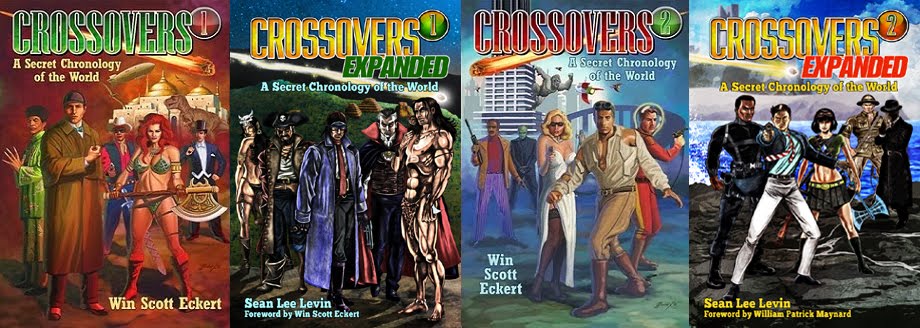
This crossover writeup is one of hundreds included in my book Crossovers Expanded: A Secret Chronology of the World Volume 3, which will be published by Meteor House! All three volumes are AUTHORIZED companions to Win Scott Eckert's Crossovers: A Secret Chronology of the World Volumes 1 and 2!

Wednesday, November 1, 2023

Crossover TV Episode: Muse


In this episode of Endeavour set in April 1968, Endeavour Morse, who has been promoted to Detective Sergeant, refuses to believe in the existence of an international thief called the Shadow, saying “It’s all a bit Simon Templar.” Among the items the Shadow is reputed to have stolen is the Lugash Diamond. The artist’s model whose murder Morse is investigating once posed for painter Gerard Pickman. Simon Templar is Leslie Charteris’ “laughing Robin Hood of crime,” the Saint. The Lugash Diamond is the titular gem from the movie The Pink Panther and its sequels. Gerard Pickman may be a relative of painter Richard Upton Pickman from H. P. Lovecraft’s “Pickman’s Model.”

This crossover is one of hundreds covered in my book Crossovers Expanded: A Secret Chronology of the World Volume 3, which will be published by Meteor House! All three volumes are AUTHORIZED companions to Win Scott Eckert's Crossovers: A Secret Chronology of the World Volumes 1 and 2!

Sunday, July 2, 2023

Crossover of the Week

November 5-7, 1964

FROM PARIS WITH HATE 

Hubert Bonisseur de la Bath, OSS 117, is assigned by his boss Armand Lesignac to rescue the French Minister of Justice from Fantômas. Lesignac says Lupin supposedly has a grandson running around Tokyo, and that Fantômas has already put Malloy, aka 077, in a body cast. 117 sets a trap to lure criminals who can help him against Fantômas using the Pink Panther diamond with the help of Inspector Clouseau. Diabolik and Eva Kant show up, as well as Anthony Logan, aka Kriminal. 117 tells Kriminal if he refuses to cooperate, he has arranged with the British government for him to spend the rest of his life in a high security “Village.” 117 calls Diabolik and Kriminal third-rate knockoffs of Fantômas, along with Satanik and Killing. 

Short story by Nathan Cabaniss in Tales of the Shadowmen Volume 13: Sang Froid, Jean-Marc and Randy Lofficier, eds., Black Coat Press, 2016; reprinted in French in Les Compagnons de l’Ombre (Tome 22), Jean-Marc Lofficier, ed., Rivière Blanche, 2018. OSS 117 is the protagonist of Jean Bruce’s spy novels. Armand Lesignac is from the movies OSS 117: Cairo, Nest of Spies and OSS 117: Lost in Rio. Fantômas is Marcel Allain and Pierre Souvestre’s master villain. Maurice Leblanc’s gentleman thief Arsène Lupin is the grandfather of the title character of Kazuhiko “Monkey Punch” Katō’s manga Lupin III. Dick Malloy, Secret Agent 077, was played by Ken Clark in three Italian spy films. The Pink Panther diamond and Inspector Clouseau are from the Pink Panther film series. Diabolik and Eva Kant are from the comic series created by Angela and Luciana Giussani. Kriminal is the antihero of an Italian comic book by Max Bunker and Magnus, as is Satanik. The Village is from the classic television series The Prisoner. Killing is the title character of an Italian photo comic (“fumetti”) series.  

This crossover writeup is one of hundreds included in my book Crossovers Expanded: A Secret Chronology of the World Volume 3, to be published by Meteor House! All three volumes are official and AUTHORIZED companions to Win Scott Eckert's Crossovers: A Secret Chronology of the World Volumes 1 and 2!

Sunday, December 6, 2015

Crossover of the Week

Autumn 1888
THE ADVENTURE OF THE SIX MALEDICTIONS
Professor Moriarty and Colonel Moran are hired by Major Humphrey “Mad” Carew to protect him from the mi-go, which seek to retrieve the gem known as the Green Eye of the Little Yellow God from him. Moriarty’s plan involves hiring a group of master thieves to steal similar cursed items. Appearing or mentioned are: Ted Baldwin; the Vermissa Valley Scowrers; Birdy Edwards, aka John McMurdo and John Douglas; Birlstone Manor; the Assassination Bureau, Ltd.; “that Limehouse Chinese with the marmoset”; the Moonstone; the Eye of Klesh; the All-Seeing Eye of the Goddess of Light; the Crimson Gem of Cyttorak; the Pink Diamond of Lugash; Lukundoo; a Zuni fetish; “a naked Porroh man”; the Barlow rubies; the Rosenthall diamonds; the Mirror of Portugal; the Agra treasure; Azathoth; Tabanga; St. Custard’s; Amaryllis Framington; Giles Conover; the Ingestre Necklace; Mrs. Lovett’s Fleet Street pie shop; the Herncastle Heirloom; the Black Pearl of the Borgias; the Hoxton Creeper; “the cricketing ponce”; the Falcon of the Knights of St. John; the Jewels of the Madonna of Naples; the Jewel of Seven Stars; the Eye of Balor; Simon Carne; Fat Kaspar; the Grand Vampire; Les Vampires; Abel Trelawny; Margaret Trelawny; Gennaro; King Brian of the Leprechauns; Bianca Castafiore; Alf Bassick; Don Rafaele Corbucci; Irene Adler; “Dynamite” Desmond Mountmain and his son Tyrone; Malvoisin’s Mirror; the Monkey’s Paw; Cap’n Flint’s treasure; Sir Michael Sinclair’s Door; Marshall Alaric Molina de Marnac; Vokins; Malilella; Henry Wilcox; Queen Tera; Mrs. Sarah “The Black Widow of Lauder” Stewart; and Hagar “Thieving Pikey” Stanley.
Short story by Colonel Sebastian Moran, edited by Kim Newman in Gaslight Arcanum: Uncanny Tales of Sherlock Holmes, J. R. Campbell and Charles Prepolec, eds., EDGE Science Fiction and Fantasy Publishing, 2011; reprinted and revised in Professor Moriarty: The Hound of the d’Urbervilles, Titan Books, 2011. Professor Moriarty, Colonel Moran, and Irene Adler are from the Sherlock Holmes stories. Ted Baldwin, the Vermissa Valley Scowrers, Birdy Edwards, and Birlstone Manor are from the Holmes novel The Valley of Fear. The Agra treasure is from the Holmes novel The Sign of Four. The Black Pearl of the Borgias is from the Holmes story “The Adventure of the Six Napoleons.” In “The Adventure of the Empty House,” Holmes states “the death of Mrs. Stewart, of Lauder, in 1887” was likely perpetrated by Moran. Mad Carew, the Green Eye of the Little Yellow God and Amaryllis Framington are from J. Milton Hayes’ poem “The Green Eye of the Little Yellow God,” although in the poem Amaryllis is only identified as “the Colonel’s daughter.” Azathoth is one of the Great Old Ones from H. P. Lovecraft’s Cthulhu Mythos. The mi-go are also from the Mythos. The Assassination Bureau, Ltd. is a novel by Jack London, completed posthumously by Robert L. Fish. “That Limehouse Chinese with the marmoset” is Dr. Fu Manchu. The Moonstone (aka the Herncastle Heirloom) is the subject of a novel by Wilkie Collins. The Eye of Klesh is from Lord Dunsany’s one-act melodrama A Night at an Inn. The All-Seeing Eye of the Goddess of Light is from the 1940 film The Thief of Bagdad. The Crimson Gem of Cyttorak is from the exploits of Marvel Comics’ Doctor Strange. Although the gem is best known as the power source of the X-Men villain Juggernaut, it is unlikely it empowered Cain Marko in the CU. The Pink Diamond of Lugash is better known as the Pink Panther, from the film series of the same name. Lukundoo is from the short story of the same name by Edward Lucas White. The Zuni fetish is from Richard Matheson’s story “Prey,” later adapted as “Amelia,” the third segment of the made-for-television film Trilogy of Terror. The “naked Porroh man” is from H. G. Wells’ story “Pollock and the Porroh Man.” The Barlow rubies are from Patrick Hamilton’s play Gas Light. “The cricketing ponce” is E. W. Hornung’s Raffles. The Rosenthall diamonds are from the Raffles story “A Costume Piece.” Don Rafaele Corbucci is Raffles’ nemesis Count Corbucci from “The Fate of Faustina” and “The Last Laugh.” Rick Lai gives the Count the first name Salvatore in his own fiction. Perhaps his full name is Salvatore Rafaele Corbucci. The Mirror of Portugal is from Arthur Morrison’s story “The Case of ‘The Mirror of Portugal,’” found in the collection The Dorrington Deed Box. Tabanga is from the film From Hell It Came. St. Custard’s is the school attended by Nigel Molesworth in books written by Geoffrey Willans and illustrated by Ronald Searle. Giles Conover and the Hoxton Creeper are from the Sherlock Holmes film The Pearl of Death. The Creeper was played by Rondo Hatton, who also portrayed a character called the Creeper in the films House of Horrors and The Brute Man; perhaps the latter-day Creeper is a descendant of his Victorian namesake and look-alike. The Ingestre Necklace and Mrs. Lovett’s Fleet Street pie shop are from the penny dreadful story “The String of Pearls: A Romance,” which formed the basis for the stage musical Sweeney Todd: The Demon Barber of Fleet Street. The Falcon of the Knights of St. John is the titular statue from Dashiell Hammett’s novel The Maltese Falcon; Fat Kaspar is Casper Gutman. The Jewels of the Madonna of Naples, Genarro, and Malilella (usually spelled without the second “l”) are from Ermanno Wolf-Ferrari’s opera The Jewels of the Madonna. The Jewel of Seven Stars, Abel Trelawny, Margaret Trelawny, and Queen Tera are from the novel The Jewel of Seven Stars by Bram Stoker. The Eye of Balor is from Celtic mythology. Simon Carne is from the collection A Prince of Swindlers by Guy Boothby. The Grand Vampire and Les Vampires are from Louis Feuillade’s serial named for the latter. King Brian of the Leprechauns is Brian Connors from the film Darby O’Gill and the Little People. Bianca Castafiore is from the Tintin comics by Hergé. Alf Bassick is from William Gillette’s play Sherlock Holmes. Desmond and Tyrone Mountmain are undoubtedly relatives of the Mountmain family which appears in Newman’s serial novel Seven Stars. Malvoisin’s Mirror is from a titular story by Chris Lowder and Brian Lewis in the British comic magazine Halls of Horror #12. The Monkey’s Paw is the subject of the short story of the same name by W. W. Jacobs. Cap’n Flint’s treasure is from Treasure Island by Robert Louis Stevenson. Sir Michael Sinclair’s Door is from “The Door,” a segment of the British horror anthology film From Beyond the Grave. Marshall Alaric Molina de Marnac is likely a descendant of Alaric de Marnac, the 15th century warlock played by Paul Naschy (née Jacinto Molina Álvarez) in the films Horror from the Tomb and Cries of Terror. Vokins is Charles Vokins from “The Horizontal Witness,” an episode of the television series Cribb, based on Peter Lovesey’s series of novels about a Victorian era Police Sergeant. Henry Wilcox is from E. M. Forster’s novel Howards End. Hagar Stanley is from the collection Hagar of the Pawn-Shop: The Gypsy Detective by Fergus Hume. The original version of this tale had references to the Emeralds of Suliman (from Edgar Wallace’s J. G. Reeder tale “The Green Mamba”) and Sylvia Marsh (from Ken Russell’s 1988 film version of Bram Stoker’s The Lair of the White Worm).

Sunday, June 28, 2015

Crossover of the Week


1929

THE JUDEX CODEX

            Raymond Mystère and Henrietta de Marigny explore a Mayan temple in Guatemala. When Raymond first met Henrietta at the University of Sorbonne, he thought she was too interested in visiting professors like Henry Jones, Thomas Swift, and John Kenton. Henrietta’s brother Etienne-Laurent de Marigny was an archaeologist specializing in occult lore, who was inspired in his choice of profession by his friend Pierre d’Artois. Henrietta was once kidnapped by a madman named Don Jose to sacrifice to a dark god. Her twin sister Louise had been previously abducted and killed by the Don. Etienne was able to attend Miskatonic University through d’Artois’ influence. Etienne disappeared in 1926 while investigating some ruins in the swamps of Louisiana, the inhabitants of which he believed to be the remnants of a Tcho-Tcho group that had come to North America during the Asian Migration. When he resurfaced, he opened a shop in New Orleans dealing in occult artifacts. A group of five men, including two named Hernandez and Aguirre respectively, attempt to steal a stone tablet discovered by Raymond and Henrietta. Months later, Raymond, recognizing the pictoglyphs on the tablet as representing Vedic words, tells the pregnant Henrietta that his grandfather, Doctor Mystère, claimed that his vehicle, the Electric Hotel, was based on ancient Vedic designs. Henrietta and Raymond’s student Jean Aubry introduces them to his father, Comte Jacques de Trémeuse. The two visit the Comte’s estate, where they meet his wife Jacqueline and their two sons, their old family friend Prosper Cocantin, his wife Daisy, and their young son Jacques. Trémeuse tells Raymond and Henrietta that his mother made his brother Roger and he swear to kill the banker Favraux for driving their father to suicide. Trémeuse shows them a tablet he discovered in Africa, one of a group of such items, almost identical to the one they discovered, which has a ring set into it. Prosper and Daisy’s adopted son Michel Cocantin, formerly known as the Licorice Kid, accompanies Henrietta and Jacqueline on a trip to buy baby clothes. Henrietta is abducted by members of a group known as the Men in Black. Jacques Cocantin has been learning the martial arts from a young Annamese boy named Cato. Henrietta refers to tales of the legendary continents of Hyboria, Lemuria, Mu, and Atlantis. Raymond says that the area where he and Henrietta found the temple was near the region described by Ventidius as Atala, which had ties with Atlantis, and was sometimes mistaken for it. Raymond suspects that there was an African civilization that was the true parent of lost cities such as Zu-Vendis, Kôr, Opar, and Zimbabue. Raymond and Trémeuse charter The Pious Woman, owned and operated by Captain Owen Kettle, to take them to Easter Island. They meet the manager of the island, Señor Ortiz. Raymond and Trémeuse are confronted by the Men in Black, who are accompanied by Dr. René Belloq. Belloq claims to have trained at Rache Churan. A crystal ball emits an image of a man resembling an elderly version of Trémeuse, who tells him and Raymond that Trémeuse is a member of the house of Elessar Telcontar. Trémeuse’s forebear refers to the crystal ball as a Palantir, and charges him to take the Book of Thain, the Book of Kings, and the Book of Mazarbul to “the one who can best translate them for your people.” Henrietta identifies Khokarsa as the sunken island civilization mentioned in the African tablets discovered by Trémeuse. It is mentioned that some believe the tale of Numenor to be the Oxford scholar to whom Henrietta sent the three books’ own version of Atlantis, rather than the story of an island empire that existed ages before Atlantis. An epic about the hero named Hadon described in the African tablets was popularized by an American author whose work was recommended to the Mystères by the Ironcastle family. Wooden tablets discovered by Raymond on Easter Island form the epic tale of a warrior-King named Thongor who lived in ancient Lemuria. After Jacques’ apparent death, his son Frédéric-Jean de Trémeuse followed in his footsteps, adopting the identity of Frédéric-Jean Orth, aka L’Ombre. Jacques Cocantin grew up to become Chief of the Sûreté after his predecessor, Chief Inspector Dreyfuss, became mentally unstable. A film version of Inspector Cocantin’s famous case against Sir Charles Litton, the jewel thief known as the Phantom, portrayed him as a buffoon, causing the Inspector to demand that the filmmakers change his name.

            Short story by Dennis E. Power in The Shadow of Judex, Jean-Marc and Randy Lofficier, eds., Black Coat Press, 2013; reprinted in French in L’Ombre de Judex, Jean-Marc and Randy Lofficier, eds., Rivière Blanche, 2013. Raymond Mystère and Henrietta de Marigny are the parents of the title character of Alfredo Castelli’s comic book Martin Mystère. Henrietta is meant to be the same character as Yvonne Marigny from E. Hoffmann Price’s Pierre d’Artois story “The Devil’s Crypt.” Don Jose and Louise (de) Marigny are also from “The Devil’s Crypt.” Etienne-Laurent de Marigny is from H.P. Lovecraft and Price’s story “Through the Gates of the Silver Key.” Etienne’s shop will be inherited by his son Henri-Laurent de Marigny, as seen in Brian Lumley’s Titus Crow novels. Henry Jones, Sr. is Indiana Jones’ father. Dr. René Belloq is from the first Indiana Jones movie, Raiders of the Lost Ark. Thomas Swift is better known as Tom Swift from the novels by Victor Appleton. John Kenton is from A. Merritt’s The Ship of Ishtar. Miskatonic University and the Tcho-Tcho are staples of the Cthulhu Mythos. Hernandez is a descendant of the robber Hernandez from Joseph Conrad’s novel Nostromo. Aguirre is a descendant of the fictionalized version of the historical conquistador Don Lope de Aguirre seen in the film Aguirre: The Wrath of God. Doctor Mystère appeared in a series of novels by Paul d’Ivoi. The Martin Mystère comics have established that Martin was the grandson of Doctor Mystère’s adopted son Cigale. Jacques de Trémeuse, his brother Roger, his wife Jacqueline, Jacqueline’s son Jean Aubry, Prosper Cocantin, his wife Daisy, their adopted son the Licorice Kid, and Favraux are from Louis Feuillade’s film serial Judex. Jacques Cocantin is meant to be Inspector Jacques Clouseau from the movie The Pink Panther and its sequels. Cato will grow up to be the Inspector’s manservant and sparring partner. Chief Inspector Dreyfus and Sir Charles Litton are also from the Pink Panther films. The tablet found by Raymond and Henrietta in Guatemala and the one found by Jacques in Africa, when combined, describe the events of J.R.R. Tolkien’s fantasy saga The Lord of the Rings. In Tolkien’s books, Elessar is the name that Aragorn took after assuming the throne of the Reunited Kingdoms. Telcontor is an Elvish term for his nickname of Strider. The Palantir is one of the scrying stones used by the order of Wizards. Tolkien claimed that The Book of Thain was his source for The Hobbit, The Lord of the Rings, and The Silmarillion. The Book of Kings and The Book of Mazarbul were supposedly the other two books that served as Tolkien’s source for Middle Earth lore not found in The Book of Thain. The Men in Black are the subject of many conspiracy theories, but the version of the group seen here is the same one that will later battle Martin Mystère. Power reveals that the Men in Black are the modern day equivalent of the Black Riders, the Nazgûl, which served the Dark Lord Sauron. Power also implies that the Men in Black are connected to the Nine from Philip José Farmer’s novels A Feast Unknown, Lord of the Trees, and The Mad Goblin; although the Secrets of the Nine trilogy takes place in an alternate reality to the Crossover Universe, Win Scott Eckert’s story “The Wild Huntsman” establishes that a version of the Nine exists in the CU. Numenor is an island that rose from the sea in The Lord of the Rings and The Silmarillion. Hyboria is from Robert E. Howard’s Conan stories. Ventidius Varro and Atala are from H. Warner Munn’s novel The Ship from Atlantis. Philip José Farmer, in his novels of Ancient Opar, revealed that the lost cities of Zu-Vendis (from H. Rider Haggard’s Allan Quatermain), Kôr (from Haggard’s She and sequels), and Opar (from the Tarzan books by Edgar Rice Burroughs) were among the remnants of the destroyed Central African empire of Khokarsa, which was later mistakenly identified with Atlantis. Power’s story adds Zimbabue (from Charles R. Saunders’ Imaro novels, the precursor to Zimbabwe) to the list. Hadon is the hero of the first two Ancient Opar books, Hadon of Ancient Opar and Flight to Opar. Captain Owen Kettle is featured in a series of books by C.J. Cutcliffe Hyne. Señor Ortiz is meant to be an ancestor of the villainous Orthis from Edgar Rice Burroughs’ Moon series. Although the Moon books take place in the Edgar Rice Burroughs Alternate Universe (ERB-AU), there is no reason why Orthis’ ancestor could not exist in both that universe and the CU. The Rache Churan monastery is from Sax Rohmer’s Fu Manchu novels. The Ironcastle family is from Farmer’s adaptation and translation of J.-H. Rosny aîné’s novel Ironcastle. Thongor of Lemuria is the hero of a series of books by Lin Carter. Frédéric-Jean Orth, aka L’Ombre, is the hero of a series of novels by Alain Page; Jean-Marc Lofficier identified L’Ombre as Judex’s son in his article “The Tangled Web: Genealogies of the Members of the French Wold Newton Families – Rocambole and Fantômas” on the website The French Wold Newton Universe.
Sunday, March 9, 2014

Crossover of the Week


March 6, 1910-August 27, 1911
PROFESSOR PEASLEE PLAYS PARIS
            In 1910, a group of men led by Count Ferenczy and Professor Peaslee uncover a meteor in the Tunguska region of Siberia. Peaslee claims that because of Ferenczy’s failure in 1795, they must struggle with men with remarkable skills, and says that this meteor must not create another Holmes or Nemo. The following year, Peaslee requests the criminal Flambeau’s aid in deceiving the criminal organization known as the Habits Noirs. Inspector Romaine visits the Louvre, from which the Mona Lisa has been stolen, and reflects that Chief Aristide Valentin has committed suicide. The best and brightest of the police, including Broquet, Guichard, and Maigret, are attempting to deal with the massive crime-wave in Paris. Romaine meets with a man in an iron mask and his female aide, Joséphine. Peaslee asks a young girl named Nardi, recommended to him by Flambeau, to steal a stone. Peaslee compares that stone, the Tear of Azathoth, to the Heart of the Ocean, the Pink Panther, and the Maltese Falcon. Baron Cesare Stromboli, an agent of the Black Coats, tries unsuccessfully to purchase the Mona Lisa from the man who stole it. The current leader of the Habits Noirs, the Iron King, is furious when he learns of the thief’s refusal. Exploring Paris’s sewers, Nardi is caught by a group of men, one of whom remarks “Rats are getting bigger it seems. Regular Sumatra down here.” The Colonel, previously believed dead, reclaims the mantle of leader from the Iron King.
            Short story by Pete Rawlik in Tales of the Shadowmen Volume 9: La Vie en Noir, Jean-Marc and Randy Lofficier, eds., Black Coat Press, 2012; reprinted in French in Les Compagnons de l’Ombre (Tome 12), Jean-Marc and Randy Lofficier, eds., Rivière Blanche, 2013. Count Ferenczy is from H.P. Lovecraft’s The Case of Charles Dexter Ward, while Professor Nathaniel Wingate Peaslee is from Lovecraft’s “The Shadow Out of Time.” The Tunguska meteor strike was a real event that occurred in 1908, and has been linked to many curious events in the CU. The 1795 reference is to the Wold Newton meteor strike. According to Philip José Farmer, Sherlock Holmes is a member of the Wold Newton Family. In The Other Log of Phileas Fogg, Farmer claimed that Jules Verne’s Captain Nemo was actually Holmes’ foe Professor James Moriarty. Later research has established that Moriarty was indeed one of at least three men who used the name Nemo, though he was not the same person as Prince Dakkar, who used that alias in Verne’s novels. The Nemo referred to by Peaslee is likely Moriarty, who was identified as a member of the Wold Newton Family in Doc Savage: His Apocalyptic Life. Flambeau and Aristide Valentin are from G.K. Chesterton’s stories about crime-solving priest Father Brown. Les Habits Noirs, aka the Black Coats, are featured in novels by Paul Féval, as is their leader, Colonel Bozzo-Corona. Inspector Romaine is from the film Charlie Chan in City in Darkness, while Nardi is from Charlie Chan in Paris. Rawlik’s story reveals that Nardi is Flambeau’s niece. Paulin Broquet is the policeman nemesis of the gypsy crime lord Zigomar in pulp novels by Léon Sazie. Commissaire Jules Maigret is featured in mystery novels by Georges Simenon. Chief Xavier Guichard was a real person who also appeared in the Maigret books. The Iron King is from Les Martin’s novel Young Indiana Jones and the Gypsy Revenge; he is a descendant of the title character of Alexandre Dumas’ The Man in the Iron Mask. Joséphine Balsamo is Arsène Lupin’s greatest foe. Azathoth, “the blind idiot god,” is one of the Great Old Ones of the Cthulhu Mythos. The Heart of the Ocean diamond is from the film Titanic. The Pink Panther gem is featured in the film of the same name. The statue known as the Maltese Falcon is from the novel of the same name by Dashiell Hammett. Baron Cesare Stromboli is a gentleman thief appearing in stories by Jose Moselli. In the Sherlock Holmes story “The Adventure of the Sussex Vampire,” Holmes mentions “the giant rat of Sumatra, a story for which the world is not yet prepared.” The tale of the giant rat is perhaps the most pastiched of the many unchronicled Holmes cases alluded to in the Canon.