Showing posts with label Josephine Balsamo. Show all posts

Sunday, November 26, 2023

Crossover of the Week

Summer 1888

THE CASE OF MRS. NORTON 

The former Irene Adler hires Erik’s Opera Ghost Agency (whose current operatives are Ayda Heidari, Ysabel de Ferre, and Hagar Stanley) to determine whether her husband Godfrey Norton is the good man he appears. Appearing or mentioned are the Persian; the Countess de Cagliostro; Liddle, Neal, & Liddle; the King of Bohemia; A. J. Raffles; Professor Moriarty; Sherlock Holmes; Trilby; Coppélius; Spallanzani; Olympia; Irma Vep; Les Vampires; La Marmoset; and Mr. Calhoun. 

Story by Kim Newman in Angels of Music, Titan Books, 2016. Erik and the Persian are from Gaston Leroux’s The Phantom of the Opera. Irene Adler, her husband Godfrey Norton, and the King of Bohemia are from Doyle and Watson’s Sherlock Holmes tale “A Scandal in Bohemia.” Ayda Heidari is the future wife of Bob Ferguson from “The Adventure of the Sussex Vampire.” Professor Moriarty is Holmes’ greatest foe. Ysabel de Ferre is a foe of detective Sexton Blake. Hagar Stanley is from Fergus Hume’s Hagar of the Pawn-Shop. Josephine Balsamo, the Countess of Cagliostro, is the archenemy of Maurice Leblanc’s gentleman burglar Arsène Lupin. Liddle, Neal, & Liddle is from Arthur Morrison’s Martin Hewitt story “The Case of Laker, Absconded.” A. J. Raffles is E. W. Hornung’s amateur cracksman. Trilby O’Ferrall is from George du Maurier’s Trilby. Coppélius, Spallanzani, and Olympia are from Jacques Offenbach’s opera Tales of Hoffmann. Irma Vep and Les Vampires are from Louis Feuillade’s silent film serial named for the latter. La Marmoset and Mr. Calhoun are from Albert W. Aiken’s “La Marmoset, the Detective Queen; or, The Lost Heir of Morel.” 

This crossover writeup is one of hundreds included in my book Crossovers Expanded: A Secret Chronology of the World Volume 3, which will be published by Meteor House! All three volumes are AUTHORIZED companions to Win Scott Eckert's Crossovers: A Secret Chronology of the World Volumes 1 and 2!

Sunday, November 15, 2015

Crossover of the Week

December 1896
CUT THE BRANCH
Appearing or mentioned are: the Black Coats; Joséphine Balsamo; the House of Crafts; Dr. Antonio Nikola; Catarina Corbucci; Count Salvatore Corbucci; Professor James Moriarty; Madame Fourneau’s College for Young Women; Norman Head; Noel Moriarty; Irina Putine; the Chupin Detective Agency; Urania Caber; the golden ram crest of the Cagliostro family; the Gentlemen of the Night; Orianne Coyatier; Rochelle Moreau; Ramirez; Professor Chavain; Madame Sara (aka Sarah Warrender); Colleen Pegler; the White Lodge; Frank Moran; Colonel Sebastian Moran; Patrick Dickson; Hamish Webb; Stangerson’s Disassociation of Matter Through Electricity; the Brotherhood of the Seven Kings; Gordo Reloj; Pilar; Aguilar; the All-Father; Dominick Moriarty; Marga Sandorf; Aristide Orlowsky Sandorf; Baron Von Schulenberg; Manny Bennet; Solly Bennet; Corben Caine; Wilmot Rogers; Jefferson Gonzales; the Lanky Gunman; the Yankee Whistler; a friend of Gordo’s; Dupont-Verdier (aka Satanas); Jillian Blake; Leonard; Etienne Cressy Raimond D’Arcourt; Sharita; the Duchy of Strackenz; the Thuggee cult’s alliance with Naga worshippers; Achmet Genghis Khan; Gruesome Clayton; Carfax Abbey; Dracula; and Ballmeyer.
Short story by Rick Lai in Sisters of the Shadows: The Cagliostro Curse, Black Coat Press, 2013. The Black Coats are a criminal conspiracy featured in novels by Paul Féval. Orianne Coyatier is the granddaughter of Jean-François Coyatier (aka the Marchef), who acted as the Black Coats’ executioner. The All-Father is the leader of the Black Coats. The Gentlemen of the Night are from Féval’s The Mysteries of London. Joséphine Balsamo battled Arsène Lupin in Maurice Leblanc’s The Countess of Cagliostro. Leonard is also from that novel. The House of Crafts is an allusion to the criminal organization known as Krafthaus in John Buchan’s The Power-House. Dr. Antonio Nikola is a scientist and criminal mastermind featured in novels by Guy Boothby. Catarina Corbucci is meant to be Madame Koluchy from L. T. Meade and Robert Eustace’s The Brotherhood of the Seven Kings. Norman Head is also from Meade and Eustace’s novel. Madame Sara is from Meade and Eustace’s The Sorceress of the Strand; her alias of Sarah Warrender is meant to imply she is the mother of Miss Warrender from Arthur Conan Doyle’s “Uncle Jeremy’s Household.” Achmet Genghis Khan was identified as Miss Warrender’s father in Doyle’s tale. Count Salvatore Corbucci dueled with A. J. Raffles in E. W. Hornung’s “The Fate of Faustina” and “The Last Laugh.” Professor James Moriarty is Sherlock Holmes’ archenemy. Noel Moriarty (whose full name is James Noel Moriarty) is the Professor’s younger brother mentioned in The Valley of Fear. Colonel Sebastian Moran is Professor Moriarty’s second-in-command from “The Adventure of the Empty House.” In The Power-House, the Krafthaus’ leader Andrew Lumley lives in a house called the White Lodge; the implication of the White Lodge reference in Lai’s story is Lumley is actually Noel Moriarty. Madame Fourneau’s College for Young Women is from the Spanish horror film La Residencia. Irina Putine is an alias for Irene Tupin from the same film. Professor Chavain is based on Madame Fourneau’s reference to her former student, a noted botanist. The Chupin Detective Agency, run by Victor “Toto” Chupin, is from the works of Emile Gaboriau. Urania Caber is meant to be Urania Moriarty, the Professor’s daughter, whose existence was revealed by Philip José Farmer in Doc Savage: His Apocalyptic Life. Jillian Blake is based on a reference to a Jill Fagin who married a Blake in Farmer’s book. The golden ram crest of the Cagliostro family is from the animated Lupin III film The Castle of Cagliostro. Rochelle Moreau is the daughter of H. G. Wells’ Dr. Moreau and the niece of Bernard Moreau, who is mentioned in La Residencia. Tuco Benedicto Pacifico Juan Maria Ramirez is from the film The Good, the Bad and the Ugly. “Colleen Pegler” is an alias for Peg Cullane from Louis L’Amour’s The Man Called Noon. Frank Moran is Francis “Colt” Moran from the film Today It’s Me…Tomorrow You! Patrick Dickson is meant to be Tricky the Gambler from the movie The Fighting Fists of Shanghai Joe. Hamish Webb is meant to be James Webb from the movie Black Killer. Stangerson’s Disassociation of Matter Through Electricity is from Gaston Leroux’s first Rouletabille novel, The Mystery of the Yellow Room. Ballmeyer is Rouletabille’s father. Gordo Reloj is meant to be Gordo Watch from the film Arizona Colt (aka The Man from Nowhere); “reloj”is Spanish for “watch.” Pilar and Aguilar are from the film A Stranger in Town. Dominick Moriarty is meant to be Dominick Medina from John Buchan’s The Three Hostages. Marga Sandorf is the niece of the title character of Jules Verne’s novel Mathias Sandorf. Aristide Orlowsky Sandorf is meant to be the Hungarian villain Orlowsky from the movie Django Strikes Again. Baron Von Schulenberg is from the movie The Big Gundown. Manny Bennet is meant to be Manuel from the film Cemetery Without Crosses. Corben Caine and Wilmot Rogers are Ben Caine and Will Rogers from the same film. Solly Bennet is Solomon “Beauregard” Bennet from the movie Face to Face. Jefferson Gonzales is from the film Ringo and His Golden Pistol. The Lanky Gunman is Hank “Lanky” Fellows from the movie A Taste for Killing. The Yankee Whistler is the title character of the movie Yankee. Gordo’s friend is Frank Talby from the movie Day of Anger. Satanas is from Louis Feuillade’s film serial Les Vampires; in the English language translation of the serial, Satanas’ real name is given as Claude Dupont-Verdier. Etienne Cressy Raimond D’Arcourt and Sharita are from Gardner F. Fox’s novel Woman of Kali. The Duchy of Strackenz is from George MacDonald Fraser’s Royal Flash; here, it is implied to be the same country as the Duchy of Cagliostro from The Castle of Cagliostro. The alliance between the Thuggee and Naga worshippers is from Emilio Salgari’s Sandokan novels. Gruesome Clayton is Sir William Clayton from Farmer’s Tarzan Alive and Doc Savage: His Apocalyptic Life. Carfax Abbey is from Bram Stoker’s Dracula.

Sunday, May 24, 2015

Crossover of the Week

1930
THE DEATH OF COUNTESS CAGLIOSTRO
            Faustine gives a young woman a letter from her deceased grandmother, Joséphine Balsamo, the Countess Cagliostro, which explains how she had an illegitimate child, Joseph, the girl’s father, by a circus contortionist, Alexandre “Sandre” Cascabel. The Countess says that if he had gone after the Moonstone, or the Hollow Needle, she could have saved Joseph from his fate, but he instead stole The Brigand’s Painting. The Countess was visited by the Master of the Black Coats (aka the Colonel-Who-Never-Died) and his executioner, the Marchef, who instructed her to kill Joseph. The Colonel says that Joseph is presently being kept in the caves of Palazzio Monteleone. If the Countess kills Joseph, the Colonel will have her taken to Sartene, near the Convent of La Merci, and she will live the rest of her life in peace. The Countess was later visited by her former second-in-command Marga.
            Short story by Jean-Marc and Randy Lofficier published as an epilogue in Arsène Lupin vs. Countess Cagliostro by Maurice Leblanc, adapted and translated by Jean-Marc and Randy Lofficier, Black Coat Press, 2010. Joséphine Balsamo is from Leblanc’s Arsène Lupin novels The Countess of Cagliostro and Countess Cagliostro’s Revenge, both of which are collected in Arsène Lupin vs. Countess Cagliostro. Faustine is also from Countess Cagliostro’s Revenge. The Hollow Needle is from Leblanc’s Lupin novel of the same name. Alexandre “Sandre” Cascabel is from Jules Verne’s novel César Cascabel. Marga Sandorf, the niece of the title character of Verne’s novel Mathias Sandorf, was created by Rick Lai, and appears in his collection Sisters of the Shadows: The Cagliostro Curse. The Moonstone is from Wilkie Collins’ novel of the same name. The Brigand’s Painting, the Colonel-Who-Never-Died (Colonel Bozzo-Corona), the Marchef, the Palazzio Monteleone, and the Convent of La Merci are from the Black Coats novels by Paul Féval. The year is conjecture.

Sunday, February 8, 2015

Crossover of the Week


1911
THE LEGACY OF ARSÈNE LUPIN
            Arsène Lupin, disguised as Prince Sernine, tells his biographer Maurice Leblanc a tale involving the Comte de Guy’s ownership of d’Artagnan’s sword, having heard rumors of how the Comte acquired it: “There’s been talk of dealings with the Chinese fence, Hanoi Shan—his path has crossed Lupin’s before—rumors of a murderous thug named Gurn…half-whispered rumors of Cagliostro, Saint-Germain, and the Englishman Barrington, who had defrauded the great Cagliostro of a fortune and the sword; talk that the sword had once been the trust of one Prince Rodolphe; that it was stolen by Colonel Bozzo-Corona or by that young rogue Rocambole; that British cracksman took a shot at it; and there was a suggestion the Devil Doctor in Limehouse had shown an interest; Josephine Balsamo’s name came up…” The sword was brought to Lupin’s attention by the young journalist Rouletabille. The Comte asks Lupin, in his guise as M. Lenormand, head of the Sûreté Nationale, to guard his valuables at a masked ball. Lupin says, “Even old Lecoq might have found himself challenged by this problem!,” and assures the Comte, “The cracksman Bunn is in Perth, by all accounts, and that Englishman Raffles who has plagued Scotland Yard has not been heard of since the Boer War.” The Comte introduces “Lenormand” to his daughter, the Comtesse Emmeline de Guy. Lupin encounters a young boy who calls himself “Stephen Tarleton” and wishes to steal the sword from the Comte. The Comte stores his valuables in a safe made by the Dale company in New York, which the American called the Gray Seal had remarkable luck in cracking. Marie Antoinette’s necklace was stolen by Cagliostro, then in England by George Barrington, the Picaroon, king of the London underworld, and from the Dreux-Soubize family by Lupin himself, as a boy. Lupin recognizes members of Paris’ infamous Vampires and the Union Corse from Marseilles at the ball, as well as deadly enemies of the English cracksman, Cleek.
            Short story by David L. Vineyard in Tales of the Shadowmen Volume 11: Force Majeure, Jean-Marc and Randy Lofficier, eds., Black Coat Press, 2014. Arsène Lupin, the Dreux-Soubize family, and Josephine Balsamo are from Maurice Leblanc’s novels. The Comte de Guy is one of the many aliases used by Carl Peterson, the archenemy of H.C. “Sapper” McNeile’s adventurer Bulldog Drummond. The Countesse Emmeline is really Carl’s mistress Irma. Hanoi Shan is from H. Ashton-Wolfe’s Warped in the Making: Crimes of Love and Hate. Hanoi Shan encountered Lupin in Vineyard’s story “The Jade Buddha” (Tales of the Shadowmen Volume 5: The Vampires of Paris, Jean-Marc and Randy Lofficier, eds., Black Coat Press, 2009.) Gurn is better known as Marcel Allain and Pierre Souvestre’s villain Fantômas. Count Cagliostro was a historical figure, who also appeared in novels by Alexandre Dumas, and was identified as the founder of a villainous branch of the Wold Newton Family by Philip José Farmer. The Comte de Saint-Germain was also a real person, and has appeared in a number of works of fiction. George Barrington is from Ernest Dudley’s novel Picaroon. Prince Rodolphe is from Eugène Sue’s The Mysteries of Paris. Colonel Bozzo-Corona is the leader of the gang known as the Black Coats in novels by Paul Féval. Rocambole is the villain-turned-hero of novels by Ponson du Terrail. The British cracksman is E.W. Hornung’s A.J. Raffles. The Devil Doctor is Sax Rohmer’s Doctor Fu Manchu, whom Farmer conflated with Hanoi Shan in Doc Savage: His Apocalyptic Life. Apparently, it is not common knowledge that Fu and Shan are the same person, and doubtless that is how the criminal mastermind prefers it. Rouletabille is a young reporter featured in novels by Gaston Leroux. Lecoq is Emile Gaboriau’s detective. Smiler Bunn is a thief appearing in comedic stories by Bertram Atkey. “Stephen Tarleton” is really Simon Templar, who will later be known as the Saint, the “laughing Robin Hood of crime” created by Leslie Charteris. Lupin thinks that Templar is fourteen years old. In fact, Templar would be ten years old in 1911. The Dale company is owned by Jimmie Dale, aka the Gray Seal, who appears in books by Frank L. Packard. The Vampires are from Louis Feuillade’s silent film serial Les Vampires. The Union Corse is a real organization, but a fictionalized version of the group appears in Ian Fleming’s James Bond novel On Her Majesty’s Secret Service. Hamilton Cleek, “the man of forty faces,” was the protagonist of books by Thomas W. Hanshew.
Saturday, April 12, 2014

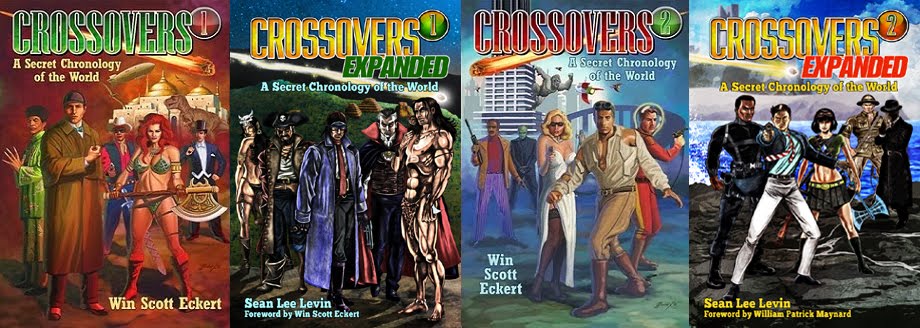
Crossover Covers: Sisters of the Shadows: The Cagliostro Curse

This collection of stories by my good friend, the brilliant Rick Lai, describes the feud between Joséphine Balsamo (one of Arsène Lupin's greatest foes) and Irina Putine (an alias for Irene Tupin from the Spanish horror film La Residencia, here portrayed as Lupin's half-sister.) The book is a mixture of revisions of previously published stories with brand-new tales. As one might expect, the stories are filled with crossovers. Win (who wrote the foreword) included the original versions of the reprinted and revised stories in the first two volumes, and I will be including the new stories in Volume 3. You can read my review of the book at this link. I highly recommend this, and all of Rick's work!

Sunday, March 9, 2014

Crossover of the Week


March 6, 1910-August 27, 1911
PROFESSOR PEASLEE PLAYS PARIS
            In 1910, a group of men led by Count Ferenczy and Professor Peaslee uncover a meteor in the Tunguska region of Siberia. Peaslee claims that because of Ferenczy’s failure in 1795, they must struggle with men with remarkable skills, and says that this meteor must not create another Holmes or Nemo. The following year, Peaslee requests the criminal Flambeau’s aid in deceiving the criminal organization known as the Habits Noirs. Inspector Romaine visits the Louvre, from which the Mona Lisa has been stolen, and reflects that Chief Aristide Valentin has committed suicide. The best and brightest of the police, including Broquet, Guichard, and Maigret, are attempting to deal with the massive crime-wave in Paris. Romaine meets with a man in an iron mask and his female aide, Joséphine. Peaslee asks a young girl named Nardi, recommended to him by Flambeau, to steal a stone. Peaslee compares that stone, the Tear of Azathoth, to the Heart of the Ocean, the Pink Panther, and the Maltese Falcon. Baron Cesare Stromboli, an agent of the Black Coats, tries unsuccessfully to purchase the Mona Lisa from the man who stole it. The current leader of the Habits Noirs, the Iron King, is furious when he learns of the thief’s refusal. Exploring Paris’s sewers, Nardi is caught by a group of men, one of whom remarks “Rats are getting bigger it seems. Regular Sumatra down here.” The Colonel, previously believed dead, reclaims the mantle of leader from the Iron King.
            Short story by Pete Rawlik in Tales of the Shadowmen Volume 9: La Vie en Noir, Jean-Marc and Randy Lofficier, eds., Black Coat Press, 2012; reprinted in French in Les Compagnons de l’Ombre (Tome 12), Jean-Marc and Randy Lofficier, eds., Rivière Blanche, 2013. Count Ferenczy is from H.P. Lovecraft’s The Case of Charles Dexter Ward, while Professor Nathaniel Wingate Peaslee is from Lovecraft’s “The Shadow Out of Time.” The Tunguska meteor strike was a real event that occurred in 1908, and has been linked to many curious events in the CU. The 1795 reference is to the Wold Newton meteor strike. According to Philip José Farmer, Sherlock Holmes is a member of the Wold Newton Family. In The Other Log of Phileas Fogg, Farmer claimed that Jules Verne’s Captain Nemo was actually Holmes’ foe Professor James Moriarty. Later research has established that Moriarty was indeed one of at least three men who used the name Nemo, though he was not the same person as Prince Dakkar, who used that alias in Verne’s novels. The Nemo referred to by Peaslee is likely Moriarty, who was identified as a member of the Wold Newton Family in Doc Savage: His Apocalyptic Life. Flambeau and Aristide Valentin are from G.K. Chesterton’s stories about crime-solving priest Father Brown. Les Habits Noirs, aka the Black Coats, are featured in novels by Paul Féval, as is their leader, Colonel Bozzo-Corona. Inspector Romaine is from the film Charlie Chan in City in Darkness, while Nardi is from Charlie Chan in Paris. Rawlik’s story reveals that Nardi is Flambeau’s niece. Paulin Broquet is the policeman nemesis of the gypsy crime lord Zigomar in pulp novels by Léon Sazie. Commissaire Jules Maigret is featured in mystery novels by Georges Simenon. Chief Xavier Guichard was a real person who also appeared in the Maigret books. The Iron King is from Les Martin’s novel Young Indiana Jones and the Gypsy Revenge; he is a descendant of the title character of Alexandre Dumas’ The Man in the Iron Mask. Joséphine Balsamo is Arsène Lupin’s greatest foe. Azathoth, “the blind idiot god,” is one of the Great Old Ones of the Cthulhu Mythos. The Heart of the Ocean diamond is from the film Titanic. The Pink Panther gem is featured in the film of the same name. The statue known as the Maltese Falcon is from the novel of the same name by Dashiell Hammett. Baron Cesare Stromboli is a gentleman thief appearing in stories by Jose Moselli. In the Sherlock Holmes story “The Adventure of the Sussex Vampire,” Holmes mentions “the giant rat of Sumatra, a story for which the world is not yet prepared.” The tale of the giant rat is perhaps the most pastiched of the many unchronicled Holmes cases alluded to in the Canon.