Showing posts with label H. Rider Haggard. Show all posts

Wednesday, July 10, 2024

Crossover Cover: Strange Incursions


This chapbook contains two stories by Jason Scott Aiken.

"The Blood of Raizor" is set in 11,550 BCE. In Northeast Africa, the lion Raizor and his sons, Tyton and Rohrdeth, battle a leopard-like alien. Raizor is killed, but his sons are changed by devouring the flesh of their foe. Tyton finds himself invulnerable, possessing more powerful claws, and unaging. In Nemea, he is slain by Heracles. Rohrdeth and his descendants possess a golden hide and enhanced intelligence and senses. The alien is of the same race as Coeurl from A. E. van Vogt’s “Black Destroyer.” According to Philip José Farmer’s Time’s Last Gift, Heracles was really John Gribardsun, an immortal time traveler from the future. One of Rohrdeth’s descendants will have a connection to Gribardsun.

In "Galazi in the Enchanted City," Galazi the Wolf investigates the murders of three members of his tribe of “ghost-wolves,” not far from the village of the People of the Axe, led by his friend Umslopogaas. Galazi sees a baobab tree that bears the images of the so-called demons of Lake Tanganyika: Loubari, Mgoussa, and Mousammouria. Galazi is captured and taken to a temple whose roof bears a grey stone sphere with a winged marble woman atop it. He is brought before Queen Touloumia of Mkinyaga. Long ago, the capital of Touloumia’s nation, Akribanza, was just one of a hundred cities in the vast empire of Kôr. A cavern wall bears the image of a man with a knife and a bow. The witch Nomma receives visions from the waters of a crystal basin. Among these visions are a muscular bronze-skinned youth breaking a leopard’s back, a bronze-skinned swordsman and a bearded giant battling soldiers, another bronze-skinned young man and a one-eyed dwarf, a white man wielding a cat-headed staff, a giant looking much like the earlier one battling what appears to be an older version of Umslopogaas, and a black warrior wielding the same type of sword as the bronzed swordsman fighting alongside a grey-haired white man and a robed bronze-skinned man battling beastly creatures near a giant crystalline stalk. Galazi the Wolf is from H. Rider Haggard’s Nada the Lily. Umslopogaas appears in not only that book, but the Allan Quatermain series as well. Loubari, Mgoussa, Mousammouria, and Queen Touloumia are from Eugène Hennebert’s The Enchanted City. The statue of the winged woman is a symbol of Truth seen in Haggard’s She and Philip José Farmer and Christopher Paul Carey’s The Song of Kwasin. Kôr is the city ruled by Ayesha, She-Who-Must-Be-Obeyed. The man with the knife and bow is Sahhindar from Farmer’s Khokarsa series. Sahhindar is also the immortal time traveler John Gribardsun from Farmer’s Time’s Last Gift, but he is best known as the lord of the apes. The crystal basin is from Haggard’s She and Allan. The bronze-skinned youth is King Minruth from the Ancient Opar books in his younger years. The bronze-skinned swordsman and the bearded giant are Hadon of Opar and his cousin Kwasin from the Ancient Opar series. The other bronze-skinned young man is Hadon’s son Kohr, while the one-eyed dwarf is Paga, whom Farmer meant to be Pag from Haggard’s Allan and the Ice-Gods. The white man with the cat-headed staff is Robert E. Howard’s Puritan adventurer Solomon Kane. The battle between Umslopogaas and the bearded giant Rezu (whose description is identical to Kwasin’s, whose fate is left open-ended at the end of The Song of Kwasin) is depicted in She and Allan. The black warrior, N’desi, is from Carey and Win Scott Eckert’s “Iron and Bronze.” The grey-haired man is Hareton Ironcastle from J.-H. Rosny Aîné’s Hareton Ironcastle’s Amazing Adventure, adapted and translated by Farmer as Ironcastle. The bronze man is Doc Ardan from Guy d’Armen’s Doc Ardan: City of Gold and Lepers, who Jean-Marc and Randy Lofficier’s translation identified with a certain bronze-skinned doctor and crimefighter. The beastly creatures are the Wandarobo from John Peter Drummond’s Ki-Gor pulp stories, who Carey and Eckert implied to be exiles from Opar, originally from the Tarzan novels. The crystalline stalk is an extension of the mineral-vegetable-king from Ironcastle, and related to the Crystal Tree of Time from Farmer’s Tarzan and the Dark Heart of Time.

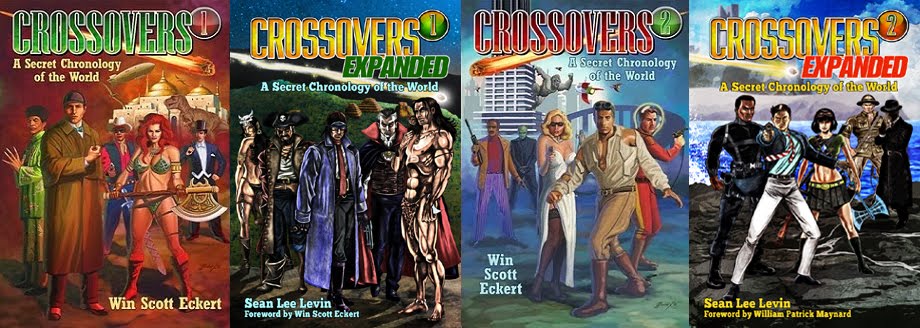
These crossovers are two of over a thousand covered in my book Crossovers Expanded: A Secret Chronology of the World Volume 3, coming this summer from Meteor House! All three volumes are AUTHORIZED companions to Win Scott Eckert's Crossovers: A Secret Chronology of the World Volumes 1 and 2

Wednesday, June 19, 2024

Crossover Cover: The Devil's Dust


Sherlock Holmes’ latest case brings he and Dr. Watson into contact with Allan Quatermain and Umslopogaas, who are trying to discover the true circumstances of the death of Quatermain’s son Harry. Quatermain talks about his encounter with Ayesha, She Who Must Be Obeyed. Holmes and Quatermain have never met before, and Holmes denies being related to Quatermain’s friend Lady Ragnall, nee Luna Holmes. Both these details differ from Thomas Kent Miller’s various Holmes/Quatermain crossover pastiches, which have been included in the CU. Also, Lovegrove’s version of Quatermain brags about his abilities, the opposite of the humble and self-effacing character H. Rider Haggard portrayed. Consequently, I consider this novel an AU.

This novel is one of over a thousand crossovers covered in my book Crossovers Expanded: A Secret Chronology of the World Volume 3, coming this summer from Meteor House! All three volumes are AUTHORIZED companions to Win Scott Eckert's Crossovers: A Secret Chronology of the World Volumes 1 and 2!

Sunday, October 1, 2023

Crossover of the Week

November 2000

SHEBA’S NECKLACE 

Maxim Gunn battles his old foe Wanda Liszt, who seeks to conquer Africa using Sheba’s necklace, the Great Snake. Sir Richard Trelawney knew Gunn’s maternal grandfather, James Rassendyll. Receiving a note about Wanda’s whereabouts signed only “T.,” Gunn orders more coffee, and thinks, “In what might have been the words of the immortal Holmes, it looked like being a three-pot problem.” A quotation from the rite Wanda intends to perform is given: “That is not dead which can eternal lie, and with strange aeons, even death may die.” Gunn thinks of a lover of his named Frances, and later about a man he’d known in Los Angeles’ Chinatown named Kwai Chang Caine. Gunn is helped by the Zulu M’hlopekazi, who identifies himself as the great-grandson of Umslopogaas who fought with Macumazahn. 

Novel by Nicholas Boving, originally published as Maxim Gunn and Sheba’s Necklace in 2012; revised as Maxim Gunn: Sheba’s Necklace, Pro Se Productions, 2017. The Great Snake is from John Buchan’s Prester John. Boving’s The Sun Fortress established that Gunn was a descendant of Rudolf Rassendyll from Anthony Hope’s The Prisoner of Zenda and Rupert of Hentzau. The immortal Holmes needs no introduction at this point. “That is not dead which can eternal lie, and with strange aeons even death may die” is a quotation from the Necronomicon appearing in H. P. Lovecraft’s “The Nameless City” and “The Call of Cthulhu.” Frances West is the protagonist of Boving’s Castle Dark, which has a prominent appearance by Gunn. Kwai Chang Caine II is from the television series Kung Fu: The Legend Continues. Umslopogaas is Allan Quatermain’s Zulu companion in H. Rider Haggard’s novels. “Macumazahn” was Quatermain’s nickname among the natives. At one point, Gunn thinks Oksana, High Priestess of the Temple of Am-mut, who uses a green flame to maintain her immortality, may have been the inspiration for Haggard’s character Ayesha. Since we know She-Who-Must-Be-Obeyed is a real person in the CU, Gunn is mistaken, but Oksana’s green flame may be connected to Ayesha’s Fire of Life. 

This crossover writeup is one of hundreds included in my book Crossovers Expanded: A Secret Chronology of the World Volume 3, to be published by Meteor House! All three volumes are AUTHORIZED companions to Win Scott Eckert's Crossovers: A Secret Chronology of the World Volumes 1 and 2!

Sunday, June 4, 2023

Crossover of the Week

Autumn 1928

MATTHEW HENSON AND THE ICE TEMPLE OF HARLEM

Matthew Henson must stop the would-be dictators of the Medusa Council from getting their hands on a meteor fragment he brought back from the Arctic. Henson’s friend Professor Henrik Ellsmere spent some time in a sanitarium called Dunwich. At the Cotton Club, a wealthy man flirts with a woman named Myra, who spent time in Asia, where she learned to speak Chinese. As he does this, Jimmie Dale, aka the Gray Seal, burgles his home. The Challenger’s Club, a club for explorers and hunters, has portraits of Allan Quatermain, Phileas Fogg, and Gertrude Bell. Henson disguises himself as a deliveryman for B. Jonas Freight.

Novel by Gary Phillips, Agora Books, 2020. Matthew Henson was a real person. The Medusa Council also appears in the Moonstone Books anthology Day of the Destroyers, edited by Phillips, as well as his collection Astonishing Heroes: Shades of Justice. Dunwich Sanitarium is likely located in the titular Massachusetts town from H. P. Lovecraft’s “The Dunwich Horror.” Myra is a future agent of the shadowy vigilante. “B. Jonas” was the name on the door of the office where that pulp hero’s agents submitted reports to him. Perhaps he met Matthew Henson shortly before the 1929 events of The Living Shadow and heard from him about his battle against the Medusa Council, inspiring his own use of the B. Jonas cover. The Gray Seal is from Frank L. Packard’s novels. Allan Quatermain is from H. Rider Haggard’s books and stories. Phileas Fogg is from Jules Verne’s Around the World in Eighty Days. According to this novel, the Challenger’s Club was already in existence during the historical New York draft riots of 1863, so it was not named after Arthur Conan Doyle’s Professor Challenger, who was born in the same year.

This crossover writeup is one of hundreds included in my book Crossovers Expanded: A Secret Chronology of the World Volume 3! Much like the first two volumes, this one is an AUTHORIZED companion to Win Scott Eckert's Crossovers: A Secret Chronology of the World Volumes 1 and 2 and will be published by Meteor House!

Monday, June 27, 2016

Crossover Cover: King Solomon's Mines

Hey, like H. Rider Haggard's Allan Quatermain novels?

Then you've probably read his first appearance, King Solomon's Mines. But did you notice that it contains references to the Count of Monte Cristo and Robinson Crusoe that sound like they refer to real people?

For all the details, check out my forthcoming books Crossovers Expanded Vols. 1 and 2, AUTHORIZED companions to Win Scott Eckert's Crossovers: A Secret Chronology of the World Vols. 1 and 2, debuting at the Meteor House booth at PulpFest/Farmercon on July 21-24!

Friday, October 9, 2015

Crossover Cover: Exiles of Kho

The priestess Lupoeth leads a band of her fellow Khokarsan exiles on a journey which results in the fulfillment of a prophecy she will found a great city. The god Sahhindar accompanies them, and says the city founded by Lupoeth and her companions will be very important to him. The foreword states the bulk of the story is derived from the recently discovered notebooks of Sir Beowulf William Clayton, the Oxford linguist who provided a partial translation of Phileas Fogg’s secret diary. The story has been reconstructed from Clayton’s translation of a tablet enigmatically designated “Holly 27-A.” Sahhindar refers to the star-shaped being from which the roots of the Tree of Kho emanate. Sahhindar and other members of Lupoeth’s group, including the priest Methquth, are captured by the K’goroshanaka tribe. Sahhindar later tells Lupoeth ingesting the nethkarna, the seed of the Tree, caused Methquth to experience visions of the future of Khokarsa. Exiles of Kho effectively serves as a prequel to Philip José Farmer’s Ancient Opar series, detailing how Lupoeth arrives at the site where she will build the city of Opar, from Edgar Rice Burroughs' novels. Sahhindar is the immortal, time-traveling John Gribardsun, as readers of Farmer’s Time’s Last Gift will recognize. Sir Beowulf William Clayton, a distant cousin of Gribardsun, is from Farmer’s The Other Log of Phileas Fogg. Holly is a reference to Ludwig Horace Holly from H. Rider Haggard’s novel She and its sequels. In She, Ayesha states her oracular powers only encompass events in Africa; her ability is derived from the same source as Methquth’s. According to Farmer, Ayesha’s native city, Kôr, was founded by Kohr, the son of Hadon of Opar. The star-shaped being is from Farmer’s translation and adaptation of J.-H. Rosny aîné’s Ironcastle. The K’goroshanakas are the ancestors of the Goura-Zannkas from Ironcastle.


Friday, June 20, 2014

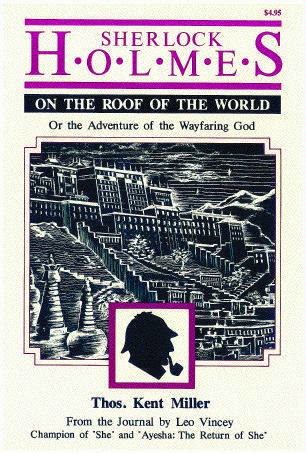
Crossover Cover: Sherlock Holmes on the Roof of the World

In this novel, Ludwig Horace Holly and Leo Vincey (from H. Rider Haggard's novels about Ayesha, aka She-who-must-be-obeyed) encounter a Norwegian named Sigerson in a Tibetan monastery. Sigerson, whom readers of Conan Doyle's "The Adventure of the Empty House" know is a supposedly dead Sherlock Holmes, investigates the murder of the monastery's head librarian. Kent has written two more Holmes pastiches, both featuring Haggard's Allan Quatermain and other literary characters, The Great Detective at the Crucible of Life (which Win included in Volume 1, along with its predecessor) and Allan Quatermain at the Dawn of Time, which will be in the new volumes. Two continuity-related matters must be noted regarding The Great Detective at the Crucible of Life. The death of Axel Lidenbrock (from Jules Verne's Journey to the Centre of the Earth) must be exaggerated, as he appears alive and well in the first chapter of John Peel's serial story "Return to the Center of the Earth" (set in 1872) and  Pete Rawlik's story "The Issue of Dr. Jekyll" (set in 1882), and is mentioned as having encountered General Zaroff (from Richard Connell's "The Most Dangerous Game") during World War I in Joshua Reynolds and Micah S. Harris' novel Jim Anthony: Super Detective Volume Two - The Hunters. Secondly, as Win noted in his writeup for the book, Miller must be incorrect in his speculation that Professor Moriarty was really Sherrinford Holmes, Sherlock's older brother, and that Sherrinford was also Jack the Ripper.