
"The Blood of Raizor" is set in 11,550 BCE. In Northeast Africa, the lion Raizor and his sons, Tyton and Rohrdeth, battle a leopard-like alien. Raizor is killed, but his sons are changed by devouring the flesh of their foe. Tyton finds himself invulnerable, possessing more powerful claws, and unaging. In Nemea, he is slain by Heracles. Rohrdeth and his descendants possess a golden hide and enhanced intelligence and senses. The alien is of the same race as Coeurl from A. E. van Vogt’s “Black Destroyer.” According to Philip José Farmer’s Time’s Last Gift, Heracles was really John Gribardsun, an immortal time traveler from the future. One of Rohrdeth’s descendants will have a connection to Gribardsun.
In "Galazi in the Enchanted City," Galazi the Wolf investigates the murders of three members of his tribe of “ghost-wolves,” not far from the village of the People of the Axe, led by his friend Umslopogaas. Galazi sees a baobab tree that bears the images of the so-called demons of Lake Tanganyika: Loubari, Mgoussa, and Mousammouria. Galazi is captured and taken to a temple whose roof bears a grey stone sphere with a winged marble woman atop it. He is brought before Queen Touloumia of Mkinyaga. Long ago, the capital of Touloumia’s nation, Akribanza, was just one of a hundred cities in the vast empire of Kôr. A cavern wall bears the image of a man with a knife and a bow. The witch Nomma receives visions from the waters of a crystal basin. Among these visions are a muscular bronze-skinned youth breaking a leopard’s back, a bronze-skinned swordsman and a bearded giant battling soldiers, another bronze-skinned young man and a one-eyed dwarf, a white man wielding a cat-headed staff, a giant looking much like the earlier one battling what appears to be an older version of Umslopogaas, and a black warrior wielding the same type of sword as the bronzed swordsman fighting alongside a grey-haired white man and a robed bronze-skinned man battling beastly creatures near a giant crystalline stalk. Galazi the Wolf is from H. Rider Haggard’s Nada the Lily. Umslopogaas appears in not only that book, but the Allan Quatermain series as well. Loubari, Mgoussa, Mousammouria, and Queen Touloumia are from Eugène Hennebert’s The Enchanted City. The statue of the winged woman is a symbol of Truth seen in Haggard’s She and Philip José Farmer and Christopher Paul Carey’s The Song of Kwasin. Kôr is the city ruled by Ayesha, She-Who-Must-Be-Obeyed. The man with the knife and bow is Sahhindar from Farmer’s Khokarsa series. Sahhindar is also the immortal time traveler John Gribardsun from Farmer’s Time’s Last Gift, but he is best known as the lord of the apes. The crystal basin is from Haggard’s She and Allan. The bronze-skinned youth is King Minruth from the Ancient Opar books in his younger years. The bronze-skinned swordsman and the bearded giant are Hadon of Opar and his cousin Kwasin from the Ancient Opar series. The other bronze-skinned young man is Hadon’s son Kohr, while the one-eyed dwarf is Paga, whom Farmer meant to be Pag from Haggard’s Allan and the Ice-Gods. The white man with the cat-headed staff is Robert E. Howard’s Puritan adventurer Solomon Kane. The battle between Umslopogaas and the bearded giant Rezu (whose description is identical to Kwasin’s, whose fate is left open-ended at the end of The Song of Kwasin) is depicted in She and Allan. The black warrior, N’desi, is from Carey and Win Scott Eckert’s “Iron and Bronze.” The grey-haired man is Hareton Ironcastle from J.-H. Rosny Aîné’s Hareton Ironcastle’s Amazing Adventure, adapted and translated by Farmer as Ironcastle. The bronze man is Doc Ardan from Guy d’Armen’s Doc Ardan: City of Gold and Lepers, who Jean-Marc and Randy Lofficier’s translation identified with a certain bronze-skinned doctor and crimefighter. The beastly creatures are the Wandarobo from John Peter Drummond’s Ki-Gor pulp stories, who Carey and Eckert implied to be exiles from Opar, originally from the Tarzan novels. The crystalline stalk is an extension of the mineral-vegetable-king from Ironcastle, and related to the Crystal Tree of Time from Farmer’s Tarzan and the Dark Heart of Time.
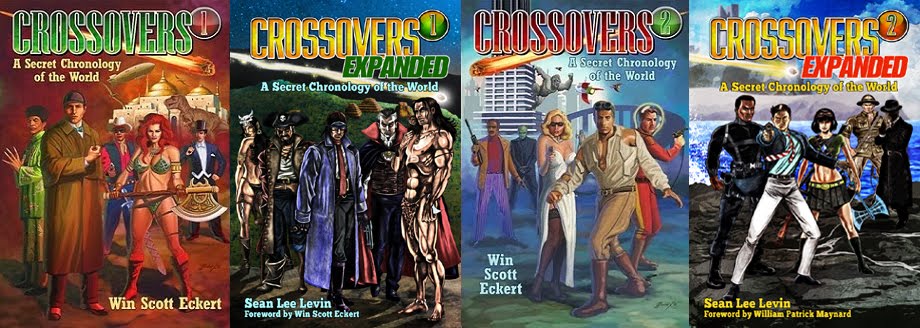
These crossovers are two of over a thousand covered in my book Crossovers Expanded: A Secret Chronology of the World Volume 3, coming this summer from Meteor House! All three volumes are AUTHORIZED companions to Win Scott Eckert's Crossovers: A Secret Chronology of the World Volumes 1 and 2!

