Showing posts with label She-who-must-be-obeyed. Show all posts

Wednesday, July 10, 2024

Crossover Cover: Strange Incursions


This chapbook contains two stories by Jason Scott Aiken.

"The Blood of Raizor" is set in 11,550 BCE. In Northeast Africa, the lion Raizor and his sons, Tyton and Rohrdeth, battle a leopard-like alien. Raizor is killed, but his sons are changed by devouring the flesh of their foe. Tyton finds himself invulnerable, possessing more powerful claws, and unaging. In Nemea, he is slain by Heracles. Rohrdeth and his descendants possess a golden hide and enhanced intelligence and senses. The alien is of the same race as Coeurl from A. E. van Vogt’s “Black Destroyer.” According to Philip José Farmer’s Time’s Last Gift, Heracles was really John Gribardsun, an immortal time traveler from the future. One of Rohrdeth’s descendants will have a connection to Gribardsun.

In "Galazi in the Enchanted City," Galazi the Wolf investigates the murders of three members of his tribe of “ghost-wolves,” not far from the village of the People of the Axe, led by his friend Umslopogaas. Galazi sees a baobab tree that bears the images of the so-called demons of Lake Tanganyika: Loubari, Mgoussa, and Mousammouria. Galazi is captured and taken to a temple whose roof bears a grey stone sphere with a winged marble woman atop it. He is brought before Queen Touloumia of Mkinyaga. Long ago, the capital of Touloumia’s nation, Akribanza, was just one of a hundred cities in the vast empire of Kôr. A cavern wall bears the image of a man with a knife and a bow. The witch Nomma receives visions from the waters of a crystal basin. Among these visions are a muscular bronze-skinned youth breaking a leopard’s back, a bronze-skinned swordsman and a bearded giant battling soldiers, another bronze-skinned young man and a one-eyed dwarf, a white man wielding a cat-headed staff, a giant looking much like the earlier one battling what appears to be an older version of Umslopogaas, and a black warrior wielding the same type of sword as the bronzed swordsman fighting alongside a grey-haired white man and a robed bronze-skinned man battling beastly creatures near a giant crystalline stalk. Galazi the Wolf is from H. Rider Haggard’s Nada the Lily. Umslopogaas appears in not only that book, but the Allan Quatermain series as well. Loubari, Mgoussa, Mousammouria, and Queen Touloumia are from Eugène Hennebert’s The Enchanted City. The statue of the winged woman is a symbol of Truth seen in Haggard’s She and Philip José Farmer and Christopher Paul Carey’s The Song of Kwasin. Kôr is the city ruled by Ayesha, She-Who-Must-Be-Obeyed. The man with the knife and bow is Sahhindar from Farmer’s Khokarsa series. Sahhindar is also the immortal time traveler John Gribardsun from Farmer’s Time’s Last Gift, but he is best known as the lord of the apes. The crystal basin is from Haggard’s She and Allan. The bronze-skinned youth is King Minruth from the Ancient Opar books in his younger years. The bronze-skinned swordsman and the bearded giant are Hadon of Opar and his cousin Kwasin from the Ancient Opar series. The other bronze-skinned young man is Hadon’s son Kohr, while the one-eyed dwarf is Paga, whom Farmer meant to be Pag from Haggard’s Allan and the Ice-Gods. The white man with the cat-headed staff is Robert E. Howard’s Puritan adventurer Solomon Kane. The battle between Umslopogaas and the bearded giant Rezu (whose description is identical to Kwasin’s, whose fate is left open-ended at the end of The Song of Kwasin) is depicted in She and Allan. The black warrior, N’desi, is from Carey and Win Scott Eckert’s “Iron and Bronze.” The grey-haired man is Hareton Ironcastle from J.-H. Rosny Aîné’s Hareton Ironcastle’s Amazing Adventure, adapted and translated by Farmer as Ironcastle. The bronze man is Doc Ardan from Guy d’Armen’s Doc Ardan: City of Gold and Lepers, who Jean-Marc and Randy Lofficier’s translation identified with a certain bronze-skinned doctor and crimefighter. The beastly creatures are the Wandarobo from John Peter Drummond’s Ki-Gor pulp stories, who Carey and Eckert implied to be exiles from Opar, originally from the Tarzan novels. The crystalline stalk is an extension of the mineral-vegetable-king from Ironcastle, and related to the Crystal Tree of Time from Farmer’s Tarzan and the Dark Heart of Time.

These crossovers are two of over a thousand covered in my book Crossovers Expanded: A Secret Chronology of the World Volume 3, coming this summer from Meteor House! All three volumes are AUTHORIZED companions to Win Scott Eckert's Crossovers: A Secret Chronology of the World Volumes 1 and 2

Wednesday, June 19, 2024

Crossover Cover: The Devil's Dust


Sherlock Holmes’ latest case brings he and Dr. Watson into contact with Allan Quatermain and Umslopogaas, who are trying to discover the true circumstances of the death of Quatermain’s son Harry. Quatermain talks about his encounter with Ayesha, She Who Must Be Obeyed. Holmes and Quatermain have never met before, and Holmes denies being related to Quatermain’s friend Lady Ragnall, nee Luna Holmes. Both these details differ from Thomas Kent Miller’s various Holmes/Quatermain crossover pastiches, which have been included in the CU. Also, Lovegrove’s version of Quatermain brags about his abilities, the opposite of the humble and self-effacing character H. Rider Haggard portrayed. Consequently, I consider this novel an AU.

This novel is one of over a thousand crossovers covered in my book Crossovers Expanded: A Secret Chronology of the World Volume 3, coming this summer from Meteor House! All three volumes are AUTHORIZED companions to Win Scott Eckert's Crossovers: A Secret Chronology of the World Volumes 1 and 2!

Tuesday, May 28, 2024

Crossover Covers: Adler


In 1902, nurse Jane Eyre returns from the Boer War and takes up rooms at Briony Lodge with Irene Adler. Soon, they must stop Ayesha, She-Who-Must-Be-Obeyed, from destroying London. Along with various characters from the Holmes stories, also appearing are Estella Havisham (from Charles Dickens’ Great Expectations), Carmilla, Arthur Raffles, King Rudolf V of Ruritania, Queen Flavia, Rupert of Hentzau, Dr. Seward, the Demeter, Phileas Fogg, and Dr. Jekyll. Various anachronisms and reinterpretations of characters make this an AU. 

This crossover is one of over a thousand covered in my book Crossovers Expanded: A Secret Chronology of the World Volume 3, coming this summer from Meteor House! All three volumes are AUTHORIZED companions to Win Scott Eckert's Crossovers: A Secret Chronology of the World Volumes 1 and 2!

Sunday, February 21, 2016

Crossover of the Week

2003
THE BIG GAME
John Taylor battles Sir Francis Varney, the King of the Vampires, who is trying to turn the Nightside into a homeland for the undead. Appearing or mentioned are: Tsothagua Tequila; Jack Drood; the Street of the Gods; Kor; Julien Advent; Something from a Black Lagoon; the withered and mummified arm of the original Grendel monster, presented to the Adventurers Club by Beowulf himself, back in the sixth century; an ex-Ghost Finder; some kind of Boojum; the Suicide Club; Dracula; and Rassillonn’s Restorative.
Novella by Simon R. Green in Tales from the Nightside, Ace Books, 2015. Sir Francis Varney is from James Malcolm Rymer’s penny dreadful serial Varney the Vampire. Tsothagua Tequila is a reference to Tsathoggua, a Great Old One created by Clark Ashton Smith as part of H. P. Lovecraft’s Cthulhu Mythos. Jack Drood is from Green’s Secret Histories novels; his appearance here places this story before the short story “Question of Solace.” The Street of the Gods is from Green’s Hawk & Fisher novellas Winner Takes All and The God Killer. Kor is from H. Rider Haggard’s novel She. Julien Advent is an alias for the titular hero of the 1960s British television series Adam Adamant Lives! Something from a Black Lagoon is a reference to the Universal horror film Creature from the Black Lagoon. The original Grendel monster and Beowulf are from the Old English epic poem Beowulf. The ex-Ghost Finder must have been a former member of the Carnacki Institute from Green’s Ghost Finders series. The Boojum is from Lewis Carroll’s poem “The Hunting of the Snark.” The Suicide Club is from Robert Louis Stevenson’s story of the same name. Dracula needs no introduction. Rassillonn’s Restorative is a reference to the Time Lord Rassilon from the long-running British science fiction television series Doctor Who.

Friday, October 9, 2015

Crossover Cover: Exiles of Kho

The priestess Lupoeth leads a band of her fellow Khokarsan exiles on a journey which results in the fulfillment of a prophecy she will found a great city. The god Sahhindar accompanies them, and says the city founded by Lupoeth and her companions will be very important to him. The foreword states the bulk of the story is derived from the recently discovered notebooks of Sir Beowulf William Clayton, the Oxford linguist who provided a partial translation of Phileas Fogg’s secret diary. The story has been reconstructed from Clayton’s translation of a tablet enigmatically designated “Holly 27-A.” Sahhindar refers to the star-shaped being from which the roots of the Tree of Kho emanate. Sahhindar and other members of Lupoeth’s group, including the priest Methquth, are captured by the K’goroshanaka tribe. Sahhindar later tells Lupoeth ingesting the nethkarna, the seed of the Tree, caused Methquth to experience visions of the future of Khokarsa. Exiles of Kho effectively serves as a prequel to Philip José Farmer’s Ancient Opar series, detailing how Lupoeth arrives at the site where she will build the city of Opar, from Edgar Rice Burroughs' novels. Sahhindar is the immortal, time-traveling John Gribardsun, as readers of Farmer’s Time’s Last Gift will recognize. Sir Beowulf William Clayton, a distant cousin of Gribardsun, is from Farmer’s The Other Log of Phileas Fogg. Holly is a reference to Ludwig Horace Holly from H. Rider Haggard’s novel She and its sequels. In She, Ayesha states her oracular powers only encompass events in Africa; her ability is derived from the same source as Methquth’s. According to Farmer, Ayesha’s native city, Kôr, was founded by Kohr, the son of Hadon of Opar. The star-shaped being is from Farmer’s translation and adaptation of J.-H. Rosny aîné’s Ironcastle. The K’goroshanakas are the ancestors of the Goura-Zannkas from Ironcastle.


Saturday, June 20, 2015

Crossover Cover: Live and Let Drood

Eddie Drood discovers that the murdered Droods and the damaged Drood Hall that he has come home to are from a different dimension, meaning that his family has been sent somewhere else, and sets out to find them, going up against Unholy Crow Lee, the most evil man in the world. Appearing or mentioned are: Merlin’s Glass (an alternate universe version of the one seen in Green's Nightside books); the Nightside, Walker, the London Knights, John Taylor, Dead Boy, the Walking Man, Augusta Moon, Kayleigh’s Eye and the Salvation Army Sisterhood (all from the Nightside series); the Kandarian language (a nod to the Kandarian demons from the Evil Dead films); Castle Frankenstein (from Mary Shelley's novel); an ancient flame that bestows eternal youth (from H. Rider Haggard's Ayesha books); tana leaves (from Universal Studios' original Mummy film series); the Carnacki Institute and Catherine Latimer (from Green's Ghost Finders books); MI13 (the CU version of the British government agency seen in the Marvel Universe); an old Transylvanian vampire count who was trying to set himself up in England (Dracula); the Scooby-Doo gang (self-explanatory); SAS combat sorcerers (from Warren Ellis' comic Gravel); and the Traveling Doctor, who said that bow ties are cool (the CU version of the Doctor of Doctor Who fame, specifically his eleventh incarnation.)

Friday, March 27, 2015

Crossover Covers: Nemo

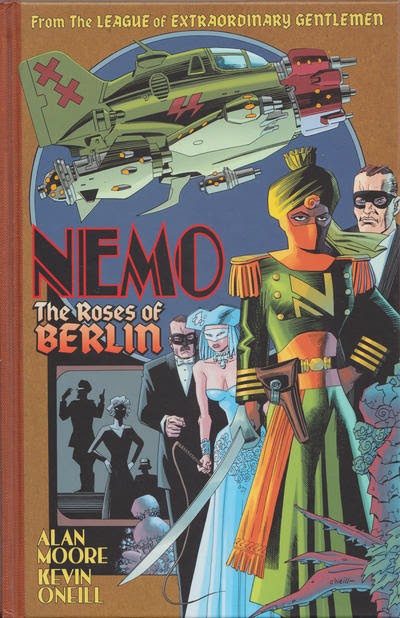
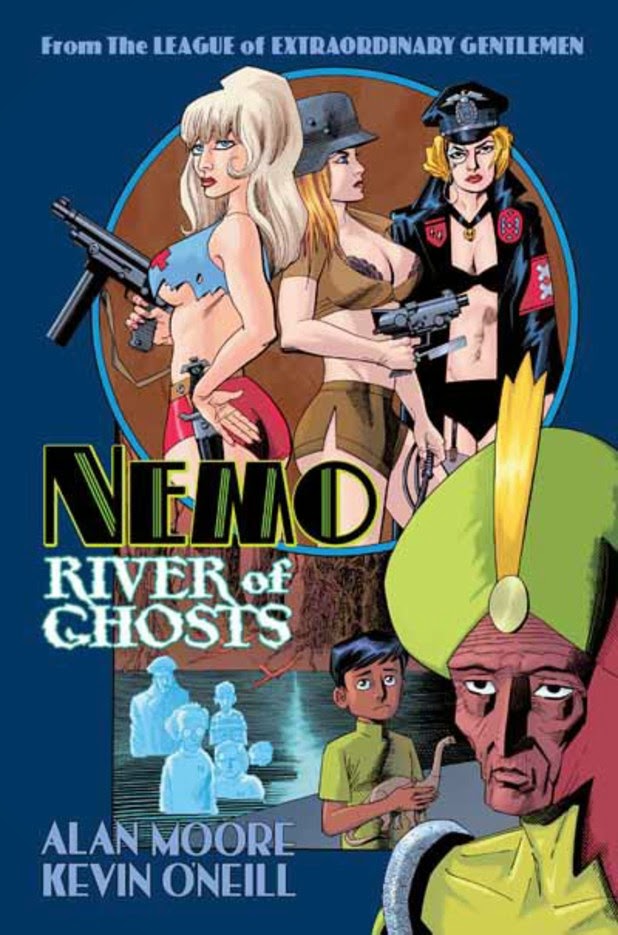
This trilogy of graphic novels features a decades long feud between Janni Dakkar (aka Janni Nemo), Captain Nemo's daughter and heir, and the immortal queen Ayesha from H. Rider Haggard's She. Janni inherited her father's mantle in The League of Extraordinary Gentlemen Volume III: Century: 1910. I have already concluded that Century does not fit into CU continuity, and the Nemo novels do not fit either, as will be shown below. In Nemo: Heart of Ice, Janni follows the trail of her father’s Antarctic expedition from decades ago after plundering Ayesha's treasures. Ayesha’s current patron, newspaper magnate Charles Foster Kane (from Orson Welles’ film Citizen Kane) dispatches aging inventors Frank Reade Jr. and Jack Wright and their younger colleague “Tom Swyfte” to retrieve the Queen’s belongings and deal with Janni and her crew. Tom Swift is portrayed in an unflattering manner, making racist comments about Janni and shooting Reade in the leg with his Electric Rifle in order to slow down a raging shoggoth, effectively leaving the elder inventor to die. Swift is also seemingly driven irrevocably insane by the encounter with the shoggoth, which does not fit with his appearances in the Tom Swift Jr. novels in the 1950s-1970s. In Nemo: The Roses of Berlin, set in 1941, Janni and her husband Broad Arrow Jack must rescue their daughter Hira and son-in-law Armand Robur (son of Jules Verne’s Robur the Conqueror) from captivity in Nazi Germany, which is under the power of Ayesha’s current benefactor, Adenoid Hynkel (from Charlie Chaplin’s film The Great Dicator). In the process, they battle the remains of Germany’s equivalent of the League of Extraordinary Gentlemen, Die Zwielichthelden (“The Twilight Heroes”.) The Berlin of 1941 in this graphic novel is based on the titular futuristic city from Fritz Lang’s film Metropolis. Finally, in Nemo: River of Ghosts, Janni, dying and experiencing hallucinations of the ghosts of those she’s lost over the years, deals with Ayesha once and for all in South America in 1975. Janni hires the superhumanly strong Hugo Coghlan, aka Hugo Hercules (the title character of a 1902-1903 comic strip by William H.D. Koerner, who is revealed here to be the Celtic demigod Cuchulainn) to act as her bodyguard. Hugo says that he was paid by “a Mr. Savage Senior” to kill Hugo Danner (the equally superstrong protagonist of Philip Wylie’s novel Gladiator) soon after the Great War, though why Savage paid him to do this is not stated. Given the strong moral code he instilled in his son, it seems very unlikely that Doc Savage’s father, Clark Savage Sr., would put out a contract on another man’s life.