Showing posts with label Rocambole. Show all posts

Sunday, May 5, 2024

Crossover of the Week

Summer 1911

HOW THE PROFESSOR TAUGHT A LESSON TO THE GNOLES 

Professor Moriarty is hired by the thief Nuth to help him plunder the treasures of the creatures known as the gnoles. Nuth says thieves trace their lineage to Slith, and before him Prometheus, and that the history of thievery is as storied as that of any noble house in Ruritania or Celephais. He also asks Moriarty, “Shall I allow the foreigner Rocambole or the dissolute Raffles to wear the crown that is rightfully mine, then?” Moriarty has a tank which is based on the designs of “a certain Sikh of my acquaintance.” Moriarty says he will teach the gnoles the lessons of Troy, of Sarnath, and of Peking. 

Story by Josh Reynolds in The Adventures of Moriarty, Maxim Jakubowski, ed., Robinson, 2015. Nuth and the gnoles are from Lord Dunsany’s “How Nuth Would Have Practiced His Art Upon the Gnoles.” Slith, besides being mentioned in that story, appears in Dunsany’s “Probable Adventure of the Three Literary Men”; both stories are included in the collection The Book of Wonder. Ruritania is from Anthony Hope’s The Prisoner of Zenda. Celephais and Sarnath are from the works of H. P. Lovecraft. Rocambole is Ponson du Terrail’s adventurer. A. J. Raffles is E. W. Hornung’s gentleman thief. The Sikh is Captain Nemo. Rick Lai’s “The Secret History of Captain Nemo” and The League of Extraordinary Gentlemen indicate Nemo would have no reason to do Moriarty any favors, so the Professor must have stolen his old foe’s technology. 

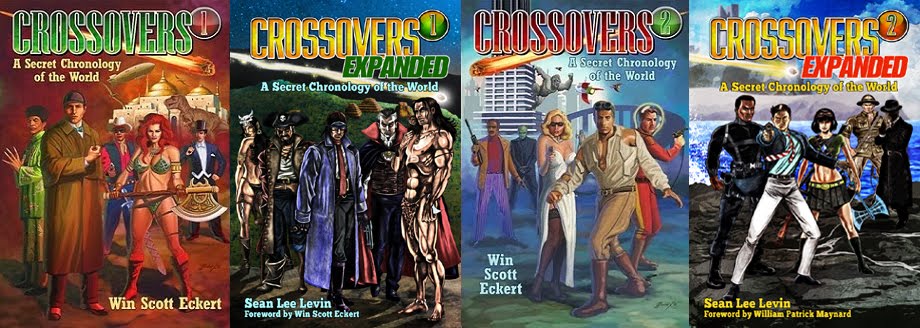
This crossover writeup is one of over a thousand appearing in my book Crossovers Expanded: A Secret Chronology of the World Volume 3, coming this summer from Meteor House! All three volumes are AUTHORIZED companions to Win Scott Eckert's Crossovers: A Secret Chronology of the World Volumes 1 and 2!

Sunday, March 5, 2023

Crossover of the Week

Spring 1868-1876 
THY NAME IS SABBATH 
A failed murder sets in motion an eight-year-long series of events that leads to a bounty hunter adopting the alias of Major D. M. Sabbath. Appearing or mentioned are: Jimmy Ballantrae (aka Valentin L’Ollonaise); Bougival Junction; Otto Stejar; Colonel Heinrich Von Skimmel; the Black Indian (aka Christian Adam Sabbath); Red Galloway; the Crazy Indian; Isaiah; Brockston-Morton Railways; Arthur Gordon; Leroy Bailey; the Hellbender Regiment; Randall; Sheriff Priam Ramsey; Hatfield; Paolo di Marco and his nephew Gino; Philip “Hot Lead” Holden; Marty Heywood; Lieutenant Tervis; Colonel Jonas Leland; Giddy Burnett; Samson McDade; Jake Sartana (aka the Ace of Hearts); “that crazy Englishman who made a bet this year about traveling around the world in 80 days”; the Gentlemen of the Night; Fergus O’Breane; Jason McIntock; O’Breane’s successor in London; Redstone; Rocambole; William LeFrank Gordon, aka Bill Gordon and Frank Gordon; Baron Gustav Von Schulenberg; Enrique Claudin; the Chupin Detective Agency; Grandville Fuller; Lost Knob, Texas; Christian Adam Sabbath, Jr.; Arthur Gordon’s wife Xaviera; Skurlock; Mitchell Stangerson; Ignacz Djanko; the J. V. Harden Tobacco Company; Bryant’s Gap; Delilah L’Ollonaise; Madame Delphine; Hot Lead’s son; John Gordon; Snow Hill County; Judge Cutthroat; Bennet’s Raiders; Specs; Horst Drebber; the Council of Four; John Ferrier; Count Stanislaus Kowalski; Anton Niklas Petersen; San Miguel; the Drifter with Many Names; Chadwell; the Black Coats; Regina; Louie Gordon; Sgt. Boomerang Smith; Captain Younger; and Delta Valley, California. 
Story by Rick Lai in Rick Lai’s Major Sabbath, Ron Fortier, ed., Airship 27 Productions, 2016. Major D. M. Sabbath is a conflation of Colonel Douglas Mortimer from the movie For a Few Dollars More with the title character of the movies Sabata and Return of Sabata, both played by Lee Van Cleef. Jimmy Ballantrae is meant to be Ballantine from the movie Adiós, Sabata. Stejar and Colonel Skimmel are also from that film. The Black Indian is meant to be the title character of Adiós, Sabata, also known as Indio Black, and played by Yul Brynner. Bougival Junction is from the movie Frenchie King. Red Galloway is a combination of Lee Galloway, the actual protagonist of the inaccurately titled film Sartana in the Valley of Death, with Banjo from Sabata; William Berger played both roles. The Crazy Indian and Isaiah are El Indio and Prophet from For a Few Dollars More. Brockston-Morton Railways is a conflation of the Brockston railroad company from the movie The Big Gundown with the Morton railroad company from the film Once Upon a Time in the West. William LeFrank Gordon is a combination of William L. “Bill” Gordon from Robert E. Howard’s “The Dead Remember” with Frank from Once Upon a Time in the West. Baron Von Schulenberg is from The Big Gundown. Here, he is Colonel Skimmel’s cousin; both characters were played by Gérard Herter. Arthur Gordon is from Emile Gaboriau’s La Vie Infernale. The Chupin Detective Agency is also from Gaboriau’s works. Bailey is from the movie Hannie Caulder. Specs is another character from that film, Thomas Luther Price. The Hellbender Regiment and Colonel Jonas are from the movie The Hellbenders. Jonas’ surname of Leland implies a genealogical relationship to Jed Leland from Citizen Kane; Joseph Cotten played both characters. Randall is bounty hunter Josh Randall from the TV series Wanted: Dead or Alive. Sheriff Priam Ramsey is the father of the title character of the TV show Hec Ramsey. Samson McDade is Sam McDade from the Hec Ramsey episode “Scar Tissue.” Hatfield is from the movie Stagecoach. Paolo and Gino di Marco are from the Have Gun – Will Travel episode “The High Graders.” Delta Valley, California is where Paladin adopted his alias in the Have Gun – Will Travel episode “Genesis.” Philip “Hot Lead” Holden is meant to be “Hot Dead” Holden from the movie I Am Sartana, Your Angel of Death. Sartana is a spaghetti western hero played by Gianni Garko, who also portrayed a virtually identical character called the Ace of Hearts in A Bullet for a Stranger. Grandville Fuller is from Light the Fuse...Sartana Is Coming. Marty Heywood is from the movie Wanted. Lieutenant Tervis is meant to be Clyde from Return of Sabata. Jason McIntock is related to Joe McIntock from the same film. In Return of Sabata, it is revealed Sabata left a woman at the altar in Redstone who later gave birth to his son; Delilah L’Ollonaise is meant to be that woman. Giddy Burnett (later Sheriff Gideon Burnett), Hot Lead’s son (Loco, played, like Hot Dead himself, by Klaus Kinski), John Gordon, Snow Hill County, Judge Cutthroat (Henry Pollicut), Regina, and Louie Gordon (Silence) are from the movie The Great Silence. “That crazy Englishman” is Phileas Fogg from Jules Verne’s Around the World in Eighty Days. The Gentlemen of the Night are from Paul Féval’s novel of the same name, as is Fergus O’Breane. The Black Coats are featured in a series of novels by Féval. O’Breane’s successor in London is Professor Moriarty, Sherlock Holmes’ archenemy. Stangerson, Drebber, the Council of Four, and John Ferrier are from Doyle and Watson’s first Holmes novel, A Study in Scarlet. The J. V. Harden Tobacco Company is based on a reference to a tobacco millionaire named John Vincent Harden in the Holmes tale “The Adventure of the Solitary Cyclist.” Rocambole is the protagonist of a series of novels by Ponson du Terrail. Enrique Claudin is really Erik, the title character of Gaston Leroux’s The Phantom of the Opera, using an alias. Erique Claudin was the Phantom’s real name in the 1943 film adaptation of the novel. Lost Knob, Texas is from Robert E. Howard’s “Graveyard Rats,” “Old Garfield’s Heart,” and “Wild Water.” Christian Adam Sabbath, Jr. is meant to be Chris Adams from the Magnificent Seven film series; he was played variously by Yul Brynner (The Magnificent Seven and Return of the Magnificent Seven), George Kennedy (Guns of the Magnificent Seven), and Lee Van Cleef (The Magnificent Seven Ride!) The implication of Arthur Gordon’s marriage to Xaviera LeFrank, the stage name of actress Francine Xavier, is that he is the grandfather of Robert E. Howard’s adventurer Francis X. Gordon, aka El Borak. Skurlock, Texas is from Howard’s “Black Wind Blowing.” Ignacz Djanko is the title character of the movies Django and Django Strikes Again. Bryant’s Gap is where a group of Texas Rangers, including Dan Reid, were massacred by Butch Cavendish’s gang; the sole survivor, Dan’s brother John Reid, adopted the guise of the Lone Ranger. Madame Delphine is Delphine Yant from Louis L’Amour’s The Proving Trail. In that novel, it is said that the Yant family also uses the aliases of Cabanus and L’Ollonaise. Bennet’s Raiders are from the movie Face to Face. Count Stanislaus Kowalski is really A. J. Raffles’ foe Count Corbucci from E. W. Hornung’s “The Fate of Faustina” and “The Last Laugh,” while Anton Niklas Petersen is in fact Guy Boothby’s villain Dr. Antonio Nikola. The names Kowalski and Petersen evoke Yodlaf Peterson and Sergei Kowalski, Franco Nero’s characters in the movies Compañeros and The Mercenary, respectively. San Miguel is a Mexican border town seen in four Eurowesterns: El Rojo, A Fistful of Dollars; Run, Man, Run, the sequel to The Big Gundown; and A Bullet for the General. The Drifter with Many Names is the Man with No Name from Sergio Leone’s “Dollars Trilogy.” His aliases are based on the names used for the character in each film: Joe Limbo (Joe in A Fistful of Dollars); Lefty (Manco in For a Few Dollars More); and Rubio (Blondie in The Good, the Bad, and the Ugly). Major (formerly Captain) Chadwell, Sgt. Boomerang Smith (Sgt. Jeremiah Smith), and Captain (formerly Lt.) Cole Younger are from the movie Charge! (aka Those Dirty Dogs). 

This crossover is only one of hundreds covered in my book Crossovers Expanded: A Secret Chronology of the World Volume 3, which will be published by the fine folks at Meteor House! All three volumes are AUTHORIZED companions to Win Scott Eckert's books Crossovers: A Secret Chronology of the World Volumes 1 and 2!
Sunday, May 15, 2016

Crossover of the Week

2012
THE IDES OF MARS
Martin Mystère finds himself in a holographic representation of Mars, where he is greeted by Colonel Bozzo and the Marchef. Bozzo is the head of the criminal organization once called the Brotherhood of Mercy or the Black Coats, now known as BlackSpear Holdings. Meanwhile, in Los Angeles, the Nyctalope prepares to do battle with the last survivor of the evil Martians he destroyed decades ago. Bozzo tells Martin some of the Martians’ technology was acquired by Kiang-Ho of the Golden Belt, who was defeated by Rama Rundjee, alias Doctor Mystère, after whom Martin was named. He also says Jean de La Hire was the Nyctalope’s biographer, just as Watson was Holmes,’ Ponson du Terrail was Rocambole’s, Burroughs was Greystoke’s, and Féval was Bozzo’s own. Bozzo knew Martin’s ancestor Remy d’Arx very well.
Short story by Jean-Marc Lofficier in Night of the Nyctalope, Jean-Marc and Randy Lofficier, eds., Black Coat Press, 2012; reprinted in French in La Nuit du Nyctalope, Jean-Marc and Randy Lofficier, eds., Rivière Blanche, 2012. Martin Mystère’s exploits have been portrayed in comics by Alfredo Castelli. Colonel Bozzo (aka Colonel Bozzo-Corona), the Marchef, the Black Coats, and Remy d’Arx appear in a series of novels by Paul Féval. BlackSpear Holdings, the present-day incarnation of the Black Coats, also appears in Castelli and Lofficier’s graphic novel The Treasure of the Veste Nere and Lofficier’s novel The Katrina Protocol. The Nyctalope was the hero of French pulp stories by Jean de La Hire. Kiang-Ho of the Golden Belt is the archenemy of Philip Reade’s dime novel boy inventor (or “Edisonade”) Tom Edison Jr. Doctor Mystère’s adventures were recounted by Paul d’Ivoi; Castelli has established the Doctor’s adopted son Cigale is Martin Mystère’s great-great-grandfather.

Sunday, February 8, 2015

Crossover of the Week


1911
THE LEGACY OF ARSÈNE LUPIN
            Arsène Lupin, disguised as Prince Sernine, tells his biographer Maurice Leblanc a tale involving the Comte de Guy’s ownership of d’Artagnan’s sword, having heard rumors of how the Comte acquired it: “There’s been talk of dealings with the Chinese fence, Hanoi Shan—his path has crossed Lupin’s before—rumors of a murderous thug named Gurn…half-whispered rumors of Cagliostro, Saint-Germain, and the Englishman Barrington, who had defrauded the great Cagliostro of a fortune and the sword; talk that the sword had once been the trust of one Prince Rodolphe; that it was stolen by Colonel Bozzo-Corona or by that young rogue Rocambole; that British cracksman took a shot at it; and there was a suggestion the Devil Doctor in Limehouse had shown an interest; Josephine Balsamo’s name came up…” The sword was brought to Lupin’s attention by the young journalist Rouletabille. The Comte asks Lupin, in his guise as M. Lenormand, head of the Sûreté Nationale, to guard his valuables at a masked ball. Lupin says, “Even old Lecoq might have found himself challenged by this problem!,” and assures the Comte, “The cracksman Bunn is in Perth, by all accounts, and that Englishman Raffles who has plagued Scotland Yard has not been heard of since the Boer War.” The Comte introduces “Lenormand” to his daughter, the Comtesse Emmeline de Guy. Lupin encounters a young boy who calls himself “Stephen Tarleton” and wishes to steal the sword from the Comte. The Comte stores his valuables in a safe made by the Dale company in New York, which the American called the Gray Seal had remarkable luck in cracking. Marie Antoinette’s necklace was stolen by Cagliostro, then in England by George Barrington, the Picaroon, king of the London underworld, and from the Dreux-Soubize family by Lupin himself, as a boy. Lupin recognizes members of Paris’ infamous Vampires and the Union Corse from Marseilles at the ball, as well as deadly enemies of the English cracksman, Cleek.
            Short story by David L. Vineyard in Tales of the Shadowmen Volume 11: Force Majeure, Jean-Marc and Randy Lofficier, eds., Black Coat Press, 2014. Arsène Lupin, the Dreux-Soubize family, and Josephine Balsamo are from Maurice Leblanc’s novels. The Comte de Guy is one of the many aliases used by Carl Peterson, the archenemy of H.C. “Sapper” McNeile’s adventurer Bulldog Drummond. The Countesse Emmeline is really Carl’s mistress Irma. Hanoi Shan is from H. Ashton-Wolfe’s Warped in the Making: Crimes of Love and Hate. Hanoi Shan encountered Lupin in Vineyard’s story “The Jade Buddha” (Tales of the Shadowmen Volume 5: The Vampires of Paris, Jean-Marc and Randy Lofficier, eds., Black Coat Press, 2009.) Gurn is better known as Marcel Allain and Pierre Souvestre’s villain Fantômas. Count Cagliostro was a historical figure, who also appeared in novels by Alexandre Dumas, and was identified as the founder of a villainous branch of the Wold Newton Family by Philip José Farmer. The Comte de Saint-Germain was also a real person, and has appeared in a number of works of fiction. George Barrington is from Ernest Dudley’s novel Picaroon. Prince Rodolphe is from Eugène Sue’s The Mysteries of Paris. Colonel Bozzo-Corona is the leader of the gang known as the Black Coats in novels by Paul Féval. Rocambole is the villain-turned-hero of novels by Ponson du Terrail. The British cracksman is E.W. Hornung’s A.J. Raffles. The Devil Doctor is Sax Rohmer’s Doctor Fu Manchu, whom Farmer conflated with Hanoi Shan in Doc Savage: His Apocalyptic Life. Apparently, it is not common knowledge that Fu and Shan are the same person, and doubtless that is how the criminal mastermind prefers it. Rouletabille is a young reporter featured in novels by Gaston Leroux. Lecoq is Emile Gaboriau’s detective. Smiler Bunn is a thief appearing in comedic stories by Bertram Atkey. “Stephen Tarleton” is really Simon Templar, who will later be known as the Saint, the “laughing Robin Hood of crime” created by Leslie Charteris. Lupin thinks that Templar is fourteen years old. In fact, Templar would be ten years old in 1911. The Dale company is owned by Jimmie Dale, aka the Gray Seal, who appears in books by Frank L. Packard. The Vampires are from Louis Feuillade’s silent film serial Les Vampires. The Union Corse is a real organization, but a fictionalized version of the group appears in Ian Fleming’s James Bond novel On Her Majesty’s Secret Service. Hamilton Cleek, “the man of forty faces,” was the protagonist of books by Thomas W. Hanshew.