Showing posts with label Robert E. Howard. Show all posts

Wednesday, May 1, 2024

Bonus Crossover of the Week (RIP Rick Lai)

Autumn 1866

THE TOMB OF THE VEILED PROPHET 

Anis-ed-Dowleh, the Shah of Persia’s favorite wife, shows Haji Abdu, the Daroga of the Secret Police, the corpse of a handmaiden allegedly murdered by Erik, the court illusionist. Erik mentioned to the Shah’s spouse he had been trained to kill with the Punjabi lasso by the deposed Maharani of Pankot. Haji Abdu and Erik discuss the rebel leader Mokanna, whose cult was led by Abd Dhulma after his death. Erik shows the Daroga a map he acquired in the mountain citadel Yolgan, which has the words, “The Lord of the Empty Abode,” “The Lord of Illusion,” and “The Lord of the Fourth Axis” written on it. Mokanna appears to the duo, saying they have resurrected him by summoning the Three Avatars of Yog-Sothoth. Mokanna names the sorcerers of Lemuria and Attluma, including Thulsa Doom, Kathulos, Rotath, Mardanax, and Descales, each of whom performed the Black Litany to infuse their souls with the Torch Fire of Nug. Erik’s nom de guerre is derived from Erlik of the Dark Star, whom Mokanna describes as a minor entity eclipsed by the cosmic splendor of the Lord of the Fourth Axis and his twin spawn, Nug and Yeb. Mokanna evokes the Moon of Yian, saying Nug demands a Red Offering in exchange for bestowing his Torch Fire upon Erik. 

Short story by Rick Lai in Tales of the Shadowmen Volume 12: Carte Blanche, Jean-Marc and Randy Lofficier, eds., Black Coat Press, 2015; reprinted in French in Les Compagnons de l’Ombre (Tome 20), Jean-Marc Lofficier, ed., Rivière Blanche, 2017. Haji Abdu is from Sir Richard Francis Burton’s poem “The Kasîdah of Hâjî Abdû El-Yezdî.” He is also mentioned in Philip José Farmer’s authorized Doc Savage novel Escape from Loki. Lai conflates Haji Abdu with the Persian from Gaston Leroux’s The Phantom of the Opera. Erik is the title character of that book. Pankot is from the movie Indiana Jones and the Temple of Doom. Mokanna is from “The Veiled Prophet of Khorassan,” the first of four poems in Thomas Moore’s collection Lalla-Rookh, as well as Sax Rohmer’s The Mask of Fu Manchu. Abd Dhulma is from G. G. Pendarves’ “Abd Dhulma, Lord of Fire.” Yolgan is from Robert E. Howard’s El Borak stories. The Lord of the Empty Abode is the title of Yog in Robert E. Howard’s Conan story “Shadows in Zamboula.” “The Lord of Illusion” and “The Lord of the Fourth Axis” are stories by E. Hoffmann Price. Here, the three Lords are all avatars of Yog-Sothoth, one of the Great Old Ones of H. P. Lovecraft's Cthulhu Mythos. Attluma and Descales are from the works of David C. Smith. Thulsa Doom is from Howard’s Kull tale “The Cat and the Skull.” Kathulos is from Howard’s “Skull-Face” and “Taverel Manor,” the latter completed posthumously by Richard A. Lupoff. Rotath is from the Kull story “The Curse of the Golden Skull.” Mardanax is from Lin Carter’s Thongor novels. Nug and Yeb are from various Lovecraft collaborations: “Out of the Aeons” (co-written by Hazel Heald), “The Mound” (coauthored by Zealia Bishop), and “The Last Test” (co-penned by Adolph de Castro). The Black Litany of Nug and Yeb is from Joseph S. Pulver’s poem of the same name. Erlik of the Dark Star is from Robert W. Chambers’ The Dark Star. The Moon of Yian is from Chambers’ “The Maker of Moons.” The Red Offering is from Lin Carter’s Cthulhu Mythos story of the same name. 

As I wrote on Facebook yesterday, RIP my friend Rick Lai, an amazing human and writer. In the 1980s, he wrote articles expanding on the Wold Newton concepts of Philip Jose Farmer and continued it after the Wold Newton websites began appearing with Win Scott Eckert’s in 1997. He broke into fiction writing beginning with the story “The Last Vendetta” in the first TALES OF THE SHADOWMEN anthology, and consistently turned out quality work. I am honored to have had my first published story in close proximity to his contribution in the last TALES. I was constantly in awe of the depth of his knowledge and retention of pop cultural details, and I genuinely believe he was a genius. We also shared a love of Spaghetti Westerns, which he drew from often in his fiction. I’m in shock right now, and I am deeply saddened that I will never see him again. FarmerCon this year will be bittersweet without him.

Thursday, April 18, 2024

Crossover Cover: The Bride of the Hound


In this story by Joshua M. Reynolds, Charles St. Cyprian, Nadja Highmill, and Philip Wendy-Smythe attend a party at Myrdstone Manor. Carnacki’s death at Ypres is mentioned. Nadja has said barely two words to their host, Delilah Myrdstone, since Gussie’s Christmas party last year. Delilah’s fiancé Mueller tells St. Cyprian certain translations of the Bible reference “the ghouls that burrow.” Wendy-Smythe mentions the primitive buildings found at Exham Priory a few years ago and says von Juntz was right about ghouls. “The Myrdstone Witch-Cult” is mentioned in Lin Carter’s Anton Zarnak story “Curse of the Black Pharaoh.” Carnacki is from William Hope Hodgson’s Carnacki, the Ghost-Finder. Carnacki’s death was likely staged, given his post-World War I appearances in the CU. Gussie is Gussie Fink-Nottle from P. G. Wodehouse’s Jeeves books. The Biblical references to “the ghouls that burrow” are fictional and derived from Robert Barbour Johnson’s “Far Below.” Exham Priory is from H. P. Lovecraft’s “The Rats in the Walls.” Friedrich von Juntz, the author of Unaussprechlichen Kulten, is from Robert E. Howard’s Mythos fiction.

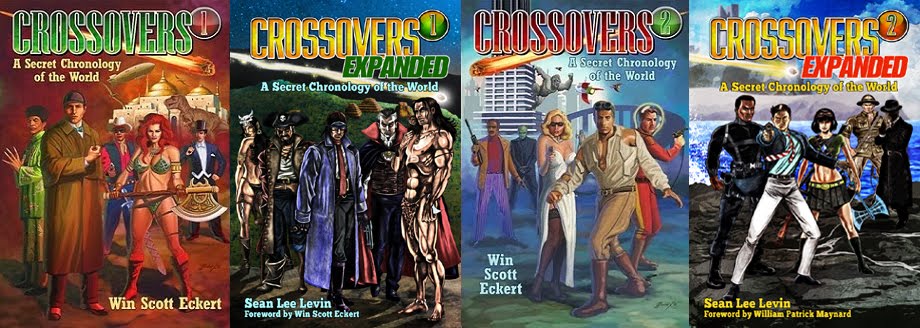
This crossover is one of over a thousand covered in my book Crossovers Expanded: A Secret Chronology of the World Volume 3, coming this summer from Meteor House! All three volumes are AUTHORIZED companions to Win Scott Eckert's Crossovers: A Secret Chronology of the World Volumes 1 and 2!

Monday, March 4, 2024

Crossover Cover: The Warm Rush of Chilled Blood


Are you a Robert E. Howard fan?

Then you'll love Greg Gick's story in this anthology, which has ties to Howard's works, as well as other crossovers!

For more information, be sure to pick up a copy of my book Crossovers Expanded: A Secret Chronology of the World Volume 3, which will be published by Meteor House! All three volumes are AUTHORIZED companions to Win Scott Eckert's Crossovers: A Secret Chronology of the World Volumes 1 and 2!

Thursday, August 10, 2023

Crossover Cover: Big Trouble in Mother Russia


The potion that Egg Shen gave to Jack Burton and friends to make them feel invincible is revealed to have been invented by a Gaelic Druid in Roman times and is kept in a gourd. Abdul Alhazred is mentioned, and Friedrich Wilhelm von Juntz’s Unaussprechlichen Kulten is seen. The potion is the same one the Druid Getafix gave to the title character of René Goscinny and Alberto Uderzo’s comic book The Adventures of Asterix to make him superhumanly strong. Abdul Alhazred is from H. P. Lovecraft’s Cthulhu Mythos tales, while Friedrich Wilhelm von Juntz and his book Unaussprechlichen Kulten are from Robert E. Howard’s own Mythos stories. 

This novel is one of hundreds of crossovers covered in my book Crossovers Expanded: A Secret Chronology of the World Volume 3, to be published by Meteor House! All three volumes are AUTHORIZED companions to Win Scott Eckert's Crossovers: A Secret Chronology of the World Volumes 1 and 2!

Sunday, July 30, 2023

Crossover of the Week

Autumn 1928

THE GHULISTAN AFFAIR 

The Kurd Ali al-Ghazi meets with a Texan. Ali, who tried to scare off an American expedition to Shahr-i-Zahr a few years before, says, “Honestly, I reckoned Jim had his eye on them since they came by way of the Levant, and King would intercept them when they headed into the Khyber Pass.” The Texan says the expedition’s dragoman would never have willingly led them into the Land of Ghouls. Ali asks the Texan if he’s ever heard of the Leng Plateau, and gives him greetings from Sonora, who has a brother who has trouble walking and sells his fever-dreams to a pulp magazine called Cleft Hooves or something similar. He also mentions Aga Khan and Shah li-Zahr. The Texan mentions the Gorge of Ghosts. The members of the expedition included a former Foreign Legionnaire, a man with a camera, a young man who had wild stories about a village in Hungary they visited, and a poet who was engaged. Ali brings up Kara-Shehr, and the two discuss Clarney. The Texan asks which of the expedition said the name Ghulistan. Afghanistan was known as Afghulistan before the Flood. The Texan once fought someone named Konaszevski. 

Short story by Sam Inabinet in Pickman’s Gallery, Matthew Carpenter, ed., Ulthar Press, 2018. Ali al-Ghazi (or el Ghazi) is a disguise used by Robert E. Howard’s character Kirby O’Donnell. The Texan is another of Howard’s heroes, Francis X. Gordon, aka El Borak. Shahr-i-Zahr is meant to be Shahrazar from the Kirby O’Donnell stories “Swords of Shahrazar” and “The Treasures of Tartary.” Shahrazar is also mentioned in the El Borak story “Blood of the Gods.” The Land of Ghouls and Ghulistan are from the El Borak story “Three-Bladed Doom” and Howard’s Conan story “The People of the Black Circle.” Afghulistan is from the latter story. Aga Khan is Baber Khan from “Three-Bladed Doom,” while Shah li-Zahr is Shalizahr from the same story. Ivan Konaszevski is also from “Three-Bladed Doom,” as is the Gorge of Ghosts. Jim and King are James Schuyler Grim, aka Jimgrim, and Athelstan King from Talbot Mundy’s novels. The Leng Plateau is from H. P. Lovecraft’s Cthulhu Mythos stories. Sonora is Steve Allison, aka the Sonora Kid, who appears in both his own series of stories by Howard and the El Borak tales. Sonora’s brother is James Allison, the wooden-legged hero of a series of stories by Howard dealing with reincarnation. “Cleft Hooves” is a reference to the magazine The Cloven Hoof from Howard’s John Kirowan story “The Children of the Night.” The Legionnaire is Randolph Carter from Lovecraft’s Dream Cycle. The photographer is Richard Upton Pickman from Lovecraft’s “Pickman’s Model.” The young man is Justin Geoffrey from Howard’s “The Black Stone.” The poet is Edward Pickman Derby from Lovecraft’s “The Thing on the Doorstep.” Kara-Shehr and Steve Clarney are from Howard’s “The Fire of Asshurbanipal.” Edward Pickman Derby married Asenath Waite in early 1929, a few months after they met, so this story likely takes place in late 1928. 

This crossover is one of hundreds included in my book Crossovers Expanded: A Secret Chronology of the World Volume 3, to be published by Meteor House! All three volumes are AUTHORIZED companions to Win Scott Eckert's Crossovers: A Secret Chronology of the World Volumes 1 and 2!

Wednesday, June 21, 2023

Crossover Cover: The Valley of the Worm


In this story by Robert E. Howard, James Allison recounts how his past incarnation, the warrior Niord, slew the monstrous snake Satha.  In Howard’s “The Scarlet Citadel,” published in the January 1933 issue of Weird Tales, Conan slew a snake called Satha whose description is identical to the serpent killed by Niord. “The Valley of the Worm” takes place long before the Hyborian Age. Satha must have been resurrected through sorcery after his death at Niord’s hands, only to be slaughtered once more by Conan. The connection to Conan brings Howard’s James Allison stories into the CU.]

This crossover is one of hundreds included in my book Crossovers Expanded: A Secret Chronology of the World Volume 3, which will be published by Meteor House! All three volumes are AUTHORIZED companions to Win Scott Eckert's Crossovers: A Secret Chronology of the World Volumes 1 and 2!

Sunday, June 18, 2023

Crossover of the Week

Autumn 1926 

WRATH OF N’KAI 

Countess Alessandra Zorzi, a professional thief-for-hire, comes to Arkham, Massachusetts to steal a mummy found in Oklahoma. Two years ago, Alessandra stole a gargoyle from the cathedral of Vyones. A month after that, she pilfered a copper ring crafted in the shape of a serpent from a house in Mayfair. Philippa “Pepper” Kelly, who works as a cab driver in male disguise, has as her head dispatcher a short, fat man named De Palma. At the unveiling of the mummy at the Miskatonic Museum, Alessandra runs into her old acquaintance Tad Visser, a New Yorker, who says the crowd includes bigwigs from Miskatonic, Harvard, Yale, and even representatives from his alma mater, Empire State. Alessandra knows of others in her profession who are violent or lacking in restraint, such as “that charlatan, Lampini.” Her teachers included an elderly Englishman with an inordinate fondness for cricket, a melancholy albino who smoked opium-soaked cigarettes, and the incomparable Mr. Nuth. Alessandra tells Pepper, “As a gentleman of my acquaintance once said, one cannot make bricks without clay.” Alessandra and Visser discuss Arkady Cottonwood’s book The Oldest Rite, a single copy of which Alessandra has stolen five times for three different clients. She also once procured a book on horology for a fat man in New York with a fondness for orchids. 

An Arkham Horror novel by Josh Reynolds, Aconyte, 2020. Vyones is from Clark Ashton Smith’s Averoigne stories. The gargoyle is a reference to Smith’s “The Maker of Gargoyles.” The copper ring is the Serpent Ring of Set from Robert E. Howard’s Conan story “The Phoenix on the Sword.” De Palma is likely the father or grandfather of Louie De Palma, head dispatcher for the Sunshine Cab Company in New York, from the TV series Taxi. Empire State University will later be attended by Peter Parker, aka Spider-Man. Lampini is Bruno J. Lampini, who appears in his own series of stories by Reynolds. Lampini is named after Professor Bruno Lampini from the movie House of Frankenstein. The elderly Englishman is E. W. Hornung’s amateur cracksman A. J. Raffles. The melancholy albino is Sexton Blake’s archenemy Zenith the Albino. Nuth is from Lord Dunsany’s story “How Nuth Would Have Practiced His Art Upon the Gnoles.” The gentleman of Alessandra’s acquaintance is Sherlock Holmes, who said “Data! Data! Data! I can’t make bricks without clay” in Doyle and Watson’s “The Adventure of the Copper Beeches.” Arkady Cottonwood is from Reynolds’ story “Corn Wolf.” Cottonwood’s book The Oldest Rite is mentioned in several of Reynolds’ works. The fat orchid enthusiast is Nero Wolfe, although Alessandra’s acquisition of the book for him must have happened before he officially hung up his shingle as a private eye in 1930. Professor Tyler Freeborn mentions his expedition to the Great Sandy Desert with Professor Nathaniel Wingate Peaslee and Professor Ferdinand Ashley from “The Shadow Out of Time” as a past event. This reference must be disregarded, as that expedition took place in 1935, nine years after the events of this novel. 

This crossover writeup is one of hundreds included in my book Crossovers Expanded: A Secret Chronology of the World Volume 3, which will be published by Meteor House! All three volumes are AUTHORIZED companions to Win Scott Eckert's Crossovers: A Secret Chronology of the World Volumes 1 and 2!

Thursday, April 20, 2023

Crossover Cover: Blood of the Hummingbird


Are you a fan of author Frank Schildiner?

Then you'll love his story in this anthology, which has references to everything from the Conan stories to the World War II-set British sitcom 'Allo 'Allo!

For the 411, check out my book Crossovers Expanded: A Secret Chronology of the World Volume 3, which will be published by Meteor House! Like its predecessors, this volume is an AUTHORIZED companion to Win Scott Eckert's Crossovers: A Secret Chronology of the World Volumes 1 and 2!

Sunday, March 5, 2023

Crossover of the Week

Spring 1868-1876 
THY NAME IS SABBATH 
A failed murder sets in motion an eight-year-long series of events that leads to a bounty hunter adopting the alias of Major D. M. Sabbath. Appearing or mentioned are: Jimmy Ballantrae (aka Valentin L’Ollonaise); Bougival Junction; Otto Stejar; Colonel Heinrich Von Skimmel; the Black Indian (aka Christian Adam Sabbath); Red Galloway; the Crazy Indian; Isaiah; Brockston-Morton Railways; Arthur Gordon; Leroy Bailey; the Hellbender Regiment; Randall; Sheriff Priam Ramsey; Hatfield; Paolo di Marco and his nephew Gino; Philip “Hot Lead” Holden; Marty Heywood; Lieutenant Tervis; Colonel Jonas Leland; Giddy Burnett; Samson McDade; Jake Sartana (aka the Ace of Hearts); “that crazy Englishman who made a bet this year about traveling around the world in 80 days”; the Gentlemen of the Night; Fergus O’Breane; Jason McIntock; O’Breane’s successor in London; Redstone; Rocambole; William LeFrank Gordon, aka Bill Gordon and Frank Gordon; Baron Gustav Von Schulenberg; Enrique Claudin; the Chupin Detective Agency; Grandville Fuller; Lost Knob, Texas; Christian Adam Sabbath, Jr.; Arthur Gordon’s wife Xaviera; Skurlock; Mitchell Stangerson; Ignacz Djanko; the J. V. Harden Tobacco Company; Bryant’s Gap; Delilah L’Ollonaise; Madame Delphine; Hot Lead’s son; John Gordon; Snow Hill County; Judge Cutthroat; Bennet’s Raiders; Specs; Horst Drebber; the Council of Four; John Ferrier; Count Stanislaus Kowalski; Anton Niklas Petersen; San Miguel; the Drifter with Many Names; Chadwell; the Black Coats; Regina; Louie Gordon; Sgt. Boomerang Smith; Captain Younger; and Delta Valley, California. 
Story by Rick Lai in Rick Lai’s Major Sabbath, Ron Fortier, ed., Airship 27 Productions, 2016. Major D. M. Sabbath is a conflation of Colonel Douglas Mortimer from the movie For a Few Dollars More with the title character of the movies Sabata and Return of Sabata, both played by Lee Van Cleef. Jimmy Ballantrae is meant to be Ballantine from the movie Adiós, Sabata. Stejar and Colonel Skimmel are also from that film. The Black Indian is meant to be the title character of Adiós, Sabata, also known as Indio Black, and played by Yul Brynner. Bougival Junction is from the movie Frenchie King. Red Galloway is a combination of Lee Galloway, the actual protagonist of the inaccurately titled film Sartana in the Valley of Death, with Banjo from Sabata; William Berger played both roles. The Crazy Indian and Isaiah are El Indio and Prophet from For a Few Dollars More. Brockston-Morton Railways is a conflation of the Brockston railroad company from the movie The Big Gundown with the Morton railroad company from the film Once Upon a Time in the West. William LeFrank Gordon is a combination of William L. “Bill” Gordon from Robert E. Howard’s “The Dead Remember” with Frank from Once Upon a Time in the West. Baron Von Schulenberg is from The Big Gundown. Here, he is Colonel Skimmel’s cousin; both characters were played by Gérard Herter. Arthur Gordon is from Emile Gaboriau’s La Vie Infernale. The Chupin Detective Agency is also from Gaboriau’s works. Bailey is from the movie Hannie Caulder. Specs is another character from that film, Thomas Luther Price. The Hellbender Regiment and Colonel Jonas are from the movie The Hellbenders. Jonas’ surname of Leland implies a genealogical relationship to Jed Leland from Citizen Kane; Joseph Cotten played both characters. Randall is bounty hunter Josh Randall from the TV series Wanted: Dead or Alive. Sheriff Priam Ramsey is the father of the title character of the TV show Hec Ramsey. Samson McDade is Sam McDade from the Hec Ramsey episode “Scar Tissue.” Hatfield is from the movie Stagecoach. Paolo and Gino di Marco are from the Have Gun – Will Travel episode “The High Graders.” Delta Valley, California is where Paladin adopted his alias in the Have Gun – Will Travel episode “Genesis.” Philip “Hot Lead” Holden is meant to be “Hot Dead” Holden from the movie I Am Sartana, Your Angel of Death. Sartana is a spaghetti western hero played by Gianni Garko, who also portrayed a virtually identical character called the Ace of Hearts in A Bullet for a Stranger. Grandville Fuller is from Light the Fuse...Sartana Is Coming. Marty Heywood is from the movie Wanted. Lieutenant Tervis is meant to be Clyde from Return of Sabata. Jason McIntock is related to Joe McIntock from the same film. In Return of Sabata, it is revealed Sabata left a woman at the altar in Redstone who later gave birth to his son; Delilah L’Ollonaise is meant to be that woman. Giddy Burnett (later Sheriff Gideon Burnett), Hot Lead’s son (Loco, played, like Hot Dead himself, by Klaus Kinski), John Gordon, Snow Hill County, Judge Cutthroat (Henry Pollicut), Regina, and Louie Gordon (Silence) are from the movie The Great Silence. “That crazy Englishman” is Phileas Fogg from Jules Verne’s Around the World in Eighty Days. The Gentlemen of the Night are from Paul Féval’s novel of the same name, as is Fergus O’Breane. The Black Coats are featured in a series of novels by Féval. O’Breane’s successor in London is Professor Moriarty, Sherlock Holmes’ archenemy. Stangerson, Drebber, the Council of Four, and John Ferrier are from Doyle and Watson’s first Holmes novel, A Study in Scarlet. The J. V. Harden Tobacco Company is based on a reference to a tobacco millionaire named John Vincent Harden in the Holmes tale “The Adventure of the Solitary Cyclist.” Rocambole is the protagonist of a series of novels by Ponson du Terrail. Enrique Claudin is really Erik, the title character of Gaston Leroux’s The Phantom of the Opera, using an alias. Erique Claudin was the Phantom’s real name in the 1943 film adaptation of the novel. Lost Knob, Texas is from Robert E. Howard’s “Graveyard Rats,” “Old Garfield’s Heart,” and “Wild Water.” Christian Adam Sabbath, Jr. is meant to be Chris Adams from the Magnificent Seven film series; he was played variously by Yul Brynner (The Magnificent Seven and Return of the Magnificent Seven), George Kennedy (Guns of the Magnificent Seven), and Lee Van Cleef (The Magnificent Seven Ride!) The implication of Arthur Gordon’s marriage to Xaviera LeFrank, the stage name of actress Francine Xavier, is that he is the grandfather of Robert E. Howard’s adventurer Francis X. Gordon, aka El Borak. Skurlock, Texas is from Howard’s “Black Wind Blowing.” Ignacz Djanko is the title character of the movies Django and Django Strikes Again. Bryant’s Gap is where a group of Texas Rangers, including Dan Reid, were massacred by Butch Cavendish’s gang; the sole survivor, Dan’s brother John Reid, adopted the guise of the Lone Ranger. Madame Delphine is Delphine Yant from Louis L’Amour’s The Proving Trail. In that novel, it is said that the Yant family also uses the aliases of Cabanus and L’Ollonaise. Bennet’s Raiders are from the movie Face to Face. Count Stanislaus Kowalski is really A. J. Raffles’ foe Count Corbucci from E. W. Hornung’s “The Fate of Faustina” and “The Last Laugh,” while Anton Niklas Petersen is in fact Guy Boothby’s villain Dr. Antonio Nikola. The names Kowalski and Petersen evoke Yodlaf Peterson and Sergei Kowalski, Franco Nero’s characters in the movies Compañeros and The Mercenary, respectively. San Miguel is a Mexican border town seen in four Eurowesterns: El Rojo, A Fistful of Dollars; Run, Man, Run, the sequel to The Big Gundown; and A Bullet for the General. The Drifter with Many Names is the Man with No Name from Sergio Leone’s “Dollars Trilogy.” His aliases are based on the names used for the character in each film: Joe Limbo (Joe in A Fistful of Dollars); Lefty (Manco in For a Few Dollars More); and Rubio (Blondie in The Good, the Bad, and the Ugly). Major (formerly Captain) Chadwell, Sgt. Boomerang Smith (Sgt. Jeremiah Smith), and Captain (formerly Lt.) Cole Younger are from the movie Charge! (aka Those Dirty Dogs). 

This crossover is only one of hundreds covered in my book Crossovers Expanded: A Secret Chronology of the World Volume 3, which will be published by the fine folks at Meteor House! All three volumes are AUTHORIZED companions to Win Scott Eckert's books Crossovers: A Secret Chronology of the World Volumes 1 and 2!

Tuesday, February 28, 2023

Crossover Cover: Maker of Shadows


Are you a fan of Robert E. Howard's fiction?

Then you'll love this novel, in which Jack Mann's occult detective Gees encounters an immortal sorcerer who is the son of Howard's Pictish king Bran Mak Morn!

For more information, see my book Crossovers Expanded: A Secret Chronology of the World Volume 3! As with the first two volumes, this new tome is an AUTHORIZED companion to Win Scott Eckert's seminal works Crossovers: A Secret Chronology of the World Volumes 1 and 2 and will be published by Meteor House!

Sunday, July 10, 2016

Crossover of the Week


Early Spring 1898
KINGDOM OF THE BLIND
            Appearing or mentioned are: Sylvia Pence; Count Salvatore Corbucci; Catarina Corbucci (aka the Blind Spinner); Noel Moriarty; the Gentlemen of the Night; the Black Coats; the Agnes de la Fere Athletic Club; Rochelle Moreau; Orianne Coyatier; Ecstasy Parker; Norman Head; Koutatsu of Shimosa Province; Sumeru Yuki; the Iga clan; Senzo; Marga Sandorf; the Order of the Serpent Heart; Baron Von Schulenberg; Colonel Skimmel; Aristide Sandorf; Dr. Eric Malbodius; Madame Sara’s Perfumery; Senora Pilar Reloj; the Pallid Mask; the Chupin Detective Agency; Chief Inspector Jacques Lefevre; Irina Putine; Vathelos; Anna Beringer; Leonard Wolfe; Superintendent Ford; the Koga clan; the White Priest; the Countess Yalta Memorial Hospital; the Royal Palace Hotel; the Regenerator of Fashion; Joséphine Balsamo; Ace Sartana; Maude North; the hero of the dime novel The Man from Minnesota; Mary Holder; Sir George Burnwell; the Old Fellow; La Frenaie wine; Dr. Antonio Nikola; Tarao Hanzo; Inspector Justin Ganimard; Helen Lipsius; Cesarine Caoutchouc; Colonel Clay; Alexander Holder; a blade used by the legendary Yagyu family to slay demons; and Julius Von Herder.
            Short story by Rick Lai in Sisters of the Shadows: The Cagliostro Curse, Black Coat Press, 2013. Sylvia Pence is meant to be Madame Sylvia from L. T. Meade and Robert Eustace’s story “Finger Tips,” included in the collection The Oracle of Maddox Street. Catarina Corbucci is better known as Madame Koluchy, from Meade and Eustace’s The Brotherhood of the Seven Kings; here, she is conflated with the Blind Spinner from John Buchan’s The Three Hostages. Norman Head, Anna Beringer, and Superintendent Ford are also from The Brotherhood of the Seven Kings. Madame Sara’s Perfumery is from another book by Meade and Eustace, The Sorceress of the Strand. Count Salvatore Corbucci dueled with A. J. Raffles in E. W. Hornung’s “The Fate of Faustina” and “The Last Laugh.” Noel Moriarty is Professor Moriarty’s younger brother, who was mentioned in the Sherlock Holmes novel The Valley of Fear. Ecstasy Parker is the sister of Larry Parker from Doyle and Watson’s “The Adventure of the Empty House.” Julius Von Herder is also from that story, although his first name is Lai’s invention, and is meant to imply he is the father of the titular villain of Ian Fleming’s James Bond novel Dr. No. Mary Holder, Sir George Burnwell, and Alexander Holder are from another Holmes tale, “The Adventure of the Beryl Coronet.” The Gentlemen of the Night are from Paul Féval’s The Mysteries of London. The Black Coats are a criminal conspiracy featured in a series of novels by Féval. Orianne Coyatier’s grandfather Jean-François Coaytier, also known as the Marchef, was the Black Coats’ executioner. The Agnes de la Fere Athletic Club is named after the main character (also known as Dark Agnes de Chastillon) of Robert E. Howard’s stories “Sword Woman,” “Blades for France,” and “Mistress of Death.” Vathelos is from Howard’s Conan story “Black Colossus.” The experiments of Rochelle Moreau’s father were chronicled in H. G. Wells’ The Island of Doctor Moreau, while her uncle Bernard is mentioned in the film La Residencia. Koutatsu of Shimosa Province and Senzo are from the movie Zatoichi’s Cane-Sword. Sumeru Yuki is related to the Marquis Sumuru from Sax Rohmer’s novels dealing with the Marquis’ villainous widow. The Iga and Koga ninja clans are historical, but their feud formed the basis for the Japanese television series Shadow Warriors. Tarao Hanzo is also from that series. Marga Sandorf’s uncle is the title character of Jules Verne’s novel Mathias Sandorf. The Order of the Serpent Heart is meant to be the secret society from H. Rider Haggard’s Heart of the World. Baron Von Schulenberg is from the film The Big Gundown, while Colonel Skimmel is from the movie Adios Sabata. Here, the Baron and the Colonel are identified as cousins; both were played by Gérard Herter. Aristide Sandorf is meant to be the villain Orlowsky from the movie Django Strikes Again. Dr. Eric Malbodius is meant to be Norbert Jacques’ criminal mastermind Dr. Mabuse. Senora Pilar Reloj is Pilar from the film A Stranger in Town; Lai’s story “Cut the Branch” revealed she married her fellow outlaw Gordo Reloj, who is meant to be Gordo Watch from the movie Arizona Colt. The Pallid Mask will later be known as Fantômas; his alias in this story is derived from Robert W. Chambers’ The King in Yellow. The Royal Palace Hotel is from the first Fantômas book, while the Old Fellow is from the seventh novel in the series, Le Pendu de Londres. Maude North is the villain’s late Boer wife mentioned in The Daughter of Fantômas. The Chupin Detective Agency, headed by Victor “Toto” Chupin, is from the works of Emile Gaboriau, as is the Regenerator of Fashion. Chief Inspector Jacques Lefevre is from the movie Bluebeard. Irina Putine is meant to be Irene Tupin from La Residencia. Leonard Wolfe is from R. Austin Freeman’s Dr. Thorndyke tale “The Aluminium Dagger.” The White Priest is Pai Mei of Chinese legend and film; his tendency to pluck out women’s eyes is an allusion to the movie Kill Bill: Vol. 2, which features a flashback in which Pai Mei rips out Elle Driver’s right eye. The Countess Yalta Memorial Hospital is named after a character from Fortuné du Boisgobey’s The Lost Casket (aka The Severed Hand); at the end of the novel, there are plans to construct a hospital in the Countess’ memory somewhere in France. Joséphine Balsamo is from Maurice Leblanc’s Arsène Lupin books The Countess of Cagliostro and Countess Cagliostro’s Revenge. Inspector Justin Ganimard is also from the Lupin tales. Ace Sartana is the Spaghetti Western hero Sartana combined with the Ace of Hearts from the movie They Called Him Cemetery; both were played by Gianni Garko. The hero of The Man from Minnesota is the title character of the film Minnesota Clay. La Frenaie wine is from the Averoigne tales by Clark Ashton Smith. Dr. Antonio Nikola was the subject of novels by Guy Boothby. Helen Lipsius is meant to be the Helen who worked for Dr. Lipsius in Arthur Machen’s The Three Hostages; her usage of the doctor’s surname is meant to suggest she is his mistress, just as Carl Peterson’s mistress Irma is often referred to as Irma Peterson. Cesarine Caoutchouc and Colonel Clay are from Grant Allen’s An African Millionaire. The Yagyu blade is from the film Samurai Reincarnation.

Saturday, May 14, 2016

Crossover Cover: The White Jade Ring

This collection includes the story “The White Jade Ring.It is mentioned Francis X. Gordon and Steve Allison (aka El Borak and the Sonora Kid, respectively) recently had a “war with the Si-Fan.” The reference to the Si-Fan, the criminal organization controlled by Dr. Fu Manchu, reinforces Gordon and Allison’s inclusion in the CU.

Thursday, April 28, 2016

Crossover Cover: Sharper Than a Serpent's Tooth

John Taylor returns from the past to stop his mother from destroying the Nightside. Appearing or mentioned are: Rollerball t-shirts (referring to William Harrison’s story “Roller Ball Murder,” which depicts a corporation-driven future that is one of several possible futures for the CU); a cyborg with golden eyes from an alternate future (one of the Hadenmen from Green’s Deathstalker books); a sonic screwdriver (from the TV series Doctor Who); a Water Baby (from Charles Kingsley’s novel The Water Babies); the Yellow Sign (from Robert W. Chambers’ The King in Yellow, and incorporated into the Cthulhu Mythos by H. P. Lovecraft in the short story “The Whisperer in Darkness; Sneaky Pete (Pete Hutter from the television Western The Adventures of Brisco County, Jr.); the Holy Hand Grenade of St. Antioch (from the movie Monty Python and the Holy Grail, although the events seen in that movie must have been exaggerated for comedic effect) ; the Doormouse (a member of a group of shapeshifting mouse hippies from Green’s novel Drinking Midnight Wine); the Bazaar of the Bizarre (from Fritz Leiber’s Fafhrd and the Grey Mouser short story of the same name); Shadows Fall (from Green's novel of the same name); Carcosa (from Ambrose Bierce’s short story “An Inhabitant of Carcosa,” which H. P. Lovecraft incorporated into the Cthulhu Mythos); Old Father Time (from Shadows Fall); the Street of the Gods (from Green’s Hawk and Fisher novellas Winner Takes All and The God Killer); a Kandarian punch dagger (connected to the Kandarian demons from the Evil Dead film series); Julien Advent, the Victorian Adventurer (intended to be Adam Adamant from the TV series Adam Adamant Lives!; in fact, at one point in the novel he is referred to as Adamant); Alf’s Button Emporium (a reference to W. A. Darlington’s fantasy novel Alf’s Button); faeries hiding from the hordes of the Adversary (from Bill Willingham and Lan Medina’s comic book series Fables, which is set in an AU); the Traveling Doctor (Doctor Who); Colonial Marines (from the science fiction film Aliens, setting up the Alien franchise as another possible future of the CU.); the Eaters of the Dead (from Michael Crichton’s titular novel); Worms of the Earth (from Robert E. Howard’s short novel of the same name); Time Tower Square (from Shadows Fall); Elder Spawn (from Lovecraft's Cthulhu Mythos); Dead-Eye Dick, who was featured in a series of dime novels (a reference to an episode of the television Western The Virginian entitled “Dead-Eye Dick;” although the episode does not mention the Dead-Eye Dick dime novels are based on the adventures of a real person, it doesn’t say they aren’t either); Rats’ Alley (from T. S. Eliot’s poem “The Waste Land”); Haceldama (from Green’s Deathstalker books); a blazer belonging to a retired secret agent, which has a button with the number six on it (from the cult TV series The Prisoner); and the Prospero and Michael Scott Memorial Library (Prospero being from William Shakespeare’s The Tempest.)

Tuesday, March 29, 2016

Crossover Cover: The Wedding of Sheila-Na-Gog

This issue contains a Simon of Gitta story by Richard L. Tierney and Glenn Rahman. Simon visits Regio Averonum, an area of Gaul. He finds himself aligned with a tribe called the Averoni, who worship a god named Sadoqua and command large black cats. Fighting Simon and his allies are the Black Goat Druids, adherents of the goddess Sheila-na-gog, who was originally in Acheron and Hyperborea. Simon throws a corrupt Roman official into Sheila-na-gog, and she gives birth to a monster who “was small and had the shape of a rat, but its pallid bearded face and handlike forepaws were evilly human.” Rick Lai writes, “Regio Averonum is a chronologically earlier version of the region of France later known as Averoigne in ‘The Holiness of Azéderac’ and other stories by Clark Ashton Smith. Sadoqua is an alias which Smith used for his demon-god Tsathoggua. The name Regio Averonum and the black cats were actually ideas of H. P. Lovecraft’s, which were given to Smith in the correspondence between the two authors (see Lovecraft’s Selected Letters IV: 1932–1934, letters #669, 674, and 685). Lovecraft also came up with the idea of a tribe called the Averones, whose name was changed to Averoni in the Simon of Gitta story. Acheron is from Robert E. Howard’s ‘Black Colossus’ and Conan the Conqueror, while Hyperborea is a polar continent described by Clark Ashton Smith. Sheila-na-gog has the form of a pool which gives birth to monsters. The appearance and nature of Sheila-na-gog are virtually identical with Abhoth the Unclean, the Hyperborean deity from Clark Ashton Smith’s ‘The Seven Geases.’ I don’t think Sheila-na-gog and Abhoth are the same deity. I suspect that they are either father and daughter, or sister and brother, or son and mother. The monsters spawned by Sheila-na-gog only have a long life span if a human being is thrown into Sheila-na-gog first. The goddess devours a human and fashions a spawn from his flesh. Sheila-na-gog’s spawn in this story could be Brown Jenkin from Lovecraft’s ‘The Dreams in the Witch-House.’”

Thursday, March 10, 2016

Crossover Cover: World War Cthulhu

This anthology contains two stories with crossovers, both written by authors with no little experience at same. One is "The Yoth Protocols" by Josh Reynolds. An FBI agent named Sarlowe thinks of centers of eldritch activity, such as the Warren site in the Big Cypress, the Martense molehills, and "certain secret cellars where a certain artist had painted certain pictures and almost certainly been eaten." He also thinks of Inspector Craig and his Special Detail in the subway tunnels beneath New York, as well as worms in the earth. Sarlowe’s partner Indrid Cold is described as having a wax-like face. It is stated there are worse things in Heaven and Earth than dreamt of in Alhazred’s philosophy. The local "old ones" include the Shonokins and the K’n-Yani. Sarlowe reminds Cold of the Yoth protocols. A circular stone covering the stairs leading to the mound where the K’n-Yani live was placed there after the Zamacona Cylinder was unearthed. "The batrachian hillbillies in Massachusetts" and N’Kai are mentioned. Cold is the only person who ever used the Voormithadreth Corridor and hadn’t rotted from the inside out. Cold identified Valusian spectrum radiation within the mound. The Russian necromancer Grigori Petrov refers to the Zann Concerto and the maw of Leng. Cold asks Petrov if he was planning to let Tsathoggua’s children loose to do his dirty work. Sarlowe quotes, "Evil the mind that is held by no head." Sarlowe is a relative of occult detective Baxter Sarlowe from Reynolds’ novel Wake the Dead. The Warren site in the Big Cypress is from H. P. Lovecraft’s story "The Statement of Randolph Carter." The Martense molehills are from Lovecraft’s "The Lurking Fear." The secret cellars where an artist painted pictures and was eaten are from Lovecraft’s story "Pickman’s Model." Inspector Craig and his Special Detail are from Robert Barbour Johnson’s story "Far Below." The worms in the earth are from Robert E. Howard’s Bran Mak Morn story "Worms of the Earth." Indrid Cold is an allegedly real person connected to the supposed Mothman sightings in 1966. His wax-like face implies Cold is a member of the wax-masked race of creatures seen in Lovecraft’s "The Festival," which is the source of the quote, "Evil the mind that is held by no head." Abdul Alhazred, the mad Arab, is the author of the Necronomicon in Lovecraft’s Cthulhu Mythos. The Shonokins are from Manly Wade Wellman’s John Thunstone stories. The K’n-Yani, Yoth, the Zamacona Cylinder, and N’Kai are from Lovecraft’s revision of Zealia Bishop’s story "The Mound." "The batrachian hillbillies in Massachusetts" are a reference to Lovecraft’s "The Shadow over Innsmouth." The Voormithadreth Corridor is connected to Mount Voormithadreth from Cthulhu Mythos stories by Clark Ashton Smith. Tsathoggua is also from Smith’s Mythos tales. Valusian spectrum radiation is a reference to the kingdom of Valusia in Robert E. Howard’s Kull stories. The Zann Concerto is from Lovecraft’s "The Music of Erich Zann." The plateau of Leng appears in a number of Lovecraft’s stories. The other story that I will include is "Cold War, Yellow Fever" by Pete Rawlik. Mitchell Peel is an operative of the Joint Advisory Committee on Korea (JACK), receiving orders from Colonel Doctor Wingate Peaslee, aka the Terrible Old Man. Peaslee tells Peel and other JACK agents Esteban Zamarano was sent to Banes, Cuba as part of Operation Mongoose to enlist his family’s aid. The Zamaranos bought six volumes from the sale of the Church of the Starry Wisdom Library, including what appears to be a Spanish-language edition of The King in Yellow. After contact was lost with Zamarano, another agent traveled to Banes, and disappeared himself, though not before sending the message, "Where is the Yellow Sign?" The Soviets are willing to neutralize the threat, but Peaslee says Washington does not want to see another Gizhinsk, particularly so close to the U.S. borders. Peel and company work with Major Romero of the Cuban Security Forces and Agent Tanya Romanova of Soviet Army Intelligence to deal with the situation. Romanova refers to documented cases of childrens’ minds being stimulated to see the universe in ways adults cannot, such as the Paradine children and "that village in Winshire." After the mission, a traumatized and disfigured Peaslee is retired to a minimum security facility near Arkham, Massachusetts. Mitchell Peel is related to David Conyers’ series character Major Harrison Peel, an NSA consultant who appears in stories set in the milieu of the Mythos. Wingate Peaslee is from Lovecraft’s story "The Shadow Out of Time"; his nickname of "the Terrible Old Man" is an homage to Lovecraft’s story of the same name. The Church of the Starry Wisdom is from Lovecraft’s "The Haunter of the Dark." Arkham, Massachusetts is the setting of a number of Mythos tales. The King in Yellow is from Robert W. Chambers’ short story collection of the same name, and was incorporated into the Cthulhu Mythos by Lovecraft in his story "The Whisperer in Darkness." The Yellow Sign is also from Chambers’ book. Gizhinsk and "that village in Winshire" are from John Wyndham’s novel The Midwich Cuckoos. Agent Tanya (or Tatiana) Romanova is from Ian Fleming’s James Bond novel From Russia, with Love. The Paradine children are from the short story "Mimsy Were the Borogroves" by "Lewis Padgett" (Henry Kuttner and C. L. Moore).

Friday, June 26, 2015

Crossover Cover: Professor Challenger: New Worlds, Lost Places

This anthology of new stories featuring Arthur Conan Doyle's Professor Challenger includes several crossovers. In Lawrence C. Connolly's "King of the Moon," Bedford, Challenger, Ann Cavor and a pair of father-and-son inventors rescue Ann’s uncle from the Selenites. Bedford, Dr. Cavor, and the Selenites are from H.G. Wells’ The First Men in the Moon, which is described as having taken place ten years ago. Bedford implies here that he is the one who put Challenger in contact with Arthur Conan Doyle. Challenger must have introduced Doyle in turn to Edward Malone. Doyle became Malone’s literary agent and editor, publishing the reporter’s accounts of his adventures with Challenger under his own byline. In Josh Reynolds' "Time's Black Gulf," Professor Summerlee, Lord John Roxton, Malone, and Thomas Carnacki battle Indrid Cold and other members of his race, who are part of a conspiracy to infiltrate the human race at every stage of its evolution along with an alien race that has swapped Challenger’s consciousness with that of one of their own people. Challenger has copies of Cultes des Goules and Unaussprechlichen Kulten. Carnacki refers to the Sigsand Manuscripts, the Book of Eibon, the Pnakotic texts, the Florentine monk Corsi, and Khephnes. The Tind’Losi, the Hounds of the Angles, appear. Dr. John Silence and Jessie Challenger ultimately save the day. Thomas Carnacki and the Sigsand Manuscripts are from William Hope Hodgson’s Carnacki the Ghost-Finder. Indrid Cold is a supposedly real person connected to the Mothman sightings of 1966-1967. Here, he is also a member of the race of creatures seen in H.P. Lovecraft’s "The Festival." This version of Cold also appears in Reynolds’ stories "The Pnakotic Puzzle" and "The Yoth Protocols." "The Pnakotic Puzzle” indicates that this story happened “some years before the war.” The consciousness-swapping alien race is the Great Race of Yith from Lovecraft’s "The Shadow Out of Time."Bartolomeo Corsi and Khephnes are also from "The Shadow Out of Time." The Cultes des Goules is a Cthulhu Mythos tome created by Robert Bloch. Unaussprechlichen Kulten is a Mythos tome created by Robert E. Howard. The Book of Eibon is from Clark Ashton Smith’s contributions to the Mythos. The Pnakotic texts are a reference to Lovecraft’s Pnakotic Manuscripts. The Tind’Losi are from Frank Belknap Long’s story "The Hounds of Tindalos." Dr. John Silence is an occult detective featured in stories by Algernon Blackwood. In John Takis' "The Crystal Minders," Challenger suggests that a scientist has "invented a machine capable of traveling through time, like that loon in Surrey, have you?" “That loon in Surrey” is the Time Traveler from H.G. Wells’ The Time Machine. This story is primarily narrated by Professor Summerlee, though a framing sequence narrated by Edward Malone involves Summerlee coming to the reporter to tell him of the adventure. Malone refers to the events of “The Disintegration Machine” in passing as a past event. This creates a chronological conflict, as Rick Lai’s essay “The Anomaly of Professor Challenger’s Daughter” (Rick Lai’s Secret Histories: Daring Adventurers, Altus Press, 2008) places both “The Disintegration Machine” and The Land of Mists in 1926. According to The Land of Mists, Summerlee died “last year,” i.e., in 1925. Therefore, the reference to “The Disintegration Machine” must be obfuscation on Malone’s part, similar to Dr. Watson providing false dates in his accounts of Sherlock Holmes’ cases. In Andrew J. Wilson's "Out of the Depths," set in 1937, Challenger and Malone encounter Nazis in Maple White Land. Hobbs Lane is from the British television science fiction serial Quatermass and the Pit, although there it is located in Knightsbridge, rather than Kensington. Doctor Moreau is from H.G. Wells’ novel The Island of Doctor Moreau. The Lidenbrock Sea is from Jules Verne’s novel Journey to the Centre of the Earth. Medusa Von Juntz is related to Friedrich Von Juntz from Robert E. Howard’s “The Black Stone.” Doctor Moreau is revealed to have been Jack the Ripper, placing this story outside CU continuity. In Guy Adams and James Goss' "Professor Challenger and the Crimson Wonder," Challenger and his wife have a run-in with aliens who are planning to overrun the world with a remarkable plant. Mycroft Holmes is Sherlock Holmes’ brother. Lidenbrock is Otto Lidenbrock from Journey to the Centre of the Earth. Cavor is from Wells’ The First Men in the Moon, as previously stated. Abner Perry is from Edgar Rice Burroughs’ Pellucidar novels. William Dyer is from H.P. Lovecraft’s “At the Mountains of Madness.” Herbert is meant to be the Time Traveler from Wells’ novel. Herakleophorbia IV, Bensington, and Miss Cossar’s brother are from Wells’ novel The Food of the Gods. Ryland and the Great Four are from Agatha Christie’s novel The Big Four. The meteorite that landed in Woking in 1898 is from Wells’ novel The War of the Worlds. This story is too overtly satirical to fit easily into CU continuity. Also, Poirot moved to England in 1916, so the portrayal of him as an agent of Mycroft Holmes in 1914 is chronologically incorrect.