Showing posts with label Clark Ashton Smith. Show all posts

Saturday, June 15, 2024

Crossover Cover: All the Devils Are Here


In this story by Jonathan Maberry, Joe Ledger and rare book specialist Lizzie Corbett team up to stop cultists in Turkmenistan who worship Atlach-Nacha. Said cultists are trying to open a door to another world and unleash the Tripod Riders onto our world. Ledger speculates that H. G. Wells must have encountered the Tripods before he wrote his book. This crossover brings together two of Maberry’s series characters, Joe Ledger and Lizzie Corbett. Atlach-Nacha is from Clark Ashton Smith’s Cthulhu Mythos story “The Seven Geases.” The tripods are from H. G. Wells’ The War of the Worlds.

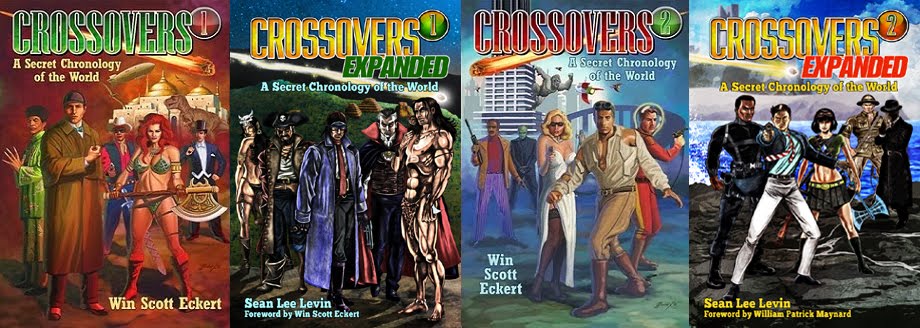
This crossover is one of over a thousand covered in my book Crossovers Expanded: A Secret Chronology of the World Volume 3, coming this summer from Meteor House! All three volumes are AUTHORIZED companions to Win Scott Eckert's Crossovers: A Secret Chronology of the World Volumes 1 and 2!
Wednesday, May 15, 2024

Crossover Cover: Dept. of Monsterology: The Trouble with Harry


In a flashback to 1928, Professor Harry Wilmington explores lost Hyperborea, which was once home to a homo serpentine civilization, and which he suggests may be a non-degenerate offshoot of classic Valusian culture that survived the Thurian cataclysm. He also mentions the Yothian Chronicles and the Elder Things of Antarctica. Hyperborea and its Serpent People are from the works of Clark Ashton Smith. Valusia and the Thurian cataclysm are from Robert E. Howard’s Kull stories. Yoth is from H. P. Lovecraft and Zealia Bishop’s “The Mound,” while the Elder Things are from Lovecraft’s “At the Mountains of Madness.” 

This crossover is one of over a thousand covered in my book Crossovers Expanded: A Secret Chronology of the World Volume 3, coming this summer from Meteor House! All three volumes are AUTHORIZED companions to Win Scott Eckert's Crossovers: A Secret Chronology of the World Volumes 1 and 2!

Tuesday, April 23, 2024

Crossover Cover: Happy Forever


In this story by Simon R. Green, professional thief Gideon Sable is hired by the father of a former lover to rescue her from a house where Time stands still. The father asks Gideon if he really stole the Hand of Eibon. Gideon finds many references to the house in books about unusual places such as Undertowen, the world below. Eibon is from Clark Ashton Smith’s Cthulhu Mythos stories. London Undertowen is from Green’s Secret Histories novel For Heaven’s Eyes Only and his Ghost Finders novel Spirits from Beyond. It bears noting that following the events of this story another thief assumes the identity of Gideon Sable, acting as the protagonist of a series of novels by Green, which have crossovers of their own.

This crossover is one of over a thousand covered in my book Crossovers Expanded: A Secret Chronology of the World Volume 3, coming this summer from Meteor House! All three volumes are AUTHORIZED companions to Win Scott Eckert's Crossovers: A Secret Chronology of the World Volumes 1 and 2!

Sunday, October 29, 2023

Crossover of the Week

Winter 1925

THE CREEPING CRAWLERS OF CLAVERING 

Charles St. Cyprian, the Royal Occultist, and his assistant Ebe Gallowglass are summoned to Clavering Grange by Philip Wendy-Smythe. St. Cyprian carried his fair share of bags when he’d played batman for Carnacki. The Sign of Koth is marked on the billiards room door in jam. Wendy-Smythe has one of Vance’s monographs on elementals and has just completed the first English translation of The Book of Minor Grotesques. St. Cyprian says he’ll resolve matters in two shakes of a Shadmock’s tail and mentions the time a dog got into the Drones. He also traces the sign of Hloh in the air and takes the Voorish Sign out of a box decorated in Hyperborean iconography. The sound of rodents reminds Gallowglass of Exham Priory. 

Short story by Josh Reynolds in Shadmocks & Shivers: New Stories Inspired by the Stories of R. Chetwynd-Hayes, Dave Brzeski, ed., Shadow Publishing, 2019. Clavering Grange is the setting of a series of books and stories by R. Chetwynd-Hayes. Thomas Carnacki is from William Hope Hodgson’s Carnacki, the Ghost-Finder. The Sign of Koth is from H. P. Lovecraft’s The Case of Charles Dexter Ward and “The Dream-Quest of Unknown Kadath.” Vance is Alice and Claude Askew’s occult investigator Aylmer Vance. The Book of Minor Grotesques is a recurring tome in Reynolds’ fiction. The Shadmock is from Chetwynd-Hayes’ eponymous story in the linked collection The Monster Club. The Drones Club is from the works of P. G. Wodehouse. Hloh is from Margery Lawrence’s Miles Pennoyer stories. The Voorish Sign is from Lovecraft’s “The Dunwich Horror.” Hyperborea is from the fiction of Clark Ashton Smith. Exham Priory is from Lovecraft’s “The Rats in the Walls.” Since the Clavering Grange stories are in the CU, so are Chetwynd-Hayes’ tales of psychic detective Francis St. Clare and his sidekick Frederica Masters, who visited Clavering in “The Cringing Couple of Clavering.”

This crossover writeup is one of hundreds included in my book Crossovers Expanded: A Secret Chronology of the World Volume 3, which will be published by Meteor House! All three volumes are AUTHORIZED companions to Win Scott Eckert's Crossovers: A Secret Chronology of the World Volumes 1 and 2! 

Sunday, June 18, 2023

Crossover of the Week

Autumn 1926 

WRATH OF N’KAI 

Countess Alessandra Zorzi, a professional thief-for-hire, comes to Arkham, Massachusetts to steal a mummy found in Oklahoma. Two years ago, Alessandra stole a gargoyle from the cathedral of Vyones. A month after that, she pilfered a copper ring crafted in the shape of a serpent from a house in Mayfair. Philippa “Pepper” Kelly, who works as a cab driver in male disguise, has as her head dispatcher a short, fat man named De Palma. At the unveiling of the mummy at the Miskatonic Museum, Alessandra runs into her old acquaintance Tad Visser, a New Yorker, who says the crowd includes bigwigs from Miskatonic, Harvard, Yale, and even representatives from his alma mater, Empire State. Alessandra knows of others in her profession who are violent or lacking in restraint, such as “that charlatan, Lampini.” Her teachers included an elderly Englishman with an inordinate fondness for cricket, a melancholy albino who smoked opium-soaked cigarettes, and the incomparable Mr. Nuth. Alessandra tells Pepper, “As a gentleman of my acquaintance once said, one cannot make bricks without clay.” Alessandra and Visser discuss Arkady Cottonwood’s book The Oldest Rite, a single copy of which Alessandra has stolen five times for three different clients. She also once procured a book on horology for a fat man in New York with a fondness for orchids. 

An Arkham Horror novel by Josh Reynolds, Aconyte, 2020. Vyones is from Clark Ashton Smith’s Averoigne stories. The gargoyle is a reference to Smith’s “The Maker of Gargoyles.” The copper ring is the Serpent Ring of Set from Robert E. Howard’s Conan story “The Phoenix on the Sword.” De Palma is likely the father or grandfather of Louie De Palma, head dispatcher for the Sunshine Cab Company in New York, from the TV series Taxi. Empire State University will later be attended by Peter Parker, aka Spider-Man. Lampini is Bruno J. Lampini, who appears in his own series of stories by Reynolds. Lampini is named after Professor Bruno Lampini from the movie House of Frankenstein. The elderly Englishman is E. W. Hornung’s amateur cracksman A. J. Raffles. The melancholy albino is Sexton Blake’s archenemy Zenith the Albino. Nuth is from Lord Dunsany’s story “How Nuth Would Have Practiced His Art Upon the Gnoles.” The gentleman of Alessandra’s acquaintance is Sherlock Holmes, who said “Data! Data! Data! I can’t make bricks without clay” in Doyle and Watson’s “The Adventure of the Copper Beeches.” Arkady Cottonwood is from Reynolds’ story “Corn Wolf.” Cottonwood’s book The Oldest Rite is mentioned in several of Reynolds’ works. The fat orchid enthusiast is Nero Wolfe, although Alessandra’s acquisition of the book for him must have happened before he officially hung up his shingle as a private eye in 1930. Professor Tyler Freeborn mentions his expedition to the Great Sandy Desert with Professor Nathaniel Wingate Peaslee and Professor Ferdinand Ashley from “The Shadow Out of Time” as a past event. This reference must be disregarded, as that expedition took place in 1935, nine years after the events of this novel. 

This crossover writeup is one of hundreds included in my book Crossovers Expanded: A Secret Chronology of the World Volume 3, which will be published by Meteor House! All three volumes are AUTHORIZED companions to Win Scott Eckert's Crossovers: A Secret Chronology of the World Volumes 1 and 2!

Sunday, May 29, 2016

Crossover of the Week

1918
DEAD MEN’S BONES
Charles St. Cyprian, Sergeant Bass of the American 81st Infantry Division, and Thomas Carnacki are camped outside the fortress of Ylourgne in the province of Averoigne. St. Cyprian had to leave the company of a young woman he met at the cabaret in Vyones in order to go on this mission. Carnacki says he believes there is an oil painting of Ylourgne, or rather the Chateau de Faussesflammes, in the Louvre. The adventures of Carnacki, England’s present Royal Occultist, appeared in the pages of The Idler, just as those of the Great Detective had appeared in The Strand. Corpses throughout Averoigne are coming back as zombies, in places such as Vyones, Les Hiboux, and Ximes. The Isoile is mentioned. Professor Max Ewer tells the trio Ylourgne was the site of one of the greatest acts of alchemical diabolism in this age or any other, according to the writings of one Gaspard du Nord: a dwarf named Nathaire made a giant monster out of dead men’s bones, which rampaged through Vyones. Carnacki refers to the 266 Squadron RFC.
Short story by Josh Reynolds in Kaiju Rising: Age of Monsters, Tim Marquitz and Nickolas Sharps, eds., Ragnarok Publications, 2014. Charles St. Cyprian is the protagonist of Reynolds’ Royal Occultist stories, which take place after he has assumed the role previously played by Carnacki. Sergeant Bass is John Bass, an occult detective from Jackapo, South Carolina featured in several of Reynolds’ stories. Thomas Carnacki appeared in stories by William Hope Hodgson published in The Idler, which were later collected as Carnacki the Ghost-Finder. Ylourgne, Averoigne, Vyones, the Chateau de Faussesflammes, Les Hiboux, Ximes, the Isoile River, Gaspard du Nord, and Nathaire are from the works of Clark Ashton Smith. This marks the second attempt by a madman to create their own version of Nathaire’s Colossus during the Great War; the first was in 1916, as seen in Matthew Baugh’s “What Rough Beast.” The Great Detective is Sherlock Holmes. The 266 Squadron RFC, from W. E. Johns’ Biggles books, is not to be confused with the real 266 Squadron RAF.
 

Sunday, May 1, 2016

Crossover of the Week

1881
THE WAR SHAMAN
The Merkabah Rider gives his ally Kabede a pistol with the Elder Sign imprinted on its side. Kabede refers to their conflict with the Great Old Ones. The two of them, along with the Rider’s old friend Dick Belden, are visited by Shar-rogs pa, the blue abbot of Shambhala, aka Faustus Montague. The monk Chaksusa told the Rider of the abbot when he’d battled Shub-Niggurath, the Yiggians, and the Black Goat Man. Faustus’ brother is Mun Gsod. Faustus tells the Rider, Kabede and Belden of stories that are true: a whaler with an Indian figurehead pursuing a pale leviathan to the doom of her crew and her scarred captain; a young boy putting his hand on a sword and drawing it lightly from a stone, becoming the greatest king the world has ever known; and thirteen heroes with two hearts between them, who set themselves between an insignificant world and all the evil that time and space can muster. He further states a word Chaksusa taught to the Rider, when combined with the Star-Stones of Mnar, is doubly detrimental to the Great Old Ones. The Apache Piishi has seen the Rider’s old acquaintance Misquamacus. Ten of Faustus’ disciples died battling Adon’s Creed on a mesa at a place called Stallions Gate in New Mexico. Among the allies of the Merkabah Riders are the Kun-Sun-Dai and the Watchers. Faustus thinks Misquamacus may be serving Nyarlathotep. The Rider’s own claustrophobia reminds him of his boyhood friend Aloysius Monkowitz’s many phobias. The Rider and Piishi faced Shub-Niggurath and the Cold Ones together. Misquamacus has manipulated the Billington family in the past. The geometric patterns in sand-images made by a group of skinwalkers remind the Rider of the diagrams in the Book of Zylac. Misquamacus summons Ossodagowah.
Short story by Edward M. Erdelac in Merkabah Rider: Have Glyphs Will Travel, Damnation Books, 2011. The Elder Sign, the Great Old Ones, Shub-Niggurath, and Yig are from H. P. Lovecraft’s Cthulhu Mythos. The Star-Stones of Mnar are from August Derleth’s The Lurker at the Threshold. Misquamacus is from both The Lurker at the Threshold and Graham Masterton’s Manitou novels. The Lurker at the Threshold mentions both Misquamacus’ devotion to Nyarlathotep and his conjuring of Ossodagowah. The Billington family is also from The Lurker at the Threshold. “Shar-rogs pa” and “Mun Gsod” are Tibetan approximations of “Darkness Slayer” and “East-helper,” the English translations of the names of the blue wizards Morinehtar and Rómestámo from J. R. R. Tolkien’s The Lord of the Rings. This story reveals Rómestámo and Misquamacus are the same being. The whaler is the Pequod from Herman Melville’s Moby-Dick. The boy who drew the sword from the stone is King Arthur. The thirteen heroes with two hearts between them are the various incarnations of the Doctor, of Doctor Who fame. While most of the Doctor’s exploits take place in an alternate universe, it has been established the Doctor has a CU counterpart, who often goes by the name of Doctor Omega. Stallions Gate, New Mexico, is the future site of Project Quantum Leap, from the television series Quantum Leap. The Watchers (more properly the Watchers’ Council) are from the television series Buffy the Vampire Slayer, while the Kun-Sun-Dai (whose full name is the Order of the Kun-Sun-Dai) are from the “Awakening” and “Calvary” episodes of the Buffy spin-off Angel. Aloysius Monkowitz is an ancestor of obsessive-compulsive private investigator Adrian Monk from the television series Monk. The Cold Ones and Zylac appear in Cthulhu Mythos fiction by Clark Ashton Smith. Zylac’s book, The Wisdom and Sacred Magic of Zylac the Mage, appears in stories by Joseph S. Pulver.

Wednesday, April 20, 2016

Crossover Cover: Casting the Stone

In John Pocsik's contribution to this 1964 Arkham House anthology, an occultist’s library includes The Book of Eibon, Cultes des Goules, Judge Pursuivant’s Vampiricon, and John Thunstone’s Myth Patterns of the Shonokins. The Book of Eibon and Cultes des Goules are tomes associated with the Cthulhu Mythos, and were created by Clark Ashton Smith and Robert Bloch respectively. Judge Keith Hilary Pursuivant is the protagonist of a series of stories by Manly Wade Wellman; The Vampiricon is mentioned in the Pursuivant stories. John Thunstone is another Wellman hero, who sometimes battled the man-like creatures known as the Shonokins; however, the book Myth Patterns of the Shonokins is Pocsik’s invention.

Tuesday, March 29, 2016

Crossover Cover: The Wedding of Sheila-Na-Gog

This issue contains a Simon of Gitta story by Richard L. Tierney and Glenn Rahman. Simon visits Regio Averonum, an area of Gaul. He finds himself aligned with a tribe called the Averoni, who worship a god named Sadoqua and command large black cats. Fighting Simon and his allies are the Black Goat Druids, adherents of the goddess Sheila-na-gog, who was originally in Acheron and Hyperborea. Simon throws a corrupt Roman official into Sheila-na-gog, and she gives birth to a monster who “was small and had the shape of a rat, but its pallid bearded face and handlike forepaws were evilly human.” Rick Lai writes, “Regio Averonum is a chronologically earlier version of the region of France later known as Averoigne in ‘The Holiness of Azéderac’ and other stories by Clark Ashton Smith. Sadoqua is an alias which Smith used for his demon-god Tsathoggua. The name Regio Averonum and the black cats were actually ideas of H. P. Lovecraft’s, which were given to Smith in the correspondence between the two authors (see Lovecraft’s Selected Letters IV: 1932–1934, letters #669, 674, and 685). Lovecraft also came up with the idea of a tribe called the Averones, whose name was changed to Averoni in the Simon of Gitta story. Acheron is from Robert E. Howard’s ‘Black Colossus’ and Conan the Conqueror, while Hyperborea is a polar continent described by Clark Ashton Smith. Sheila-na-gog has the form of a pool which gives birth to monsters. The appearance and nature of Sheila-na-gog are virtually identical with Abhoth the Unclean, the Hyperborean deity from Clark Ashton Smith’s ‘The Seven Geases.’ I don’t think Sheila-na-gog and Abhoth are the same deity. I suspect that they are either father and daughter, or sister and brother, or son and mother. The monsters spawned by Sheila-na-gog only have a long life span if a human being is thrown into Sheila-na-gog first. The goddess devours a human and fashions a spawn from his flesh. Sheila-na-gog’s spawn in this story could be Brown Jenkin from Lovecraft’s ‘The Dreams in the Witch-House.’”

Thursday, March 10, 2016

Crossover Cover: World War Cthulhu

This anthology contains two stories with crossovers, both written by authors with no little experience at same. One is "The Yoth Protocols" by Josh Reynolds. An FBI agent named Sarlowe thinks of centers of eldritch activity, such as the Warren site in the Big Cypress, the Martense molehills, and "certain secret cellars where a certain artist had painted certain pictures and almost certainly been eaten." He also thinks of Inspector Craig and his Special Detail in the subway tunnels beneath New York, as well as worms in the earth. Sarlowe’s partner Indrid Cold is described as having a wax-like face. It is stated there are worse things in Heaven and Earth than dreamt of in Alhazred’s philosophy. The local "old ones" include the Shonokins and the K’n-Yani. Sarlowe reminds Cold of the Yoth protocols. A circular stone covering the stairs leading to the mound where the K’n-Yani live was placed there after the Zamacona Cylinder was unearthed. "The batrachian hillbillies in Massachusetts" and N’Kai are mentioned. Cold is the only person who ever used the Voormithadreth Corridor and hadn’t rotted from the inside out. Cold identified Valusian spectrum radiation within the mound. The Russian necromancer Grigori Petrov refers to the Zann Concerto and the maw of Leng. Cold asks Petrov if he was planning to let Tsathoggua’s children loose to do his dirty work. Sarlowe quotes, "Evil the mind that is held by no head." Sarlowe is a relative of occult detective Baxter Sarlowe from Reynolds’ novel Wake the Dead. The Warren site in the Big Cypress is from H. P. Lovecraft’s story "The Statement of Randolph Carter." The Martense molehills are from Lovecraft’s "The Lurking Fear." The secret cellars where an artist painted pictures and was eaten are from Lovecraft’s story "Pickman’s Model." Inspector Craig and his Special Detail are from Robert Barbour Johnson’s story "Far Below." The worms in the earth are from Robert E. Howard’s Bran Mak Morn story "Worms of the Earth." Indrid Cold is an allegedly real person connected to the supposed Mothman sightings in 1966. His wax-like face implies Cold is a member of the wax-masked race of creatures seen in Lovecraft’s "The Festival," which is the source of the quote, "Evil the mind that is held by no head." Abdul Alhazred, the mad Arab, is the author of the Necronomicon in Lovecraft’s Cthulhu Mythos. The Shonokins are from Manly Wade Wellman’s John Thunstone stories. The K’n-Yani, Yoth, the Zamacona Cylinder, and N’Kai are from Lovecraft’s revision of Zealia Bishop’s story "The Mound." "The batrachian hillbillies in Massachusetts" are a reference to Lovecraft’s "The Shadow over Innsmouth." The Voormithadreth Corridor is connected to Mount Voormithadreth from Cthulhu Mythos stories by Clark Ashton Smith. Tsathoggua is also from Smith’s Mythos tales. Valusian spectrum radiation is a reference to the kingdom of Valusia in Robert E. Howard’s Kull stories. The Zann Concerto is from Lovecraft’s "The Music of Erich Zann." The plateau of Leng appears in a number of Lovecraft’s stories. The other story that I will include is "Cold War, Yellow Fever" by Pete Rawlik. Mitchell Peel is an operative of the Joint Advisory Committee on Korea (JACK), receiving orders from Colonel Doctor Wingate Peaslee, aka the Terrible Old Man. Peaslee tells Peel and other JACK agents Esteban Zamarano was sent to Banes, Cuba as part of Operation Mongoose to enlist his family’s aid. The Zamaranos bought six volumes from the sale of the Church of the Starry Wisdom Library, including what appears to be a Spanish-language edition of The King in Yellow. After contact was lost with Zamarano, another agent traveled to Banes, and disappeared himself, though not before sending the message, "Where is the Yellow Sign?" The Soviets are willing to neutralize the threat, but Peaslee says Washington does not want to see another Gizhinsk, particularly so close to the U.S. borders. Peel and company work with Major Romero of the Cuban Security Forces and Agent Tanya Romanova of Soviet Army Intelligence to deal with the situation. Romanova refers to documented cases of childrens’ minds being stimulated to see the universe in ways adults cannot, such as the Paradine children and "that village in Winshire." After the mission, a traumatized and disfigured Peaslee is retired to a minimum security facility near Arkham, Massachusetts. Mitchell Peel is related to David Conyers’ series character Major Harrison Peel, an NSA consultant who appears in stories set in the milieu of the Mythos. Wingate Peaslee is from Lovecraft’s story "The Shadow Out of Time"; his nickname of "the Terrible Old Man" is an homage to Lovecraft’s story of the same name. The Church of the Starry Wisdom is from Lovecraft’s "The Haunter of the Dark." Arkham, Massachusetts is the setting of a number of Mythos tales. The King in Yellow is from Robert W. Chambers’ short story collection of the same name, and was incorporated into the Cthulhu Mythos by Lovecraft in his story "The Whisperer in Darkness." The Yellow Sign is also from Chambers’ book. Gizhinsk and "that village in Winshire" are from John Wyndham’s novel The Midwich Cuckoos. Agent Tanya (or Tatiana) Romanova is from Ian Fleming’s James Bond novel From Russia, with Love. The Paradine children are from the short story "Mimsy Were the Borogroves" by "Lewis Padgett" (Henry Kuttner and C. L. Moore).

Sunday, February 21, 2016

Crossover of the Week

2003
THE BIG GAME
John Taylor battles Sir Francis Varney, the King of the Vampires, who is trying to turn the Nightside into a homeland for the undead. Appearing or mentioned are: Tsothagua Tequila; Jack Drood; the Street of the Gods; Kor; Julien Advent; Something from a Black Lagoon; the withered and mummified arm of the original Grendel monster, presented to the Adventurers Club by Beowulf himself, back in the sixth century; an ex-Ghost Finder; some kind of Boojum; the Suicide Club; Dracula; and Rassillonn’s Restorative.
Novella by Simon R. Green in Tales from the Nightside, Ace Books, 2015. Sir Francis Varney is from James Malcolm Rymer’s penny dreadful serial Varney the Vampire. Tsothagua Tequila is a reference to Tsathoggua, a Great Old One created by Clark Ashton Smith as part of H. P. Lovecraft’s Cthulhu Mythos. Jack Drood is from Green’s Secret Histories novels; his appearance here places this story before the short story “Question of Solace.” The Street of the Gods is from Green’s Hawk & Fisher novellas Winner Takes All and The God Killer. Kor is from H. Rider Haggard’s novel She. Julien Advent is an alias for the titular hero of the 1960s British television series Adam Adamant Lives! Something from a Black Lagoon is a reference to the Universal horror film Creature from the Black Lagoon. The original Grendel monster and Beowulf are from the Old English epic poem Beowulf. The ex-Ghost Finder must have been a former member of the Carnacki Institute from Green’s Ghost Finders series. The Boojum is from Lewis Carroll’s poem “The Hunting of the Snark.” The Suicide Club is from Robert Louis Stevenson’s story of the same name. Dracula needs no introduction. Rassillonn’s Restorative is a reference to the Time Lord Rassilon from the long-running British science fiction television series Doctor Who.

Friday, June 26, 2015

Crossover Cover: Professor Challenger: New Worlds, Lost Places

This anthology of new stories featuring Arthur Conan Doyle's Professor Challenger includes several crossovers. In Lawrence C. Connolly's "King of the Moon," Bedford, Challenger, Ann Cavor and a pair of father-and-son inventors rescue Ann’s uncle from the Selenites. Bedford, Dr. Cavor, and the Selenites are from H.G. Wells’ The First Men in the Moon, which is described as having taken place ten years ago. Bedford implies here that he is the one who put Challenger in contact with Arthur Conan Doyle. Challenger must have introduced Doyle in turn to Edward Malone. Doyle became Malone’s literary agent and editor, publishing the reporter’s accounts of his adventures with Challenger under his own byline. In Josh Reynolds' "Time's Black Gulf," Professor Summerlee, Lord John Roxton, Malone, and Thomas Carnacki battle Indrid Cold and other members of his race, who are part of a conspiracy to infiltrate the human race at every stage of its evolution along with an alien race that has swapped Challenger’s consciousness with that of one of their own people. Challenger has copies of Cultes des Goules and Unaussprechlichen Kulten. Carnacki refers to the Sigsand Manuscripts, the Book of Eibon, the Pnakotic texts, the Florentine monk Corsi, and Khephnes. The Tind’Losi, the Hounds of the Angles, appear. Dr. John Silence and Jessie Challenger ultimately save the day. Thomas Carnacki and the Sigsand Manuscripts are from William Hope Hodgson’s Carnacki the Ghost-Finder. Indrid Cold is a supposedly real person connected to the Mothman sightings of 1966-1967. Here, he is also a member of the race of creatures seen in H.P. Lovecraft’s "The Festival." This version of Cold also appears in Reynolds’ stories "The Pnakotic Puzzle" and "The Yoth Protocols." "The Pnakotic Puzzle” indicates that this story happened “some years before the war.” The consciousness-swapping alien race is the Great Race of Yith from Lovecraft’s "The Shadow Out of Time."Bartolomeo Corsi and Khephnes are also from "The Shadow Out of Time." The Cultes des Goules is a Cthulhu Mythos tome created by Robert Bloch. Unaussprechlichen Kulten is a Mythos tome created by Robert E. Howard. The Book of Eibon is from Clark Ashton Smith’s contributions to the Mythos. The Pnakotic texts are a reference to Lovecraft’s Pnakotic Manuscripts. The Tind’Losi are from Frank Belknap Long’s story "The Hounds of Tindalos." Dr. John Silence is an occult detective featured in stories by Algernon Blackwood. In John Takis' "The Crystal Minders," Challenger suggests that a scientist has "invented a machine capable of traveling through time, like that loon in Surrey, have you?" “That loon in Surrey” is the Time Traveler from H.G. Wells’ The Time Machine. This story is primarily narrated by Professor Summerlee, though a framing sequence narrated by Edward Malone involves Summerlee coming to the reporter to tell him of the adventure. Malone refers to the events of “The Disintegration Machine” in passing as a past event. This creates a chronological conflict, as Rick Lai’s essay “The Anomaly of Professor Challenger’s Daughter” (Rick Lai’s Secret Histories: Daring Adventurers, Altus Press, 2008) places both “The Disintegration Machine” and The Land of Mists in 1926. According to The Land of Mists, Summerlee died “last year,” i.e., in 1925. Therefore, the reference to “The Disintegration Machine” must be obfuscation on Malone’s part, similar to Dr. Watson providing false dates in his accounts of Sherlock Holmes’ cases. In Andrew J. Wilson's "Out of the Depths," set in 1937, Challenger and Malone encounter Nazis in Maple White Land. Hobbs Lane is from the British television science fiction serial Quatermass and the Pit, although there it is located in Knightsbridge, rather than Kensington. Doctor Moreau is from H.G. Wells’ novel The Island of Doctor Moreau. The Lidenbrock Sea is from Jules Verne’s novel Journey to the Centre of the Earth. Medusa Von Juntz is related to Friedrich Von Juntz from Robert E. Howard’s “The Black Stone.” Doctor Moreau is revealed to have been Jack the Ripper, placing this story outside CU continuity. In Guy Adams and James Goss' "Professor Challenger and the Crimson Wonder," Challenger and his wife have a run-in with aliens who are planning to overrun the world with a remarkable plant. Mycroft Holmes is Sherlock Holmes’ brother. Lidenbrock is Otto Lidenbrock from Journey to the Centre of the Earth. Cavor is from Wells’ The First Men in the Moon, as previously stated. Abner Perry is from Edgar Rice Burroughs’ Pellucidar novels. William Dyer is from H.P. Lovecraft’s “At the Mountains of Madness.” Herbert is meant to be the Time Traveler from Wells’ novel. Herakleophorbia IV, Bensington, and Miss Cossar’s brother are from Wells’ novel The Food of the Gods. Ryland and the Great Four are from Agatha Christie’s novel The Big Four. The meteorite that landed in Woking in 1898 is from Wells’ novel The War of the Worlds. This story is too overtly satirical to fit easily into CU continuity. Also, Poirot moved to England in 1916, so the portrayal of him as an agent of Mycroft Holmes in 1914 is chronologically incorrect.