Showing posts with label Professor Challenger. Show all posts

Sunday, July 7, 2024

Crossover of the Week

Early Autumn 1926 

A WHISPER OF SOFT WINGS 

Noticing parallels between his current case and a previous affair, Charles St. Cyprian asks Inspector Moxley if he was acquainted with Inspector Quennell. Not long after solving that case, Quennell turned over his notes to St. Cyprian’s predecessor, Carnacki. Quennell’s main suspect was Dr. Mallinger. The Voyagers Club resides on Dover Street, alongside others of its ilk, such as the Albermarle, the Drones, and the Diogenes. The late Geoffrey Botkin was one of the few who has been to Maple White Land, a few years after the Challenger expedition, with Lord John Roxton in 1913. According to a newspaperman named Malone, Botkin was almost eaten by a giant spider. The Voyagers’ bar has a bust of Quatermain over the door. St. Cyprian discusses an alchemist and member of the Order of the Cosmic Ram who engaged in experiments like Mallinger’s with another member of the Order, who also belongs to the Bollinger Club. St. Cyprian’s friend Bertie lives on Berkley Street. 

Short story by Josh Reynolds on the website Curious Fictions. Inspector Quennell and Dr. Carl Mallinger are from the movie The Blood Beast Terror. Thomas Carnacki is from William Hope Hodgson’s Carnacki, the Ghost-Finder. The Drones Club is from the works of P. G. Wodehouse. Bertie is Bertie Wooster. The Diogenes Club is from Doyle and Watson’s Sherlock Holmes stories. Maple White Land, Professor George Edward Challenger, Lord John Roxton, and Edward D. Malone are from Doyle’s The Lost World. Allan Quatermain is from H. Rider Haggard’s novels and stories. The Bollinger Club is from Evelyn Waugh’s Decline and Fall

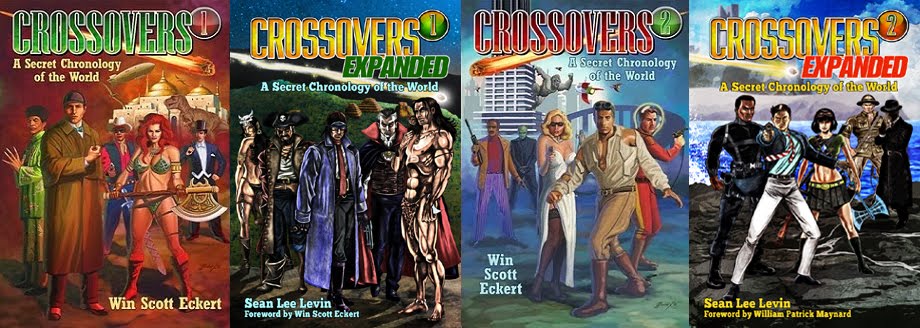
This crossover writeup is one of over a thousand included in my book Crossovers Expanded: A Secret Chronology of the World Volume 3, coming this summer from Meteor House! All three volumes are AUTHORIZED companions to Win Scott Eckert's Crossovers: A Secret Chronology of the World Volumes 1 and 2!

Friday, June 28, 2024

Crossover Cover: The Manifestations of Sherlock Holmes


Are you a Sherlock Holmes fan?

Then you'll love this anthology, which includes a story in which Holmes meets Professor Challenger, as well as alternate universe stories involving the Cthulhu Mythos and Dr. Jekyll and Mr. Hyde!

For more information, be sure to purchase my book Crossovers Expanded: A Secret Chronology of the World Volume 3, coming this summer from Meteor House! All three volumes are AUTHORIZED companions to Win Scott Eckert's Crossovers: A Secret Chronology of the World Volumes 1 and 2!

Friday, June 21, 2024

Crossover Cover: Sherlock Holmes: Consulting Detective Volume 12


This anthology includes three stories with crossovers.

In I. A. Watson's "The Nottingham Crakster," Holmes is visited by a police inspector who seeks a gem belonging to Lord Roger Roxton, which has been stolen by criminal and “crakster” (a Northern slang expression for a trickster) Jemmy Wilson, and which he believes Holmes himself has stolen. Holmes deduces that the so-called policeman is in fact Wilson himself. A footnote to this story suggests that Lord Roger Roxton may be the father of Lord John Roxton from Doyle and Malone’s The Lost World and other Professor Challenger tales. To square this with Philip José Farmer’s genealogy for Lord John in Tarzan Alive, we must conclude that “Lord Roger Roxton” is a Watsonian pseudonym for George Wimsey, the 14th Duke of Denver, Lord John’s adoptive father. Obviously, Edward D. Malone used the same coded surname as Watson in his written accounts of his, Roxton, and Challenger’s exploits. Jemmy Wilson is from Doyle’s “Selecting a Ghost: The Ghosts of Goresthorpe Grange.”

In Barbara Doran's "The Adventure of the Counterfeit Secretary," Holmes and Watson team with Professor Augustus S. F. X. Van Dusen, aka the Thinking Machine, and his companion journalist Hutchinson Hatch to thwart sabotage of the Berlin International Trade Exposition. Professor Van Dusen and Hutchinson Hatch are from Jacques Futrelle’s detective stories and novels. 

In Brad Mengel's "The Adventure of the Stolen Tattoo," Watson has dinner with Dr. Stamford and his new wife, who honeymooned in Australia, where they were robbed by the bushranger known as the Stingaree. During the Second Opium War, a chap by the name of Flashman came by the Barrington house and told Richard Francis Barrington’s mother of her husband’s death. The Stingaree is from E. W. Hornung’s Irralie’s Bushranger and Stingaree. Flashman is Harry Flashman, whose service in the Second Opium War is described in George MacDonald Fraser’s Flashman and the Dragon.

These crossovers are among over a thousand covered in my book Crossovers Expanded: A Secret Chronology of the World Volume 3, coming this summer from Meteor House! All three volumes are AUTHORIZED companions to Win Scott Eckert's Crossovers: A Secret Chronology of the World Volumes 1 and 2!

Tuesday, May 21, 2024

Crossover Covers: Dept. of Monsterology: Sabbaticals


At Dunsany College, Professor Booker’s secretary, Mrs. Chandrasekeran, tells a caller that he is not in, and tries to remember where Emma Hampton is on an expedition with one of Dunsany’s field teams, naming the Leng Plateau and Westchester House as possible sites. Team Carnacki is in Scotland, while Team Challenger is on an expedition in South America, on a plateau inhabited by dinosaurs. Javier de Tovar refers to the Yiggian digs in North Africa and Sardinia. The Plateau of Leng is from H. P. Lovecraft’s Cthulhu Mythos stories. Westchester House is from the titular scenario for the role-playing game Call of Cthulhu. Team Carnacki is named for Thomas Carnacki from William Hope Hodgson’s Carnacki, the Ghost-Finder. The South American plateau must be Maple White Land, which was discovered by Team Challenger’s namesake Professor George Edward Challenger in Doyle and Malone’s The Lost World. Yig is from Lovecraft and Zealia Bishop’s “The Curse of Yig” and “The Mound.”

This crossover is one of over a thousand covered in my book Crossovers Expanded: A Secret Chronology of the World Volume 3, coming this summer from Meteor House! All three volumes are AUTHORIZED companions to Win Scott Eckert's Crossovers: A Secret Chronology of the World Volumes 1 and 2!

Sunday, May 19, 2024

Crossover of the Week

Summer 1936

THE FROST WOLF 

Harry Dickson meets with Prime Minister Caius Keyes and his wife Angelique. Keyes introduces Dickson to Doctor Omega and Captain Gullivar Jones. An object like a comet or meteor has crashed in Clapham Common, which Keyes initially assumed was a precursor to an alien invasion, being as familiar with the historical works of H. G. Wells as anyone. Omega says he is aware of a dog-like wolf with human-level intelligence which manifests itself at certain points in history, calling it the Hound of the Baskervilles, the Hound of Death, and the Beast of Gevaudan. Dickson has enough firearms to equip a fair-sized dinosaur-hunting party to the Lost World. Omega describes lights they see as the Aether’s spatio-temporal vortex. The inhabitant of the crashed time machine, injured from the mesonychid wolf’s attack, identifies himself as Heracles Danby. The injured Omega, Jones, and Danby, as well as another man, are treated in a high dependency ward run by a Dr. Mannering from Cardiff. The third man’s belongings bear the legend Catharus Mine, while his dog tags identify him as Adam Oberstein. Dickson witnesses a scene of horror that reminds him of the Miller’s Court Triptych painted by Walter Sickert depicting the death of the final victim of Jack the Ripper that he had been shown back when he was a member of the Roebuck Cabal. The Prime Minister says he used to be part of the Home Office’s elite Gordian Squad, but Dickson thinks that surely one of the Great Men of Baker Street or Rouletabille would have told him about it. The Frost Wolf is killed by Pandora, who is accompanied by Liandra Ritter and her son Kulath Jr., who refers to Danby as “grandfather.” Omega warns Dickson about Total Security Management and the Cull Men. 

Short story by Martin Gately in Exquisite Pandora and Other Fantastic Adventures, Black Coat Press, 2020. Harry Dickson appeared in pulp stories by Jean Ray and others. Caius Keyes, Angelique Datura, and the Gordian Squad first appeared in Gately’s “The White Box.” Doctor Omega is the title character of Arnould Galopin’s science fiction novel. Jean-Marc and Randy Lofficier’s translation of that book identified Omega with Doctor Who. The lights are the Time Vortex from Doctor Who. Gullivar Jones is from Edwin L. Arnold’s Lieut. Gullivar Jones: His Vacation. The H. G. Wells reference evokes The War of the Worlds. The wolf first appeared in Gately’s “Wolf at the Door of Time.” The Hound of the Baskervilles is from the titular Sherlock Holmes novel. The Hound of Death is from Agatha Christie’s story of the same name. The Lost World is from Arthur Conan Doyle’s eponymous book. Heracles Danby, Liandra Ritter, and Kulath Sr. are from Gately’s “The Cataclysm Will Not Be Televised.” Dr. Frank Mannering is from the movie Frankenstein Meets the Wolf Man. The Catharus Mine is from Gately’s “Rouletabille and the New World Order,” and is associated with the Catharus Society, a precursor to THRUSH from the TV series The Man from U.N.C.L.E. Adam Oberstein is related to spy Hugo Oberstein from Doyle and Watson’s Sherlock Holmes tales “The Adventure of the Second Stain” and “The Adventure of the Bruce-Partington Plans.” The Roebuck Cabal is from Gately’s eponymous story. As established in Gately’s stories about Gaston Leroux’s journalist and detective Rouletabille, the Great Men of Baker Street are Sherlock Holmes, Sexton Blake, Seaton Begg (from the works of Michael Moorcock), and Victor Drago (from the British comic book Tornado). Pandora is from Gately’s “Exquisite Pandora.” Total Security Management and the Cull Men appear in another story by Gately, “The Unfettered Man,” set in one of the many possible futures for the CU. 

This crossover writeup is one of over a thousand included in my book Crossovers Expanded: A Secret Chronology of the World Volume 3, coming this summer from Meteor House! All three volumes are AUTHORIZED companions to Win Scott Eckert's Crossovers: A Secret Chronology of the World Volumes 1 and 2!

Friday, March 29, 2024

Crossover Cover: Moonbreaker


Are you an Arthur Conan Doyle fan?

Then you may enjoy this entry in Simon R. Green's Secret Histories series, which has a nod to Professor Challenger, among other crossovers!

For more information, be sure to purchase a copy of my book Crossovers Expanded: A Secret Chronology of the World Volume 3 when Meteor House publishes it! All three volumes are AUTHORIZED companions to Win Scott Eckert's Crossovers: A Secret Chronology of the World Volumes 1 and 2!

Thursday, February 15, 2024

Crossover Covers: Dept. of Monsterology


Dunsany College’s Department of Cryptozoology, Mythological Studies, Parapsychology, and Fortean Phenomena, funded by the Hampton Foundation, has three field teams: Teams Challenger, Carnacki, and the long-lost Carter, whose members died on a space mission. The gold idol Indiana Jones lost in 1936 and the Lament Configuration are seen in Department head Professor Booker’s office. Team Challenger goes on an underwater expedition at 47°9’S 126°43’W, encountering fish men in the process, and recovering a squid-headed idol. Cryptogeographer Javier De Tovar says the markings on the idol are like those in the Ponape Manuscript. Meanwhile, Team Carnacki goes up against some jiangshi (Chinese vampires); a folk tradition from Szechuan suggests the hoofs of a black donkey as a weapon against the undead. Carnacki member Dominic Belasco is described as a “necronaut.” Miskatonic and “Kostabi’s people” are suggested among the parties who may have beat Carnacki to their next destination. In the Pacific, Challenger encounters a dinosaur, whose home De Tovar describes as late Pnakotic Era civilization ruins. A picture from Team Carter’s expedition to Yuggoth is seen. Dunsany’s first expedition to the Antarctic brought back a star-headed creature. The Department’s field teams are named after Arthur Conan Doyle’s Professor Challenger, William Hope Hodgson’s Thomas Carnacki, and Edgar Rice Burroughs’ warlord of Mars, respectively. The gold idol is from the movie Raiders of the Lost Ark. The Lament Configuration is from the Hellraiser films. 47°9’S 126°43’W are the coordinates of R’lyeh according to H. P. Lovecraft’s “The Call of Cthulhu.” The fish men are the Deep Ones from Lovecraft’s “The Shadow over Innsmouth.” The squid-headed idol is of Cthulhu. The Ponape Manuscript is from Lin Carter’s Cthulhu Mythos stories. Miskatonic University is mentioned in several of Lovecraft’s stories, as is Yuggoth. The Pnakotic Era refers to Lovecraft’s Pnakotic Manuscripts. The star-headed creature is an Elder Thing from Lovecraft’s “At the Mountains of Madness.” The idea of black donkey hooves being used to fight jiangshi comes from Zhang Muye’s Ghost Blows Out the Light. Necronauts is a comic by Rennie and Frazer Irving. “Kostabi’s people” refers to Rennie and Dom Reardon’s comic Caballistics, Inc

This crossover is one of hundreds covered in my book Crossovers Expanded: A Secret Chronology of the World Volume 3, which will be published by Meteor House! All three volumes are AUTHORIZED companions to Win Scott Eckert's Crossovers: A Secret Chronology of the World Volumes 1 and 2!

Sunday, August 20, 2023

Crossover of the Week

Autumn 1940

RED SHAMBHALA 

Jim Anthony battles a Russian villain called Koschei. Appearing or mentioned are: Xonira; the Heart of Fortune; the Bugle; the Globe; the New York Inquirer; Sovereign City; Maple White Land; Richard Upton Pickman’s infamous painting “Subway Accident”; Campalans; the Brainerd punch-card automata; Thunder Jim Wade; Doc Ardan; Hanoi Xan and his World Crime League; the Si-Fan; the Brotherhood of the Golden Chrysanthemum; the Vampires of Paris; the Order of the Cosmic Ram; Commissioner Warner; the Black Bat; the Kingscote School for Girls; St. Trinian’s; and a Freiburg dance academy of dubious reputation. 

Novel by Joshua Reynolds, Pro Se Productions, 2015. Jim Anthony appeared in the pulp magazine Super Detective. Xonira is from Derrick Ferguson’s Dillon series. The Heart of Fortune is the riverboat home and gambling casino of Ferguson’s character Fortune McCall. The Daily Bugle and the Daily Globe are from Marvel’s Spider-Man comics. The New York Inquirer is from the classic film Citizen Kane. Sovereign City is the setting of a book imprint from Pro Se; Fortune McCall is one of the city’s heroes. Maple White Land is from Arthur Conan Doyle and Edward Malone’s The Lost World. Richard Upton Pickman and his painting “Subway Accident” are from H. P. Lovecraft’s “Pickman’s Model.” The fictional cubist painter Jusep Torres Campalans was the subject of a biography by Max Aub. The Brainerd punch-card automata are based on technology invented by Johnny Brainerd in Edward S. Ellis’ The Steam Man of the Prairies. Thunder Jim Wade appeared in stories by “Charles Stoddard” (Henry Kuttner) in the pulp magazine Thrilling Adventures. Doc Ardan is from Guy d’Armen’s Doc Ardan: City of Gold and Lepers. Jean-Marc and Randy Lofficier’s adaptation and translation of that novel implied Ardan was really a famous American pulp hero. Hanoi Xan and the World Crime League are from the movie The Adventures of Buckaroo Banzai Across the 8th Dimension. The Si-Fan is from Sax Rohmer’s Fu Manchu novels. The Brotherhood of the Golden Chrysanthemum is mentioned in several works by Reynolds. The Vampires of Paris are from the serial Les Vampires. The Order of the Cosmic Ram is from Reynolds’ Royal Occultist series. Commissioner Jerome Warner is from the Black Bat stories. The Kingscote School for Girls is from Antonia Forest’s Marlow novels. St. Trinian’s is the setting of a comic strip by Ronald Searle. The Freiburg dance academy is from the movie Suspiria.

This crossover writeup is one of hundreds included in my book Crossovers Expanded: A Secret Chronology of the World Volume 3, which will be published by Meteor House! All three volumes are AUTHORIZED companions to Win Scott Eckert's Crossovers: A Secret Chronology of the World Volumes 1 and 2!

Saturday, June 4, 2016

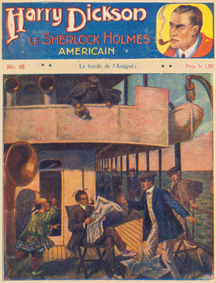
Crossover Cover: Harry Dickson vs. the Spider

This story, originally published as "La Bande de l’Araignée" in Harry Dickson #86, is translated and adapted by Jean-Marc and Randy Lofficier in the anthology Harry Dickson vs. the Spider, with crossover references added. Baker Street detective Harry Dickson battles Georgette Cuvelier and her Spider Society. Georgette tells Dickson the Society’s plans wouldn’t even be limited to Earth if they had the means to leave it, like Mr. Barbicane did. Georgette tells Dickson and his young assistant Tom Wills to evade two Italian mercenaries belonging to the Black Coats. Dickson first met a money lender friend of his when he cleared the man of murder during his time as an apprentice to Sexton Blake. The Society’s headquarters is located inside an opium den; the entrance to their lair can be accessed by manipulating statuettes of the Three Madmen of Toko-Djawa, which are described in Challenger’s book on the religions of Sumatra. Impey Barbicane is the president of the Baltimore Gun Club in Jules Verne’s novels From the Earth to the Moon and Around the Moon. The Black Coats are a criminal organization appearing in novels by Paul Féval. Sexton Blake is the most famous British penny dreadful detective; G. L. Gick revealed a young Dickson served as Blake’s apprentice in his novella “The Werewolf of Rutherford Grange.” Professor George Edward Challenger is the protagonist of The Lost World and other tales by Arthur Conan Doyle. Georgette reappeared in "The Phantom Executioners," which revealed that she was the daughter of Professor Flax, who was a recurring foe of Dickson, but first appeared in Louis Forest’s Someone is Stealing Children in Paris.

Sunday, March 20, 2016

Crossover of the Week

Early January 1891
THE GREEK INVERTEBRATE
Professor Moriarty and Colonel Moran are asked by the Professor’s brother, Colonel James Moriarty, to ignore a summons from the third Moriarty brother, stationmaster James. The Professor and Moran defy his orders, and become involved with espionage and a new machine with which to wage war. Appearing or mentioned are: Sir Augustus Moran; the Club of the Damned; the Mausoleum Club; a chandelier falling on the audience of the Paris Opera during the jewel song from Faust; Fal Vale Junction; Greyfriars; the kuripuri; the Grand Vampire; Les Vampires; a German rival of Moriarty’s who sometimes assumes the guise of “a shock-haired, stooped alienist with mesmeric eyes”; Irma Vep; Palliser; Nevil Airey Stent; Fred Porlock; the Lord of Strange Deaths; R. G. Sanders; Eduardo Lucas; Thomas Carnacki; Cursitor Doone; Monsieur Sabin; Ilse von Hoffmansthal, aka Madame Gabrielle Valladon; Flaxman Low; Hugo Oberstein; Sophy Kratides; Malilella of the Stiletto; Irene Adler; Lady Yuki Kashima; Mad Margaret Trelawny; Dr. Syn; Partington; Paul Finglemore, alias Colonel Clay; and Ram Singh.
Short story by Colonel Sebastian Moran, edited by Kim Newman in Professor Moriarty: The Hound of the d’Urbervilles, Titan Books, 2011. Professor Moriarty, Colonel Moran, and Irene Adler are from Doyle and Watson’s Sherlock Holmes stories. Colonel Moriarty is mentioned in “The Final Problem.” Stationmaster Moriarty and Fred Porlock are from The Valley of Fear. Sir Augustus Moran, the Colonel’s father, is mentioned in “The Adventure of the Empty House.” Eduardo Lucas is from the Holmes story “The Adventure of the Second Stain”; since Lucas died in that story, which Baring-Gould has dated to October 1886, the Lucas in Newman’s story must be a cousin of Doyle’s character who is also involved in espionage. Hugo Oberstein is mentioned in both “The Adventure of the Second Stain” and “The Adventure of the Bruce-Partington Plans,” which is also the source of Partington. Sophy Kratides is from the Holmes tale “The Adventure of the Greek Interpreter.” The Club of the Damned is from the 1970s British television series Supernatural. The Mausoleum Club is from the 1980s BBC radio comedy series Tales from the Mausoleum Club. The chandelier falling on the audience of the Paris Opera during the jewel song from Faust is a reference to The Phantom of the Opera by Gaston Leroux. Fal Vale Junction is from Arnold Ridley’s play The Ghost Train. Greyfriars is the school attended by Billy Bunter in stories written by Charles Hamilton under the pen name Frank Richards. The kuripuri (originally spelled curupuri) is from Doyle’s novel The Lost World. Les Vampires are from Louis Feuillade’s film serial of the same name, as are their leader, the Grand Vampire, and Irma Vep. This Grand Vampire’s predecessor, who appeared in “The Adventure of the Six Maledictions,” must be the one murdered by Erik, the Phantom of the Opera, in 1889, as mentioned in Josh Reynolds’ Phileas Fogg and the War of Shadows. Rick Lai’s “All Predators Great and Small” has Irma as a child in 1895; perhaps the alias “Irma Vep” is used by whoever serves as Les Vampires’ primary female operative at any given time. This is likely the same Irma seen in Phileas Fogg and the War of Shadows. Moriarty’s German rival is Dr. Mabuse, the master criminal who appeared in fiction by Norbert Jacques and three films directed by Fritz Lang. Palliser is Plantagenet Palliser, the protagonist of a series of novels by Anthony Trollope. The Palliser novels are connected to the Chronicles of Barsetshire series, as well as several non-series novels by Trollope. Stent is from H. G. Wells’ The War of the Worlds. The Lord of Strange Deaths is Fu Manchu. R. G. Sanders is Edgar Wallace’s Sanders of the River. Sanders and another of Wallace’s characters, Lieutenant Bones, appear in each other’s series. Thomas Carnacki, “the Ghost-Finder,” was created by William Hope Hodgson. Cursitor Doone’s name is meant to evoke the British comic book character Cursitor Doom. Monsieur Sabin is from E. Phillips Oppenheim’s novels Mysterious Mister Sabin and The Yellow Crayon. Ilse Von Hoffmansthal (originally spelled without the second “h”), aka Gabrielle Valladon, is from Billy Wilder’s film The Private Life of Sherlock Holmes. Flaxman Low is from the collection Ghosts; Being the Experiences of Flaxman Low, by “E. and H. Heron” (Hesketh V. Prichard and Kate O’Brien Ryall Prichard). Malilella (usually spelled without the second “l”) is from Ermanno Wolf-Ferrari’s opera The Jewels of the Madonna. Lady Yuki Kashima is better known as the title character of Kazuo Koike and Kazuo Kamimura’s manga Lady Snowblood. Margaret Trelawny is from Bram Stoker’s The Jewel of Seven Stars. Dr. Syn is from novels by Russell Thorndike. Paul Finglemore, aka Colonel Clay, is from Grant Allen’s An African Millionaire. Ram Singh is from the film Sherlock Holmes and the Secret Weapon. Several details given about the Moriarty family in this story contradict their established CU history: the Colonel is younger than the Professor, the father of all three brothers was named James, and the Professor implicitly killed his own parents. Moriarty must have had an ulterior motive for lying to Moran.

Saturday, February 13, 2016

Crossover Covers: Gaslight


These three anthologies contain stories of Sherlock Holmes encountering the supernatural or other remarkable cases. The first anthology, Gaslight Grimoire, included many crossovers, most of which Win included in the original volumes. The only one not included, which will be in the new volumes, is "Red Sunset" by Bob Madison. A private investigator asks an elderly, decrepit British consulting detective to assist him in a case involving a missing man, who upon being discovered by the American detective attacked him, forcing the detective to fire three bullets into him, which had no effect. The British sleuth deduces the younger detective works for either the Chandler or Continental agencies. The person responsible for the man’s strange condition is a Romanian Count, who mentions the Dutch doctor. The elderly British detective is Holmes. The Continental Detective Agency is from Dashiell Hammett’s Continental Op stories, and the American detective is the Op himself. The Romanian Count is Dracula, while his Dutch foe is Doctor Abraham Van Helsing. This story takes place during World War II, and the P.I. claims Holmes was smuggled out of London when the Blitz began, his continued existence being considered vital to British morale. This conflicts with the events of Anthony Boucher’s story "The Adventure of the Illustrious Impostor" and Manly Wade Wellman’s "But Our Hero Was Not Dead," both of which portray Holmes as still residing in London in 1941. References to Marshal Antonescu’s overthrow in Rumania would seem to place this story in 1944. However, Holmes says he is over a hundred-years-old. Since Holmes was born in 1854, he would be only 90 in 1944. The feebleness and brittle bones displayed by Holmes in this story are inconsistent with references in several pastiches set in the CU to his discovery of a Royal Jelly elixir that arrests the aging process. Given all these factors, this story cannot take place in the CU.
The second anthology is Gaslight Grotesque. In William Patrick Maynard's "The Tragic Case of the Child Prodigy," Holmes and Dr. Watson attempt to rescue young violin virtuoso Arthur Tremayne’s mother from the influence of occultist William Frawley. Back in Baker Street, Holmes tells Watson he will fetch Billy the page and see if young Mr. Pons is interested in learning the proper way to play the violin. Watson is married to Mary Morstan, which places this story before the Great Hiatus. August Derleth’s sleuth Solar Pons studied the art of detection under Holmes, who must have taught the ten-year-old Pons how to play the violin as well. In Neil Jackson's "Celeste," Holmes and Watson investigate the salvaged ship Mary Celeste alongside Dr. Joseph Jephson, whose father Habakuk was one of those who disappeared from the ship in 1872. Jephson says a diary allegedly written by his father is a hoax. The diary is a reference to Arthur Conan Doyle’s story "J. Habakuk Jephson’s Statement." Both Doyle’s and Jackson’s stories offer different solutions to the mystery of the historical Mary Celeste than Philip José Farmer’s The Other Log of Phileas Fogg, and therefore neither can take place in the CU. Doyle’s story also takes many liberties with the known true facts of the case. In Stephen Volk's "Hounded," Dr. Watson attends a séance where the Hound of the Baskervilles is conjured up. The late Sherlock Holmes forced Watson to write a mostly fabricated account of their encounter with Hound, including the false claim the beast was not in fact supernatural in origin. The spiritualist’s house contains a painting of a unicorn by Harvey Deacon and books by, among others, occultist Paul Le Duc; both individuals are from Arthur Conan Doyle’s short story "Playing with Fire." Professor George Challenger is mentioned as a believer in spiritualism. A reference to Rudolph Valentino places this story sometime between the 1914 events of "His Last Bow" (1914 also being the year Valentino began acting) and the star’s death in 1926. This story must be an AU.
The third anthology is Gaslight Arcanum. I covered Kim Newman's "The Adventure of the Six Maledictions" in a previous post. The other crossover stories are all AUs. In "The Comfort of the Seine" by the aforementioned Stephen Volk, Holmes recounts his time in Paris, where he learned the art of detection from the supposedly deceased Edgar Allan Poe, then living under the name Dupin. Among the cases they investigated were the affair of the so-called "phantom" of the Paris Opera and the case of the horla and its tragically afflicted seer. These are references to Gaston Leroux’s The Phantom of the Opera and Guy de Maupassant’s "The Horla." Dupin is portrayed as a completely fictional character created by Poe. In Lawrence Connolly's "The Executioner," Frankenstein’s Monster revives Sherlock Holmes and Professor Moriarty after their fatal battle at Reichenbach Falls. In Kevin Cockle's "Sherlock Holmes and the Great Game," Holmes, discussing his fictionalized exploits with Watson, refers to "Challenger’s nonsense." This story portrays Holmes as having been granted insights by a mystic Zulu dagger given to Watson in Afghanistan rather than being a natural deductive genius.
Thursday, November 19, 2015

Crossover Covers: The Luke Challenger series

This series features Luke Challenger, Professor Challenger's grandson. The first book, Return to the Lost World, takes place in May–July 1933. 14-year-old Luke and his cousin Nick Malone, who is the same age, travel to Maple White Land to rescue Luke’s mother, Lady Harriet Challenger, from the Sons of Destiny, a multinational group dedicated to allowing fascism to rise so they can take over the world. The second book in the series, Return to 20,000 Leagues Under the Sea, takes place in June–August 1934. Challenger Industries is contacted by Jessica Land, the 16-year-old great-granddaughter of Ned Land, who has found out her great-grandfather had been willed the Journals of Captain Nemo by Professor Aaron X. Perrier (who Jules Verne disguised as Pierre Aronnax). Luke and Nick join the expedition to locate the Nautilus in a race against the Sons of Destiny to gain the nuclear secrets of the submarine. It is possible references to the Nautilus being nuclear-powered and The Mysterious Island being fictional are influenced by Professor H. W. Starr’s essay “A Submersible Subterfuge, or, Proof Impositive.” The third book, Return to King Solomon’s Mines, takes place from December 1934–January 1935. Luke and Nick go to Ethiopia to visit Luke’s mother on an archaeological dig. Accompanying them is Elsa Fairfax, great-granddaughter of Allan Quatermain. The expedition comes across Kukuanaland, and discovers the people were ruled by the reincarnation of the High Priestess Gagool after the death of King Ignosi. Nick Malone is the son of Ned Malone and the late Enid Challenger. If he and Luke are both 14-years-old in 1933, they would’ve been born around 1919. However, Ned and Enid fell in love during the events of Doyle’s The Land of Mist, which Rick Lai has dated to 1926. Combined with the dismissal of The Mysterious Island as fictional, this argues against placement of these books in CU continuity.

Saturday, October 24, 2015

Crossover Cover: Underland

Vampire Victor Renquist travels to “the Hollow Earth,” actually a series of underground caverns that can be reached from various points on Earth. Renquist spent time in England during World War II monitoring an occult warfare unit working out of Ravenkeep Priory under the command of the Duke de Richleau. Marcus De Reske’s attempts to raise Cthulhu are mentioned. Pelucidar is another of the Hollow Earth’s names. A member of a serpentlike race called the Dhrakuh tells Renquist, “the English eccentric, Professor Challenger, had made it into one of the subsidiary caves, but never discovered a major underground city, unlike the Norwegian, Nielsen, and two years later, the Prussian, Erich von Stalhein, who had come with a well-equipped expedition funded by the Krupp family.” The Duke de Richleau is from novels by Dennis Wheatley. Cthulhu is, of course, one of the Great Old Ones in the fiction of H. P. Lovecraft. Marcus De Reske was prevented by Renquist and his nosferatu coven from releasing Cthulhu in the second novel in the series, Darklost. The name “Pelucidar” is a variant on that of the world at the Earth’s core from the novels of Edgar Rice Burroughs. The land seen in Underland is clearly not Burroughs’ world, but both this novel and Steven Utley and Howard Waldrop’s story “Black as the Pit, from Pole to Pole” indicate there are many inner worlds. Professor Challenger appears in The Lost World and other works by Arthur Conan Doyle. Nielsen is not a pre-existing character, but Erich von Stalhein is the archenemy of W. E. Johns’ heroic aviator Biggles.

Monday, October 12, 2015

Crossover Cover: Scourge of the Skies

Captain Philip Strange battles a mechanical pterodactyl developed by the Germans to terrify the Allies. Strange claims unnamed “scientists” believe in the existence of dinosaurs living in “an almost impassable jungle in South America.” Strange even remembers Harmer, a Canadian explorer, who talked of a “lost world” in “the upper Amazon country.” Strange is referring to Maple White Land from Arthur Conan Doyle’s The Lost World.

Tuesday, October 6, 2015

Crossover Cover: Savage Dawn

The Outlanders series, written by various authors under the pseudonym “James Axler,” is set in a future incompatible with the one seen in the Star Trek franchise. This particular novel is by Douglas P. Wojtowicz. Kondo says of a subterranean empire filled with dinosaurs, “It’s amazing that no one has ever stumbled upon it.” Remus replies, “Some have. But the tales were so astounding that those who lived in the world above relegated them to flights of fancy, instead of the true exploits of men such as George Edward Challenger or David Innes.” Besides this reference, Wojtowicz's Wings of Death establishes that one of the series' main characters, Kane, is the reincarnation of Solomon Kane.


Friday, June 26, 2015

Crossover Cover: Professor Challenger: New Worlds, Lost Places

This anthology of new stories featuring Arthur Conan Doyle's Professor Challenger includes several crossovers. In Lawrence C. Connolly's "King of the Moon," Bedford, Challenger, Ann Cavor and a pair of father-and-son inventors rescue Ann’s uncle from the Selenites. Bedford, Dr. Cavor, and the Selenites are from H.G. Wells’ The First Men in the Moon, which is described as having taken place ten years ago. Bedford implies here that he is the one who put Challenger in contact with Arthur Conan Doyle. Challenger must have introduced Doyle in turn to Edward Malone. Doyle became Malone’s literary agent and editor, publishing the reporter’s accounts of his adventures with Challenger under his own byline. In Josh Reynolds' "Time's Black Gulf," Professor Summerlee, Lord John Roxton, Malone, and Thomas Carnacki battle Indrid Cold and other members of his race, who are part of a conspiracy to infiltrate the human race at every stage of its evolution along with an alien race that has swapped Challenger’s consciousness with that of one of their own people. Challenger has copies of Cultes des Goules and Unaussprechlichen Kulten. Carnacki refers to the Sigsand Manuscripts, the Book of Eibon, the Pnakotic texts, the Florentine monk Corsi, and Khephnes. The Tind’Losi, the Hounds of the Angles, appear. Dr. John Silence and Jessie Challenger ultimately save the day. Thomas Carnacki and the Sigsand Manuscripts are from William Hope Hodgson’s Carnacki the Ghost-Finder. Indrid Cold is a supposedly real person connected to the Mothman sightings of 1966-1967. Here, he is also a member of the race of creatures seen in H.P. Lovecraft’s "The Festival." This version of Cold also appears in Reynolds’ stories "The Pnakotic Puzzle" and "The Yoth Protocols." "The Pnakotic Puzzle” indicates that this story happened “some years before the war.” The consciousness-swapping alien race is the Great Race of Yith from Lovecraft’s "The Shadow Out of Time."Bartolomeo Corsi and Khephnes are also from "The Shadow Out of Time." The Cultes des Goules is a Cthulhu Mythos tome created by Robert Bloch. Unaussprechlichen Kulten is a Mythos tome created by Robert E. Howard. The Book of Eibon is from Clark Ashton Smith’s contributions to the Mythos. The Pnakotic texts are a reference to Lovecraft’s Pnakotic Manuscripts. The Tind’Losi are from Frank Belknap Long’s story "The Hounds of Tindalos." Dr. John Silence is an occult detective featured in stories by Algernon Blackwood. In John Takis' "The Crystal Minders," Challenger suggests that a scientist has "invented a machine capable of traveling through time, like that loon in Surrey, have you?" “That loon in Surrey” is the Time Traveler from H.G. Wells’ The Time Machine. This story is primarily narrated by Professor Summerlee, though a framing sequence narrated by Edward Malone involves Summerlee coming to the reporter to tell him of the adventure. Malone refers to the events of “The Disintegration Machine” in passing as a past event. This creates a chronological conflict, as Rick Lai’s essay “The Anomaly of Professor Challenger’s Daughter” (Rick Lai’s Secret Histories: Daring Adventurers, Altus Press, 2008) places both “The Disintegration Machine” and The Land of Mists in 1926. According to The Land of Mists, Summerlee died “last year,” i.e., in 1925. Therefore, the reference to “The Disintegration Machine” must be obfuscation on Malone’s part, similar to Dr. Watson providing false dates in his accounts of Sherlock Holmes’ cases. In Andrew J. Wilson's "Out of the Depths," set in 1937, Challenger and Malone encounter Nazis in Maple White Land. Hobbs Lane is from the British television science fiction serial Quatermass and the Pit, although there it is located in Knightsbridge, rather than Kensington. Doctor Moreau is from H.G. Wells’ novel The Island of Doctor Moreau. The Lidenbrock Sea is from Jules Verne’s novel Journey to the Centre of the Earth. Medusa Von Juntz is related to Friedrich Von Juntz from Robert E. Howard’s “The Black Stone.” Doctor Moreau is revealed to have been Jack the Ripper, placing this story outside CU continuity. In Guy Adams and James Goss' "Professor Challenger and the Crimson Wonder," Challenger and his wife have a run-in with aliens who are planning to overrun the world with a remarkable plant. Mycroft Holmes is Sherlock Holmes’ brother. Lidenbrock is Otto Lidenbrock from Journey to the Centre of the Earth. Cavor is from Wells’ The First Men in the Moon, as previously stated. Abner Perry is from Edgar Rice Burroughs’ Pellucidar novels. William Dyer is from H.P. Lovecraft’s “At the Mountains of Madness.” Herbert is meant to be the Time Traveler from Wells’ novel. Herakleophorbia IV, Bensington, and Miss Cossar’s brother are from Wells’ novel The Food of the Gods. Ryland and the Great Four are from Agatha Christie’s novel The Big Four. The meteorite that landed in Woking in 1898 is from Wells’ novel The War of the Worlds. This story is too overtly satirical to fit easily into CU continuity. Also, Poirot moved to England in 1916, so the portrayal of him as an agent of Mycroft Holmes in 1914 is chronologically incorrect.