Sherlock
Holmes, the Time Traveler, and a Scotland Yard inspector travel to
the future to prevent the birth of the Morlocks. Charles Marlow (from
Joseph Conrad’s “Youth,” Heart
of Darkness,
Lord
Jim,
and Chance),
Martin Hewitt (Arthur Morrison’s sleuth) and Sebastian Zambra (a
detective created by Headon Hill) are mentioned. The Time Traveler’s
real name is given as Moesen Maddoc rather than Bruce Clarke Wildman,
so I consider this an AU.
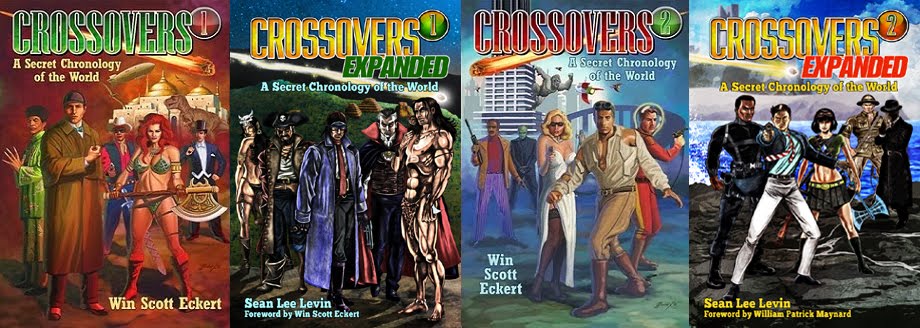
The Crossover UniverseTM is a companion blog to the books Crossovers: A Secret Chronology of the World Volumes 1-2 by Win Scott Eckert, and the forthcoming Crossovers Expanded Volumes 1-2 by Sean Levin. Material excerpted from Crossovers Volumes 1 & 2 is © copyright 2010-2014 by Win Scott Eckert. All rights reserved. Material excerpted from Crossovers Expanded Volumes 1 & 2 is © copyright 2014-present by Sean Levin. All rights reserved.
Showing posts with label The Time Machine. Show all posts
Thursday, March 17, 2016
Sunday, March 13, 2016
Crossover of the Week
1910
WOLF
AT THE DOOR OF TIME
Doctor
Omega, traveling aboard the Cosmos,
discovers a derelict time machine and its owner, Doctor Moses
Nebogipfel. Omega believes Nebogipfel’s machine is from the
Arcadian Hegemony of the 42nd century. Nebogipfel was transporting a
masonychid, a proto-wolf, in his conveyance, but the wolf escaped and
is now bouncing through time. Annoyed with Nebogipel, Omega thinks he
has been lucky in his choice of companions, including Fred, Borel,
and Tizairou. In 1643, the masonychid attacks a man named Sir Hugo
near the village of Grimpen on Dartmoor. In 1767, Omega convinces
Joseph Balsamo to make a special cylinder Jean Chastel can use to
destroy the masonychid, now known as the Beast of Gévaudan. In rural
France in the 18th century, the wolf convinces a sabot-maker named
Thibault it is Satan. Omega tells Nebogipfel masonychids are the
ancestors of all land-based whales and dolphins, and his actions have
altered the time stream so a race of sky-whales in the far future
will never exist, and rather than the deity Zoomashmarta, the
remaining humans will worship a wolf that devours human flesh.
Thibault asks the masonychid to bring him all the women he has ever
desired, including Agnelette, Madame Magloire, and the Comtesse de
Mont-Gobert. The Cosmos
is
almost hit by an ionized meteorite, which will exit the void of time
in 1795, and which Omega believes might cause beneficial mutations.
Omega travels to the battlefield of Mons in 1916, where he encounters
Captain Yeskes of the Fifth Northumberland Fusiliers, who is wounded
by the masonychid. A Nurse Miller treats his wounds, and contemplates
writing a book about the story Yeskes tells her of the attack. Omega
reveals Nebogipfel is a brainwashed member of the same race to which
Omega himself belongs. Omega does not believe Nebogipfel should
continue his exile in the 19th or 20th centuries; otherwise, he would
drop him off in “that rather lovely Italianate village in North
Wales near Penrhyndeudrath.” The Arcadian Hegemony was founded by a
starship commander known as Captain Strange, who is at war with the
Federation. Omega finally decides to place Nebogipfel in Randgrith
Abbey near the Village of Wulnoth in the mid 11th
century.
In the 20th
century, the Nyctalope battles the masonychid, now known as the King
Wolf, and his legions at the request of Comrade Frunzoff. After he
kills it and Omega takes a sample of its blood, the Nyctalope
encounters Captain Gogol of Army Intelligence, who is accompanied by
Oktobriana and Avakoum Zahov.
Short
story by Martin Gately in Tales
of the Shadowmen Volume 9: La Vie en Noir,
Jean-Marc and Randy Lofficier, eds., Black Coat Press, 2012;
reprinted in French in Les
Compagnons de l’Ombre (Tome 14),
Jean-Marc and Randy Lofficier, eds., Rivière Blanche, 2014. Doctor
Omega is from the novel of the same name by Arnould Galopin, as are
the Cosmos,
Fred, Borel, and Tizairou. The Lofficiers’ translation and
adaptation of Galopin’s novel implied Doctor Omega was the CU
universe counterpart of the Doctor of Doctor
Who fame,
a member of the extraterrestrial Time Lords of Gallifrey. Moses
Nebogipfel is from H. G. Wells’ story “The Chronic Argonauts,”
a precursor to his novel The
Time Machine,
and is here meant to be a counterpart of the Doctor’s foe the
Meddling Monk.
Wulnoth, a village headman in the year 1066, appeared in the
Doctor Who serial
that introduced the Monk, “The Time Meddler.” Arcadia, Captain
Strange, and the Federation are from Sarah Brightman and Hot Gossip’s
song “I Lost My Heart to a Starship Trooper.” It is worth noting
the song mentions both Flash Gordon and Darth Vader as real people.
Sir Hugo Baskerville and the village of Grimpen are from The
Hound of the Baskervilles,
arguably Sherlock Holmes’ most famous exploit. Joseph Balsamo,
Count Cagliostro, is a historical figure who also appears in novels
by Alexandre Dumas; Philip José Farmer also identified him as the
ancestor of a branch of the Wold Newton Family in Doc
Savage: His Apocalyptic Life.
Thibault, Agnelette, Madame Magloire, and the Comtesse de Mont-Gobert
are from Dumas’ story “The Wolf-Leader.” The Beast of Gévaudan
was a real creature whose exact nature is much debated; Jean Chastel
is usually credited as having killed the monster. The sky-dolphins
and Zoomashmarta are from Philip José Farmer’s science fiction
sequel to Herman Melville’s Moby-Dick,
The
Wind Whales of Ishmael.
According to Farmer’s novel A
Feast Unknown,
the family of the jungle lord Lord Grandrith originally called
themselves Randgrith. The Grandrith/Caliban novels take place in an
alternate universe to the CU, but perhaps a version of the Randgrith
family existed in the CU, one of whose members founded the abbey.
However, John Cloamby, Lord Grandrith, himself never existed in the
CU. The meteorite will arrive in the village of Wold Newton in 1795,
where it will indeed, as Omega theorized, cause beneficial mutations
in the offspring and descendants of those exposed to its ionization,
as revealed by Farmer in Tarzan
Alive and
Doc
Savage: His Apocalyptic Life.
The Fifth Northumberland Fusiliers were a real regiment whose CU
equivalent counted Dr. John H. Watson among its numbers. Nurse Miller
will later write novels under her married name of Agatha Christie;
one of her stories, “The Hound of Death,” was likely inspired by
the tale Yeskes told her. The village in North Wales is the Village
from the cult-classic television series The
Prisoner;
the village of Portmeirion, located in Penrhyndeudraeth, was used as
the filming location for the Village. The Nyctalope (aka Leo
Saint-Clair) is the night-sighted hero of a series of novels by Jean
de La Hire. Comrade Frunzoff is Frunzoff Nosh from the Doc Savage
novel The
Red Spider.
Captain Gogol is the future General Anatol Alexis Gogol from the
James Bond films The
Spy Who Loved Me,
Moonraker,
For
Your Eyes Only,
Octopussy,
and A
View to a Kill.
Many of the Bond films are incompatible with the Fleming novels, and
thus with the CU; however, despite using the titles of Fleming novels
or stories, the five films in which Gogol appears are radically
different from the works they are based on, and can be considered
separate or sequel incidents for CU purposes. Oktobriana (or
Octobriana) was created by Czech artist Petr Sadecký, and, not being
under copyright, has appeared in a number of works by different
artists and writers. Avakoum Zahov is a Bulgarian secret agent
featured in Andrei Gulyashki’s novels The
Zahov Mission and
Avakoum
Zahov versus 07.
The year is conjecture based on Doctor Omega’s perspective, which
is after the events of Galopin’s novel.
Tuesday, December 8, 2015
Crossover Cover: The Rook
Myfanwy
Thomas is a member of the Checquy, a British agency dedicated to
protecting the world from supernatural threats. She writes letters to
her future self after hearing a prophecy she will lose her memories
soon. Mentioned in the letters are: Brigadoon; Groke; Scabmettler;
Marshwiggle; Hattifattener; Panwere; Flukeman; Morlock; Aufwader;
Balrog; cat in shoes; creepy blond kids wandering around in Winshire;
talking mice that infested Lewisham; a two-door wardrobe in the spare
room of a country house; and a couturier in Gloucestershire who had
been imprisoned for using rodents as indentured servants. Brigadoon
is from Alan Jay Lerner and Frederick Loewe’s titular musical. The
Groke and the Hattifatteners are from Tove Jansson’s Moomin books.
The Scabmettlers are from China Miéville’s novels about the
fantasy world of Bas-Lag. Marshwiggles and the two-door wardrobe are
from C. S. Lewis’ Narnia books. The Panweres mentioned here must be
CU versions of the race seen in Laurell K. Hamilton’s Anita
Blake, Vampire Hunter books,
which take place in an alternate reality where the world is aware
vampires and other supernatural beings really do exist. The Flukeman
is from “The Host,” an episode of The
X-Files.
Morlocks are from H. G. Wells’ The
Time Machine;
since they are mentioned as having visited Bath before the events of
this book, a group of Morlocks must have traveled or been transported
back in time from their native era. Aufwaders are from Robin Jarvis’
Whitby Witches books, while the talking mice in Lewisham are a
reference to Jarvis’ Deptford Mice series. Balrogs are from J. R.
R. Tolkien’s fantasy saga The
Lord of the Rings.
Cat in shoes is a reference to the fairy tale Puss
in Boots.
The creepy blond kids wandering around Winshire are from John
Wyndham’s book The
Midwich Cuckoos.
The couturier in Gloucestershire who used rodents as indentured
servants is a reference to Beatrix Potter’s children’s book The
Tailor of Gloucester.
Wednesday, September 30, 2015
Crossover Covers: Area 52
Area
52 is a secret government storage facility in Antarctica where
super-weapons, occult items, and other weird stuff are stored. Items
held within Area 52 include wreckage from Roswell, the Ark of the
Covenant, the Super-Soldier formula, Mjolnir, Wonder Woman’s Lasso
of Truth, the Time Machine, and an alien power ring that shoots green
energy. The
Ark of the Covenant is from the movie Raiders
of the Lost Ark,
of course. Apparently the Ark was moved to Area 52 from the
government warehouse where it was stored in 1936. The Super-Soldier
formula turned the frail Steve Rogers into Captain America. Mjolnir
is the hammer wielded by the heroic god Thor;
it must have passed into Area 52’s hands millennia after Conan gave
it to Crom, following the events of “What If Thor of Asgard Had Met
Conan the Barbarian?” Wonder Woman’s lasso is self-explanatory.
The Time Machine is from H. G. Wells’ novel of the same name. The
alien power ring is the one wielded by the superhero Green Lantern. Several of Simon R. Green's novels mention an Area 52 in the Antarctic, further bolstering this series' connection to the CU.
Sunday, August 23, 2015
Crossover of the Week
1857
THE
NEXT OMEGA
An
old man seeking a younger fellow who claims to be Doctor Omega
remarks, “A Morlock would feel right at home in this neighborhood.”
The older man, who is also known as Doctor Omega, carries a robot
head in a hatbox that he acquired in the future, in the city of
Metropolis. His companion Fred is mentioned. The two Doctors’
carriage is driven by Eugene Papillon. The duo discovers a card
bearing the name Maupertuis. The older Omega refers to Lecoq and
“that Marple woman.” The Omegas find themselves pursued by robed
men that appear to be followers of the Ubasti. The elder Omega tells
the younger how a wave of radioactive turbulence separated him and
his traveling companions, and asks if he has been to Quinnis in the
fourth universe. The apparent Ubasti cultists work for Baron Oscar
Maupertuis. Omega refers to a suppressed account by Watson. They are
attacked by the robed men, who turn out to actually be Red Lectroids.
The younger Omega shows his elder namesake a crystal, which the
latter identifies as from Metebelis-Three. The young Omega regains
his memory of traveling to the Moon, where he met one of the Lunian
Immortals, and realizes that he is really balloonist Antoine Gerpré.
Omega recognizes Maupertuis as Ozer, one of many immortals claiming
to be the Wandering Jew. Omega departs with Helvetius, his fellow
traveler in space and time.
Short
story by Travis Hiltz in Tales
of the Shadowmen Volume 10: Esprit de Corps,
Jean-Marc and Randy Lofficier, eds., Black Coat Press, 2013;
reprinted in French in Les
Compagnons de l’Ombre (Tome 16),
Jean-Marc and Randy Lofficier, eds., Rivière Blanche, 2015.
Doctor Omega is from Arnould Galopin’s novel of the same name, as
are Fred and Helvetius. The Lofficiers’ translation and adaptation
of Galopin’s book implied that the Doctor was the Crossover
Universe counterpart of the time and-space-traveling Doctor from the
television series Doctor
Who.
Quinnis in the fourth universe is mentioned in the Doctor
Who serial
“The Edge of Destruction,” while Metebelis-Three is from the
serials “The Green Death” and “Planet of the Spiders.” The
Morlocks are from H.G. Wells’ The
Time Machine.
The robot and the city of Metropolis are from Fritz Lang’s film
Metropolis.
Doctor Omega visited Metropolis in Hiltz’s story “The Robots of
Metropolis” (Tales
of the Shadowmen Volume 7: Femmes Fatales,
2011.) Lecoq is Emile Gaboriau’s sleuth. Eugene Papillon is from
Gaboriau’s novel Monsieur
Lecoq.
Baron Maupertuis is mentioned in the Sherlock Holmes story “The
Adventure of the Reigate Squire”; here, he is conflated with Ozer
from Paul Féval’s novel The
Wandering Jew’s Daughter.
“That Marple woman” is Agatha Christie’s detective Miss Jane
Marple. The Cult of Ubasti is from the serial The
Return of Chandu,
and has also appeared in Hiltz’s stories “The Treasure of the
Ubasti” (Tales
of the Shadowmen Volume 6: Grand Guignol,
2009) and “In the Caves of the Serpent” (Tales
of the Shadowmen Volume 8: Agents Provocateurs,
2011.) The serial was based on the radio series Chandu
the Magician,
which spawned a spin-off, Omar
the Mystic.
After being separated from Omega, Fred found himself in the year
1776, where he also encountered Red Lectroids, as seen in Hiltz’s
tale “What Lurks in Romney Marsh?” (Tales
of the Shadowmen Volume 9: La Vie En Noir,
2012.) The Lunian Immortals and Antoine Gerpré are from Alfred
Driou’s book The
Adventures of a Parisian Aeronaut in the Unknown Worlds,
which has been translated by Brian Stableford for Black Coat Press.
Monday, August 10, 2015
Crossover Cover: Property of a Lady Faire
Eddie
Drood seeks out the Lady Faire, an omnisexual being created by Baron
Frankenstein later in his life. This Baron is a member of the family seen in Mary Shelley’s
novel Frankenstein and its many continuations. Also appearing or mentioned are: Harry
Fabulous, the Nightside, the Painted Ghoul, the London Knights, Kayleigh's Eye, Strangefellows, Dead Boy, Sinister Albion, John Taylor, the Griffin, Hadleigh Oblivion, Rossignol, Ms. Fate, and Larry Oblivion (all from the Nightside series); Dagon, Cthulhu, and the Plateau of Leng (all from H.P. Lovecraft's Cthulhu Mythos); MI13 (the CU version of the branch of British intelligence seen in the Marvel Universe); the Doormouse’s shop (from the Nightside books, though the group of hippies-turned-mice the Doormouse belongs to first appeared in Green's novel Drinking Midnight Wine);
Shadows Fall (from Green's novel of the same name); Carcosa (from Ambrose Bierce's short Story "An Inhabitant of Carcosa"); Lud’s Gate (from Green's Ghost Finders novel Spirits from Beyond); old Carnacki (from William Hope Hodgson's Carnacki the Ghost Finder);
stuffed baby Morlock (from H.G. Wells' The Time Machine); the Deep School (from Manly Wade Wellman's John Thunstone stories); Jimmy
Thunder, God for Hire (from Drinking Midnight Wine); the Bride of Frankenstein (from the titular Universal horror film);
and “something from the Black Lagoon" (a
reference to another Universal horror film, Creature
from the Black Lagoon, and its sequels.)
Friday, June 26, 2015
Crossover Cover: Professor Challenger: New Worlds, Lost Places
This anthology of new stories featuring Arthur Conan Doyle's Professor Challenger includes several crossovers. In Lawrence C. Connolly's "King of the Moon," Bedford,
Challenger, Ann Cavor and a pair of father-and-son inventors rescue
Ann’s uncle from the Selenites. Bedford,
Dr. Cavor, and the Selenites are from H.G. Wells’ The First Men in the Moon,
which is described as having taken place ten years ago. Bedford implies here
that he is the one who put Challenger in contact with Arthur Conan Doyle.
Challenger must have introduced Doyle in turn to Edward Malone. Doyle became Malone’s
literary agent and editor, publishing the reporter’s accounts of his adventures
with Challenger under his own byline. In Josh Reynolds' "Time's Black Gulf," Professor
Summerlee, Lord John Roxton, Malone, and Thomas Carnacki battle Indrid
Cold and other members of his race, who are part of a conspiracy to infiltrate
the human race at every stage of its evolution along with an alien race that
has swapped Challenger’s consciousness with that
of one of their own people. Challenger has copies of Cultes des Goules and Unaussprechlichen
Kulten. Carnacki refers to the Sigsand Manuscripts, the Book of Eibon, the Pnakotic texts, the
Florentine monk Corsi, and Khephnes. The Tind’Losi,
the Hounds of the Angles, appear. Dr. John Silence and Jessie Challenger
ultimately save the day. Thomas Carnacki and the Sigsand Manuscripts are from William Hope Hodgson’s Carnacki the Ghost-Finder.
Indrid Cold is a supposedly real person connected to the Mothman sightings of
1966-1967. Here, he is also a member of the race of creatures seen in H.P.
Lovecraft’s "The Festival." This version of Cold also appears in Reynolds’
stories "The Pnakotic Puzzle" and "The Yoth Protocols." "The Pnakotic Puzzle”
indicates that this story happened “some years before the war.” The consciousness-swapping alien race is the Great Race of
Yith from Lovecraft’s "The Shadow Out of Time."Bartolomeo Corsi and Khephnes
are also from "The Shadow Out of Time." The Cultes des Goules is a Cthulhu Mythos tome created by Robert
Bloch. Unaussprechlichen Kulten is a
Mythos tome created by Robert E. Howard. The Book of Eibon is from Clark Ashton Smith’s contributions
to the Mythos. The Pnakotic texts are a reference to Lovecraft’s Pnakotic
Manuscripts. The Tind’Losi are from
Frank Belknap Long’s story "The Hounds of Tindalos." Dr. John Silence is an
occult detective featured in stories by Algernon Blackwood. In John Takis' "The Crystal Minders," Challenger
suggests that a scientist has "invented a machine capable of traveling through
time, like that loon in Surrey, have you?" “That
loon in Surrey” is the Time Traveler from H.G. Wells’ The Time Machine. This
story is primarily narrated by Professor Summerlee, though a framing sequence
narrated by Edward Malone involves Summerlee coming to the reporter to tell him
of the adventure. Malone refers to the events of “The Disintegration Machine” in passing
as a past event. This creates a chronological conflict, as Rick Lai’s essay
“The Anomaly of Professor Challenger’s Daughter” (Rick Lai’s Secret
Histories: Daring Adventurers, Altus
Press, 2008) places both “The Disintegration Machine” and The Land of Mists
in 1926. According to The Land of
Mists, Summerlee died “last year,” i.e.,
in 1925. Therefore, the reference to “The Disintegration Machine” must be
obfuscation on Malone’s part, similar to Dr. Watson providing false dates in
his accounts of Sherlock Holmes’ cases. In Andrew J. Wilson's "Out of the Depths," set in 1937, Challenger and
Malone encounter Nazis in Maple White Land. Hobbs Lane is from the
British television science fiction serial Quatermass
and the Pit, although there it is located in Knightsbridge, rather than
Kensington. Doctor Moreau is from H.G. Wells’ novel The Island of Doctor Moreau. The Lidenbrock Sea is from Jules
Verne’s novel Journey to the Centre of
the Earth. Medusa Von Juntz is related to Friedrich Von Juntz from Robert
E. Howard’s “The Black Stone.” Doctor Moreau is revealed to have been Jack the
Ripper, placing this story outside CU continuity. In Guy Adams and James Goss' "Professor Challenger and the Crimson Wonder," Challenger and his wife have a run-in with aliens who are planning to
overrun the world with a remarkable plant. Mycroft Holmes is Sherlock Holmes’ brother. Lidenbrock is Otto
Lidenbrock from Journey to
the Centre of the Earth. Cavor is from Wells’ The First Men in the Moon, as previously stated. Abner Perry is from Edgar Rice
Burroughs’ Pellucidar novels. William Dyer is from H.P. Lovecraft’s “At the
Mountains of Madness.” Herbert is meant to be the Time Traveler from Wells’
novel.
Herakleophorbia IV, Bensington, and Miss Cossar’s brother are from Wells’ novel
The Food of the Gods. Ryland and the
Great Four are from Agatha Christie’s novel The
Big Four. The meteorite that landed in Woking in 1898 is from Wells’ novel The War of the Worlds. This story is too
overtly satirical to fit easily into CU continuity. Also, Poirot moved to
England in 1916, so the portrayal of him as an agent of Mycroft Holmes in 1914
is chronologically incorrect.
Subscribe to:
Posts (Atom)


