Friday, December 25, 2015

Crossover Cover: PulpWork Christmas Special 2014


This special from PulpWork Press includes three stories with crossovers.

In Josh Reynolds' Royal Occultist story "The Teeth of Winter," Charles St. Cyprian, hunting down a man-eating wendigo in Alberta alongside his assistant Ebe Gallowglass and the elderly Native American gunfighter Lone Crow, makes the third Hloh gesture. St. Cyprian first met the Inuit angakkuq Ukaleq in London, before the War, when he was an assistant to Thomas Carnacki. St. Cyprian and Lone Crow discuss Dr. Silence. St. Cyprian traces the sacred shape of the Voorish Sign in the air. Lone Crow appears in weird Western stories by Joel Jenkins. Hloh is from Margery Lawrence’s stories about occult detective Miles Pennoyer. Thomas Carnacki is from William Hope Hodgson’s collection Carnacki the Ghost-Finder, while Dr. Silence is from Algernon Blackwood’s collection John Silence. The Voorish Sign is from H. P. Lovecraft’s story "The Dunwich Horror."

Just as Reynolds' story features a character created by Joel Jenkins, Jenkins' own contribution to the special is a Royal Occultist story. On Maitress Island, St. Cyprian and Gallowglass battle the God of the Dark Burgeoning Deaths. St. Cyprian notes, "Professor Moriarty Moreau is said to have possession of a fragment of the Pnakotic Manuscript which contains directions for sealing portals without the use of human blood." Bella Mae Jobson of the Royal Archaeological Society comes to St. Cyprian and Gallowglass’ aid. St. Cyprian and Gallowglass are from the Royal Occultist stories by Josh Reynolds. Professor Moriarty Moreau’s connection to Professor James Robert Moriarty and Doctor Alphonse Moreau is unknown. The Pnakotic Manuscript is from H. P. Lovecraft’s Cthulhu Mythos. Bella Mae Jobson, originally from P. G. Wodehouse’s Drones Club story "The Editor Regrets," first encountered St. Cyprian and Gallowglass in Reynolds’ story "Deo Viridio."

The final story relevant to this blog is "Dillon and the Night of the Krampus" by Derrick Ferguson. Dillon and his friends Wyatt Hyatt and Reynard Hansen battle a Krampus in Reynolds, Alaska. Dillon receives a puppy from Hoover, a man he met years ago. Dillon once sought out a man named Jim Anthony in New York to learn certain specialized knowledge from him. Professor Ursula Van Houghton, who teaches at Grand Lakes University, has been hired by the people of Reynolds to help them deal with the Krampus and recover their stolen children. Dillon took some courses in archaeology and cultural anthropology at the University of Northeastern California under Professor Sydney Fox. Hoover is Alaska Jim Hoover from the German pulp magazine Alaska Jim, Ein Held der Kanadischen Polizei. Jim Anthony appeared in the American pulp Super Detective. Dillon first met Alaska Jim and Jim Anthony in the novel The Vril Agenda, coauthored by Ferguson and Reynolds. Grand Lakes University is from the movie Back to School. The University of Northeastern California is from the sitcom Undeclared. Professor Sydney Fox is from the television series Relic Hunter.

Happy holidays!


Thursday, December 24, 2015

Crossover DVD Cover: Lupin III vs. Detective Conan

Arsène Lupin III and amateur sleuth Shinichi Kudo, aka Conan Edogawa, become involved in an investigation into the death of Queen Sakura and Prince Gill of the kingdom of Vesparand. Conan’s best friend and would-be love interest, Ran Mori, is a dead ringer for Princess Mira. Shinichi (or Jimmy in the English dubbed version) Kudo, aka Conan Edogawa, is from Gosho Aoyama’s manga Detective Conan (aka Case Closed) and its anime adaptation. Philip José Farmer identified Lupin III’s grandfather, Arsène Lupin, as a Wold Newton Family member, and therefore this crossover brings Conan Edogawa into the CU. Lupin and Conan encounter each other again in the film Lupin III vs. Detective Conan: The Movie.

Wednesday, December 23, 2015

Crossover Cover: Ghost of a Dream

The field agents of the Carnacki Institute investigate a haunting at an abandoned theater that is up for renovation. Julien Advent, the Apocalypse Door, the Droods, and Area 52 are mentioned, and Alistair Gravel appears. The Carnacki Institute is named after the title character of William Hope Hodgson’s Carnacki the Ghost-Finder. The Apocalypse Door was destroyed by the Drood family in Green’s Secret Histories novel From Hell with Love. Julien Advent is from Green’s Nightside novels; he is meant to be adventurer Adam Adamant, from the television series Adam Adamant Lives! The Area 52 referred to in Green’s work is located in the Antarctic, and thus is probably meant to be the same one seen in the Image Comics miniseries of the same name. Alistair Gravel is probably meant to be a relative of combat magician William Gravel from Warren Ellis’ comic Gravel.

Tuesday, December 22, 2015

Crossover Cover: Radiation Wipeout

Matt Hawke, the Avenger, makes reference to meeting Mark Hardin, the Penetrator. The Penetrator battled a descendant of Dracula in Quaking Terror, so this crossover brings in the Avenger (not to be confused with the Wold Newton Family member who used that name, or Jim Brandon from the radio series The Avenger). The fifth book in Cunningham’s Avenger series was published in 2012, and updated the character so Hawke served in Afghanistan rather than Vietnam. However, it can be assumed the novel’s events actually take place in the 1980s, as did its predecessors.

Monday, December 21, 2015

Crossover Cover: I Spy Something...Boo!

Scooby and the gang team up with Secret Squirrel and Morocco Mole to apprehend a ghost that repeatedly attempts to disrupt a treaty between two rival nations. Jonny Quest is mentioned. Secret and Morocco are anthropomorphic animals, and therefore I place this story in an AU.

Sunday, December 20, 2015

Crossover of the Week

1911
THE WHITE LADY OF POURVILLE (LA DAME BLANCHE DE POURVILLE)
Detective Sexton Blake and his apprentice Harry Dickson travel to Pourville to investigate the appearance of what seems to be the legendary White Lady, whose gaze drives men mad. Dickson befriends Adèle Blanc-Sec. Dickson and Adèle travel to Tiffauges to research the history of Gilles de Rays, and are told about de Rays and Joan of Arc by Doctor Jules de Grandin of the Faculty of Forensic Medicine of Paris. A false de Rays proves to be the archcriminal Fantômas, who is told to surrender by a policeman named Juve. Fantômas’ plan involved a Subatlantic locomotive, designed by the great French inventor, Arsène Golbert, and sabotaged by William Boltyn, the leader of the so-called “billionaires’ conspiracy.” The alleged White Lady is actually the mentally ill Paulette Arnaud, whose sister Thérèse works for the French Secret Service. Most of the cases of madness suffered by those who encountered Paulette were actually caused by an Indian poison called Rajaijah.
Short story by Michel Stéphan appearing as “La Dame Blanche de Pourville” in in Les Compagnons de L’Ombre (Tome 10), Jean-Marc and Randy Lofficier, eds., Rivière Blanche, 2012, and then in English in Harry Dickson vs. the Spider, Jean-Marc and Randy Lofficier, eds., Black Coat Press, 2014. Harry Dickson, “the American Sherlock Holmes,” was the subject of German, Dutch, Belgian, and French pulp magazines, the latter written by Jean Ray. Sexton Blake is one of the most famous British penny dreadful detectives. G.L. Gick’s story “The Werewolf of Rutherford Grange” revealed Dickson served as an apprentice to Blake in his youth, before he struck out on his own as a detective. Adèle Blanc-Sec will later become a private investigator herself, as seen in Jacques Tardi’s comic book The Extraordinary Adventures of Adèle Blanc-Sec. Doctor Jules de Grandin is Seabury Quinn’s occult detective, who appeared in the magazine Weird Tales. Fantômas and Juve are from the novels by Marcel Allain and Pierre Souvestre. Arsène Golbert and William Boltyn are from Gustave Le Rouge and Gustave Guitton’s pulp serial The Dominion of the World, which has been translated and adapted in four volumes by Brian Stableford. Thérèse Arnaud is from Pierre Yrondy’s The Adventures of Thérèse Arnaud of the French Secret Service, which has been translated by Nina Cooper for Black Coat Press. Rajaijah is from Hergé’s Tintin comic The Blue Lotus.

Saturday, December 19, 2015

Crossover Movie Poster: Shorts

Toe Thompson eats a cereal called Great White Bites, which first appeared in Planet Terror. Robert Rodriguez directed both films. Win included Planet Terror in Volume 2, with the caveat that the film's apocalyptic ending must have been fictionalized.

Friday, December 18, 2015

Crossover Cover: Flashman and the Mountain of Light

Harry Flashman tells his great-niece Selina the story of a man who lost a rifle in Paris and tripped over it in West Africa twenty years later. The man who lost the rifle is Captain Battreau from P. C. Wren’s story “No. 187017,” included in the collection Flawed Blades. “No. 187017” and Wren’s other books and stories involving the French Foreign Legion are interconnected, including Beau Geste, which Philip José Farmer referenced in Doc Savage: His Apocalyptic Life. The main events of Fraser’s novel take place in 18451846, but the framing sequences, which refer to Flashman telling Battreau’s story to Selina, were written by Flashman after 1894 and before 1902.

Thursday, December 17, 2015

Crossover Cover: Dogs of War

I mistakenly posted earlier about Underland, a book I already covered a couple months ago. Here's a replacement. 


The British agent Sparrow mentions the Nazis’ Special Projects Division from the video game Wolfenstein.

Wednesday, December 16, 2015

Crossover Cover: Horror in Clay

The Green Lama battles a murderous golem created by a Rabbi who initially unleashed the creature on the German consulate in New York. The Rabbi has learned of the Holocaust the Nazis will soon enact against his people from hieroglyphics in an ancient temple in Jerusalem. The temple had images on the walls of the Ark of the Covenant, the Staff of Ra, and crystal skulls. Also in the temple was a statue of a horrible ancient god named Cthulhu. The Green Lama appeared in stories by “Richard Foster” (Kendell Foster Crossen) in the pulp magazine Double Detective. The Ark of the Covenant, Staff of Ra, and crystal skull references are meant to evoke the Indiana Jones films; indeed, an earlier version of this novella that appeared in the anthology The Green Lama Volume One contains a reference to “Professor Jones, Jr. at Marshall College.” Cthulhu needs no explanation at this point. The Lama went on to battle Cthulhu in Garcia's The Green Lama: Unbound.


Tuesday, December 15, 2015

Crossover Covers: Star Trek/Green Lantern: The Spectrum War


The Enterprise crew of the divergent universe seen in the films Star Trek (2009) and Star Trek: Into Darkness encounter Green Lantern Hal Jordan and the surviving members of six other Corps bearing different-colored rings that allow them to harness the powers of the Emotional Spectrum, who were sent there from their own reality (a possible future of the DC Comics Universe) to escape the wrath of the embodiment of Death known as Nekron, who instead follows them to this new universe.

Monday, December 14, 2015

Crossover Cover: Star Trek: The Motion Picture

According to the novelization of the first Star Trek film, “The moon Io had held some shocks for the first Earth scientists to land there, although not nearly as shattering as the earlier discovery that Earth’s own moon had once served as a base for space voyagers (their identity still a mystery) who had conducted experiments with Earth’s early life forms a million or more years before human history had begun.” This is a reference to the unknown race that created the Monoliths in the movie 2001: A Space Odyssey. Since that film is incompatible with the early 21st century of the CU (or our world), the beings responsible for the Monoliths must have counterparts in both universe.

Saturday, December 12, 2015

Crossover of the Week

HAPPY WOLD NEWTON DAY!!!

April 1917
THE ADVENTURE OF THE FALLEN STONE
Dr. Watson’s pregnant wife, Nylepthah, is staying with her cousin, Sir George Curtis. In 1919, Holmes would visit his old friend with a large financial payment from the English Lord of the Apes, the result of their adventure in Africa in 1916. Holmes’ gardener, Black Mike Croteau, has been murdered. After examining the body, Holmes and Watson are met at the former’s cottage by Harry Dickson, who has apprenticed with both Barker (Holmes’ Surrey rival) and Blake. He takes them to the Diogenes Club, where Holmes accuses his brother Mycroft of knowing there was a possibility he and Watson would be blown off course during the previous year’s African expedition he sent them upon. Holmes suggests Mycroft knew all along the ape lord was actually impersonating his deceased cousin, “William Clayton, the 7th Duke of Grey—.” Holmes points out Mycroft identified their flier, Leftenant John Drummond, as the great-nephew of Holmes’ old acquaintance, the 6th Duke. However, if Mycroft had been unaware of the imposture, he would have identified the Leftenant as the 6th Duke’s grandson. Mycroft reveals William Clayton was a government agent reporting directly to him, and William’s alleged shipwreck in Africa was actually part of his investigation. When he died, the Duke’s cousin, the ape lord, who had survived a prior shipwreck as an infant, assumed his identity, wishing to avoid the publicity attendant to the discovery of an English lord who had been reared and suckled by apes. The mission involved tracking down the German spy Von Bork and his bacillus. Holmes deduces Mycroft hoped he and Watson would encounter the ape lord and asks why. Holmes speculates it has to do with the many unlikely coincidences the ape man comes up against. Mycroft says their scientists call it “the human magnetic moment.” Holmes’ adversary, Dr. Shan Ming Fu, informed Holmes of the lotus vitae almost ten years ago. Holmes’ encounter with the ape man brought him into contact with the jungle man’s “human magnetic” influence, causing him to discover the lotus in the hidden valley of Zu-Vendis, though he asked Watson to omit that discovery from his written account. The lotus has been stolen from Holmes’ garden. Mycroft says if Holmes’ bees can be induced to sample the lotus’ nectar, a particular honey may result, which would be the key ingredient in a unique concoction. Holmes mentions the “Hellbirds” incident, in which Von Bork escaped, though Mycroft asked Watson to distort his account of these events so Von Bork fell to his death from the Eiffel Tower. Von Bork is being trailed by Sexton Blake. The mastermind of the theft is a man who has been known by many names, including Wolf Larsen, Karl Woldheim, and Carl Woldhaus; currently, he goes by the name of Baron Ulf Von Waldman. He is the Commandant of a seemingly inescapable German prison camp for those who have escaped from other camps and been recaptured. The Baron also conducts experiments on humans. There are rumors Von Waldman is the son of Professor Moriarty. Holmes, Watson, Dickson and Isis Vanderhoek travel to Blakeney House. Isis’ father was Mr. Klaw, “the dreaming detective.” Mycroft tells Sherlock that the Diogenes Club has recently become more focused on investigating outré and unexplainable matters that affect the Empire. The butler at Blakeney House gives Dickson a coded message from Blake, in which he says he has wired Peter Blakeney in Richmond (with whom he has common relatives dating back to the mid 17th century), and Blakeney House is at their disposal, with Blakeney Jr. off at war. Blake soon arrives with a captive Von Bork in tow. Holmes recalls the tale of Openshaw. Blake tells his comrades about several places of interest in the East Riding of Yorkshire, including the village of Wold Newton, where a meteor fell near Major Edward Topham’s property, the Wold Cottage, in 1795. Holmes decides they must visit the Wold Cottage and the monument Topham had placed at the site of the meteor’s fall. Holmes unmasks “Blake” as Von Waldman. Holmes and his allies free the true Blake, and discover some fragments of stone. Holmes concludes the Germans believe exposing the lotus vitae to the meteor fragments will result in the prolongation of human life. Isis mentions Holmes’ own cultivation of the plant. Von Waldman escapes from his bonds, taking the plant with him; however, Holmes still has seeds to grow more. When Watson asks Holmes if he thinks Von Waldman is really the son of Professor Moriarty, Holmes replies that Mycroft’s files on the Baron indicate that he was born in 1888, that he was investigating Moriarty quite thoroughly at that time, and that there was no indication of a child born to the Professor in that period. Dickson suggests Von Waldman may have been someone else, much older, who once had access to a similar elixir, but whose supply may have run out, leading him to attempt to find a means of duplicating it.
Short story by Dr. Watson, edited by Win Scott Eckert in Sherlock Holmes: The Crossovers Casebook, Howard Hopkins, ed., Moonstone Books, 2012. This story serves as a sequel to Watson’s account The Adventure of the Peerless Peer, as edited by Philip José Farmer. Watson’s wife Nylepthah and child are from that novel; Nylepthah is the daughter of Sir Henry Curtis from the Allan Quatermain stories (although Farmer says she is Curtis’ granddaughter, Eckert’s essay “Who’s Going to Take Over the World When I'm Gone?: A Look at the Genealogies of Wold Newton Family Super-Villains and Their Nemeses” [Myths for the Modern Age: Philip José Farmer’s Wold Newton Universe, Win Scott Eckert, ed., MonkeyBrain Books, 2005] argues she is in fact his daughter). Nylepthah’s cousin, Sir George Curtis, is from Farmer’s translation and adaptation of J.-H. Rosny aîné’s Ironcastle; Farmer specifically identifies Sir George as Sir Henry’s nephew. The ape lord is Lord Greystoke, of course. Harry Dickson is “the American Sherlock Holmes” who appeared in French pulp stories by Jean Ray and others. Holmes’ rival Cecil Barker first appeared in the story “The Adventure of the Retired Colourman”; Dickson acted as his apprentice in Eckert’s story “No Ghosts Need Apply” (The Phantom Chronicles, Vol. 2, Joe Gentile and Mike Bullock, eds., Moonstone Books, 2010). Sexton Blake is one of the longest-running British penny dreadful detectives; Dickson acted as his apprentice in Greg Gick’s story “The Werewolf of Rutherford Grange” (originally published in two parts in Tales of the Shadowmen Volume 1: The Modern Babylon, Jean-Marc and Randy Lofficier, eds., Black Coat Press, 2005, and Tales of the Shadowmen Volume 2: Gentlemen of the Night, Jean-Marc and Randy Lofficier, eds., Black Coat Press, 2006; reprinted in Harry Dickson and the Werewolf of Rutherford Grange, Black Coat Press, 2011). William Clayton, the 7th Duke of Greystoke, appears in Edgar Rice Burroughs’ novels Tarzan of the Apes and The Return of Tarzan; in his essay “A Case of Identity,” H. W. Starr identified the 6th Duke of Holdernesse and his son Lord Saltire from the Holmes story “The Adventure of the Priory School” as the 6th and 7th Duke of Greystoke, respectively, a theory adapted by Farmer for his biography Tarzan Alive. Leftenant Drummond is the jungle lord’s adopted son John Drummond-Clayton. Farmer identified the human magnetic moment in Tarzan Alive. Dr. Shan Ming Fu is Sax Rohmer’s Fu Manchu; Dennis E. Power revealed the Devil Doctor’s birth name in his essay “The Devil Doctor: The Early History of Fu Manchu,” found on the Wold Newton Universe: A Secret History website. The lotus vitae is the plant from which Fu Manchu’s life-prolonging Elixir vitae is derived; Fu Manchu told Holmes about the elixir in George Alec Effinger’s story “The Adventure of the Celestial Snows.” The honey is the Royal Jelly that, according to William S. Baring-Gould in his biography Sherlock Holmes of Baker Street, has extended Holmes’ natural lifespan. The Hellbirds incident refers to Austin Mitchelson and Nicholas Utechin’s Holmes pastiche Hellbirds. Wolf Larsen is from Jack London’s novel The Sea Wolf; in his essay “The Green Eyes Have It—Or Are They Blue? or Another Case of Identity Recased” (Myths for the Modern Age), Christopher Paul Carey argued Larsen and Baron von Hessel (from Farmer’s authorized Doc Wildman novel Escape from Loki) were really aliases of XauXaz from Farmer’s trilogy of novels about the evil secret society known as the Nine. In his essay “Asian Detectives in the Wold Newton Universe” (Myths for the Modern Age), Dennis E. Power instead offered the alternative theory Larsen was the son of Professor Moriarty. Isis and her father Moris Klaw are from Sax Rohmer’s book The Dream Detective. The Diogenes Club’s latter-day focus on outré matters is the subject of many stories by Kim Newman. Blakeney House is one of the holdings of the Blakeney family, whose most famous member is Sir Percy Blakeney, the Scarlet Pimpernel. Blakeney House previously appeared in Eckert’s stories “Is He in Hell?” (Tales of the Shadowmen Volume 6: Grand Guignol, Jean-Marc and Randy Lofficier, eds., Black Coat Press, 2010; reprinted and revised in The Worlds of Philip José Farmer 1: Protean Dimensions, Michael Croteau, ed., Meteor House, 2010) and “Nadine’s Invitation” (Tales of the Shadowmen Volume 7: Femmes Fatales, Jean-Marc and Randy Lofficier, eds., Black Coat Press, 2010). Peter Blakeney Jr. is Sir Percy’s descendant from The Pimpernel and Rosemary. In his series of articles “The Wold Wold West” (found at the Wold Newton Universe: A Secret History website), Dennis E. Power argued Sexton Blake was distantly related to the Blakeney family, a theory Eckert adopted for his essay “The Blakeney Family Tree” (The Worlds of Philip José Farmer 1). Openshaw is from the Holmes story “The Five Orange Pips.”
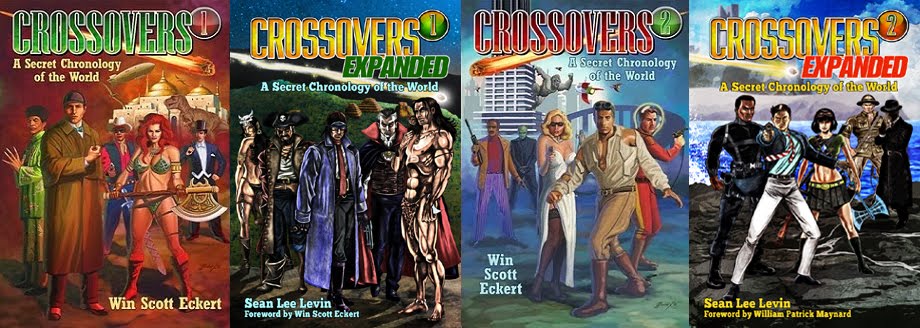
Crossover Cover: Ashes 2 Ashes

Ash Williams and the Wise Man track the Necronomicon Ex Mortis to an ancient temple which contains what appears to be Indiana Jones’ skeleton. This miniseries takes place concurrent with the first Evil Dead film. The skeleton’s resemblance to Indy is puzzling, considering his appearances as an old man in the framing sequences of The Young Indiana Jones Chronicles, which are set in the 1990s, as well as his encounter with Lara Croft sometime before 2000, after apparently having been rejuvenated back to the prime of life (hence Lara's reference to him being "seemingly ageless").


Friday, December 11, 2015

Crossover Cover: The Fifth Heart

A Sherlock Holmes pastiche. Colonel Moran is identified as Colonel John Sebastian “Tiger Jack” Moran, the same full name and nickname given for him in George MacDonald Fraser’s Flashman and the Tiger. Inspector Hanaud (a detective seen in novels by A. E. W. Mason) and Hercule Poirot are mentioned, and the Lakota Indian Paha Sapa from Simmons’ novel Black Hills appears. The revelations in this novel about Holmes and Moriarty place it in an alternate universe.

Thursday, December 10, 2015

Crossover Cover: The Goon Meets Hellboy

Hellboy gets knocked on the head, and upon regaining consciousness finds himself at a different location, where he meets a zombie-killing palooka known as the Goon. After another knock on the head, Hellboy finds himself back where he was when he received the first blow to the head. The exploits of Powell's adventurer the Goon take place in the present day, but in a very surreal world with 1930s trappings, and therefore likely occur in an alternate reality to the Crossover Universe. Hellboy must have somehow been transported to the Goon’s universe from the CU. The two would later cross paths again at the end of the one-shot Criminal Macabre/The Goon: When Freaks Collide. Cal McDonald recognized Hellboy, so they must have both come from the CU, and other crossovers in the Criminal Macabre comics and prose stories support this.

Wednesday, December 9, 2015

Crossover Cover: Writ in Blood

The first novel in the Serenity Falls Trilogy. Immortal occult detective Jonathan Crowley encounters a Deep One. Besides the Trilogy, Crowley is featured in other novels and stories by Moore. The run-in with a Deep One (from Lovecraft’s “The Shadow Over Innsmouth”) brings him into the CU.

Tuesday, December 8, 2015

Crossover Cover: The Rook

Myfanwy Thomas is a member of the Checquy, a British agency dedicated to protecting the world from supernatural threats. She writes letters to her future self after hearing a prophecy she will lose her memories soon. Mentioned in the letters are: Brigadoon; Groke; Scabmettler; Marshwiggle; Hattifattener; Panwere; Flukeman; Morlock; Aufwader; Balrog; cat in shoes; creepy blond kids wandering around in Winshire; talking mice that infested Lewisham; a two-door wardrobe in the spare room of a country house; and a couturier in Gloucestershire who had been imprisoned for using rodents as indentured servants. Brigadoon is from Alan Jay Lerner and Frederick Loewe’s titular musical. The Groke and the Hattifatteners are from Tove Jansson’s Moomin books. The Scabmettlers are from China Miéville’s novels about the fantasy world of Bas-Lag. Marshwiggles and the two-door wardrobe are from C. S. Lewis’ Narnia books. The Panweres mentioned here must be CU versions of the race seen in Laurell K. Hamilton’s Anita Blake, Vampire Hunter books, which take place in an alternate reality where the world is aware vampires and other supernatural beings really do exist. The Flukeman is from “The Host,” an episode of The X-Files. Morlocks are from H. G. Wells’ The Time Machine; since they are mentioned as having visited Bath before the events of this book, a group of Morlocks must have traveled or been transported back in time from their native era. Aufwaders are from Robin Jarvis’ Whitby Witches books, while the talking mice in Lewisham are a reference to Jarvis’ Deptford Mice series. Balrogs are from J. R. R. Tolkien’s fantasy saga The Lord of the Rings. Cat in shoes is a reference to the fairy tale Puss in Boots. The creepy blond kids wandering around Winshire are from John Wyndham’s book The Midwich Cuckoos. The couturier in Gloucestershire who used rodents as indentured servants is a reference to Beatrix Potter’s children’s book The Tailor of Gloucester.

Monday, December 7, 2015

Crossover Cover: Truth, Justice, and Scooby Snacks

When Caesar’s ghost appears in the Daily Planet’s offices, Superman calls in Mystery, Inc. to help him find out the truth behind the haunting. It turns out to be the work of the Prankster, who transforms Superman into a monstrous form with Red Kryptonite. With the help of Superman’s dog Krypto, as well as Scooby and Shaggy inadvertently drinking the serums that once gave Lois Lane and Jimmy Olsen superpowers, the gang saves the day. Velma alludes in passing to the events of an earlier story, “A (Super) Friend in Need”; however, given that the Super Friends, as a superhero team, do not fit into the CU, this should be disregarded. Lois seems unaware that Clark Kent is Superman, even though CU continuity holds that she and Clark have been married for over two decades by this point. Lois must be merely keeping up appearances in front of her coworkers and Scooby and the gang in order to keep Clark’s dual identity a secret.

Sunday, December 6, 2015

Crossover of the Week

Autumn 1888
THE ADVENTURE OF THE SIX MALEDICTIONS
Professor Moriarty and Colonel Moran are hired by Major Humphrey “Mad” Carew to protect him from the mi-go, which seek to retrieve the gem known as the Green Eye of the Little Yellow God from him. Moriarty’s plan involves hiring a group of master thieves to steal similar cursed items. Appearing or mentioned are: Ted Baldwin; the Vermissa Valley Scowrers; Birdy Edwards, aka John McMurdo and John Douglas; Birlstone Manor; the Assassination Bureau, Ltd.; “that Limehouse Chinese with the marmoset”; the Moonstone; the Eye of Klesh; the All-Seeing Eye of the Goddess of Light; the Crimson Gem of Cyttorak; the Pink Diamond of Lugash; Lukundoo; a Zuni fetish; “a naked Porroh man”; the Barlow rubies; the Rosenthall diamonds; the Mirror of Portugal; the Agra treasure; Azathoth; Tabanga; St. Custard’s; Amaryllis Framington; Giles Conover; the Ingestre Necklace; Mrs. Lovett’s Fleet Street pie shop; the Herncastle Heirloom; the Black Pearl of the Borgias; the Hoxton Creeper; “the cricketing ponce”; the Falcon of the Knights of St. John; the Jewels of the Madonna of Naples; the Jewel of Seven Stars; the Eye of Balor; Simon Carne; Fat Kaspar; the Grand Vampire; Les Vampires; Abel Trelawny; Margaret Trelawny; Gennaro; King Brian of the Leprechauns; Bianca Castafiore; Alf Bassick; Don Rafaele Corbucci; Irene Adler; “Dynamite” Desmond Mountmain and his son Tyrone; Malvoisin’s Mirror; the Monkey’s Paw; Cap’n Flint’s treasure; Sir Michael Sinclair’s Door; Marshall Alaric Molina de Marnac; Vokins; Malilella; Henry Wilcox; Queen Tera; Mrs. Sarah “The Black Widow of Lauder” Stewart; and Hagar “Thieving Pikey” Stanley.
Short story by Colonel Sebastian Moran, edited by Kim Newman in Gaslight Arcanum: Uncanny Tales of Sherlock Holmes, J. R. Campbell and Charles Prepolec, eds., EDGE Science Fiction and Fantasy Publishing, 2011; reprinted and revised in Professor Moriarty: The Hound of the d’Urbervilles, Titan Books, 2011. Professor Moriarty, Colonel Moran, and Irene Adler are from the Sherlock Holmes stories. Ted Baldwin, the Vermissa Valley Scowrers, Birdy Edwards, and Birlstone Manor are from the Holmes novel The Valley of Fear. The Agra treasure is from the Holmes novel The Sign of Four. The Black Pearl of the Borgias is from the Holmes story “The Adventure of the Six Napoleons.” In “The Adventure of the Empty House,” Holmes states “the death of Mrs. Stewart, of Lauder, in 1887” was likely perpetrated by Moran. Mad Carew, the Green Eye of the Little Yellow God and Amaryllis Framington are from J. Milton Hayes’ poem “The Green Eye of the Little Yellow God,” although in the poem Amaryllis is only identified as “the Colonel’s daughter.” Azathoth is one of the Great Old Ones from H. P. Lovecraft’s Cthulhu Mythos. The mi-go are also from the Mythos. The Assassination Bureau, Ltd. is a novel by Jack London, completed posthumously by Robert L. Fish. “That Limehouse Chinese with the marmoset” is Dr. Fu Manchu. The Moonstone (aka the Herncastle Heirloom) is the subject of a novel by Wilkie Collins. The Eye of Klesh is from Lord Dunsany’s one-act melodrama A Night at an Inn. The All-Seeing Eye of the Goddess of Light is from the 1940 film The Thief of Bagdad. The Crimson Gem of Cyttorak is from the exploits of Marvel Comics’ Doctor Strange. Although the gem is best known as the power source of the X-Men villain Juggernaut, it is unlikely it empowered Cain Marko in the CU. The Pink Diamond of Lugash is better known as the Pink Panther, from the film series of the same name. Lukundoo is from the short story of the same name by Edward Lucas White. The Zuni fetish is from Richard Matheson’s story “Prey,” later adapted as “Amelia,” the third segment of the made-for-television film Trilogy of Terror. The “naked Porroh man” is from H. G. Wells’ story “Pollock and the Porroh Man.” The Barlow rubies are from Patrick Hamilton’s play Gas Light. “The cricketing ponce” is E. W. Hornung’s Raffles. The Rosenthall diamonds are from the Raffles story “A Costume Piece.” Don Rafaele Corbucci is Raffles’ nemesis Count Corbucci from “The Fate of Faustina” and “The Last Laugh.” Rick Lai gives the Count the first name Salvatore in his own fiction. Perhaps his full name is Salvatore Rafaele Corbucci. The Mirror of Portugal is from Arthur Morrison’s story “The Case of ‘The Mirror of Portugal,’” found in the collection The Dorrington Deed Box. Tabanga is from the film From Hell It Came. St. Custard’s is the school attended by Nigel Molesworth in books written by Geoffrey Willans and illustrated by Ronald Searle. Giles Conover and the Hoxton Creeper are from the Sherlock Holmes film The Pearl of Death. The Creeper was played by Rondo Hatton, who also portrayed a character called the Creeper in the films House of Horrors and The Brute Man; perhaps the latter-day Creeper is a descendant of his Victorian namesake and look-alike. The Ingestre Necklace and Mrs. Lovett’s Fleet Street pie shop are from the penny dreadful story “The String of Pearls: A Romance,” which formed the basis for the stage musical Sweeney Todd: The Demon Barber of Fleet Street. The Falcon of the Knights of St. John is the titular statue from Dashiell Hammett’s novel The Maltese Falcon; Fat Kaspar is Casper Gutman. The Jewels of the Madonna of Naples, Genarro, and Malilella (usually spelled without the second “l”) are from Ermanno Wolf-Ferrari’s opera The Jewels of the Madonna. The Jewel of Seven Stars, Abel Trelawny, Margaret Trelawny, and Queen Tera are from the novel The Jewel of Seven Stars by Bram Stoker. The Eye of Balor is from Celtic mythology. Simon Carne is from the collection A Prince of Swindlers by Guy Boothby. The Grand Vampire and Les Vampires are from Louis Feuillade’s serial named for the latter. King Brian of the Leprechauns is Brian Connors from the film Darby O’Gill and the Little People. Bianca Castafiore is from the Tintin comics by Hergé. Alf Bassick is from William Gillette’s play Sherlock Holmes. Desmond and Tyrone Mountmain are undoubtedly relatives of the Mountmain family which appears in Newman’s serial novel Seven Stars. Malvoisin’s Mirror is from a titular story by Chris Lowder and Brian Lewis in the British comic magazine Halls of Horror #12. The Monkey’s Paw is the subject of the short story of the same name by W. W. Jacobs. Cap’n Flint’s treasure is from Treasure Island by Robert Louis Stevenson. Sir Michael Sinclair’s Door is from “The Door,” a segment of the British horror anthology film From Beyond the Grave. Marshall Alaric Molina de Marnac is likely a descendant of Alaric de Marnac, the 15th century warlock played by Paul Naschy (née Jacinto Molina Álvarez) in the films Horror from the Tomb and Cries of Terror. Vokins is Charles Vokins from “The Horizontal Witness,” an episode of the television series Cribb, based on Peter Lovesey’s series of novels about a Victorian era Police Sergeant. Henry Wilcox is from E. M. Forster’s novel Howards End. Hagar Stanley is from the collection Hagar of the Pawn-Shop: The Gypsy Detective by Fergus Hume. The original version of this tale had references to the Emeralds of Suliman (from Edgar Wallace’s J. G. Reeder tale “The Green Mamba”) and Sylvia Marsh (from Ken Russell’s 1988 film version of Bram Stoker’s The Lair of the White Worm).

Saturday, December 5, 2015

Crossover Covers: Stoker and Holmes


This series is set in a Steampunk London (and therefore takes place in an AU), and features Alvermina “Mina” Holmes, Mycroft’s daughter and Sherlock’s niece, and Evaline Stoker, sister of Bram and descendant of Victoria Gardella Grantworth from Gleason’s series The Gardella Vampire Chronicles.

Friday, December 4, 2015

Crossover Cover: Mr. Blank

A man with many identities works for all of the various conspiracies and secret societies (and a few monsters) in Los Angeles. As a result of his work, he can find Symbionia, Thule, Shangri-La, and the entrance to the Hollow Earth on a map. The Elder Gods are mentioned, and our nameless hero mentions rumors of a Gill-Man in Reseda, though it turned out to be a mechanic with a skin condition. Thule is a region in the far north in European folklore. Shangri-La is from James Hilton’s novel Lost Horizon. The Hollow Earth theory has been adapted in a number of works of fiction, including Edgar Rice Burroughs’ series set at the Earth’s core. The Elder Gods were created by August Derleth as part of Lovecraft’s Cthulhu Mythos, and are inimical to the Great Old Ones. This false Gill-Man is pretending to be a member of the species seen in the film Creature from the Black Lagoon and its sequels.

Thursday, December 3, 2015

Crossover Cover: Forsaken

The first novel in J. D. Barker’s Shadow Cove Trilogy. Writer Thad McAlister and his family are menaced by a witch cult from one of Thad’s books, which turns out to be real. Thad’s wife Rachael bought the journal in which Thad wrote the novel at Needful Things, a store in Castle Rock, Maine, owned by Leland Gaunt. The connection to Stephen King’s novel Needful Things brings this series into the CU. Although the epilogue which shows Rachael buying the book from Gaunt is stated to have taken place ten years earlier, Gaunt was only in Castle Rock in 1991, twenty-two years before the novel’s main events. At one point, Rachael reads an old e-mail dated Thursday, December 3, 2014. December 3, 2014 was a Wednesday, and also after this book’s publication date, and therefore the date given for the e-mail must be considered misinformation.


Wednesday, December 2, 2015

Crossover Cover: All the Tea in China

In 1839, Carolus Mortdecai “Karli” van Cleef arrives in England with the intention of selling fine china, and is befriended by John Jorrocks, MFH, merchant of Great Coram Street. Karli’s first customer is a Lord Windermere. Mr. Jorrocks is proud of having established an Honourable Wooster as a customer of his own. Karli is the ancestor of Bonfiglioli’s series character Charlie Mortdecai, whom I've written about in previous posts. Mr. Jorrocks is from R. S. Surtees’ Jorrocks’ Jaunts and Jollities. Lord Windermere must be an ancestor of the holder of that title seen in Oscar Wilde’s Lady Windermere’s Fan. The Honourable Wooster must be related to Bertie Wooster.

Tuesday, December 1, 2015

Crossover Cover: Castle Eppstein


The narrator of the introduction, telling ghost stories, says, “Certainly Hoffmann believed in the reality of his characters: he had seen Master Floh and had known Coppelius.” This reference implies Master Floh (from E. T. A. Hoffman’s novel Master Flea: A Fairy-Tale in Seven Adventures of Two Friends) and Coppelius (from Hoffmann’s story “The Sandman”) exist in the same universe as the characters in this novel. “The Sandman” has already been established as taking place in the Crossover Universe, and therefore both this novel and Master Flea take place in the CU as well. While the introduction takes place contemporaneously with this book’s publication, the rest of the novel happens during the time of Napoleon.